AI and Branding

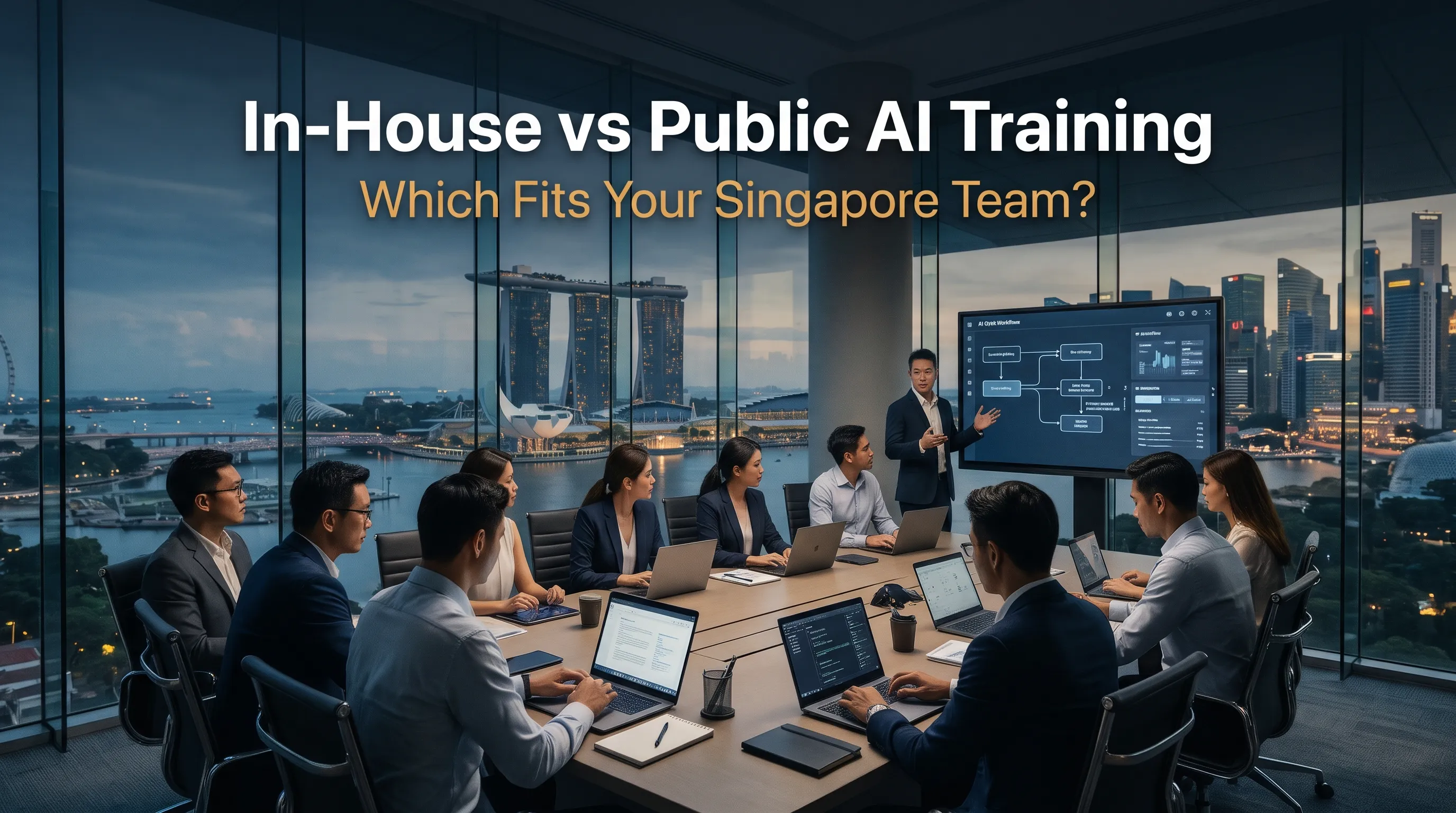
In-House vs Public AI Training: Which Fits Your Singapore Team?

Published on October 28, 2026By Team Dr. Jerome Joseph
In-House vs Public AI Training: Which Fits Your Singapore Team?

Most companies decide between a public AI course and in-house AI training by comparing the price per seat. It is the easiest number to find, and it is almost always the wrong place to start. A cheap seat that changes nothing about how a team works is not cheap. A bespoke programme for two people who only needed a primer is not smart.

This guide gives HR heads, L&D leads and business owners a way to decide. It is written for Singapore firms, but the logic holds across Asia.

What is the difference between in-house and public AI training?

Public AI training is an open course that people from many companies attend together. In-house AI training is delivered for one organisation, using its own roles, tools and work. Public suits individuals building basic skills. In-house suits teams that must change how they work together.

That one line carries most of the decision. A public course teaches a general audience, so examples must be general too. In-house training can use your proposals, your client emails, your reports and your rules, because everyone in the room shares them.

Public AI training

In-house AI training

Best for

One or a few individuals, early exploration

A team doing similar work that must change together

Examples used

General sample content

Your own tasks, documents and rules

Confidential material

Keep out of exercises

Can be handled under your own usage rules

Manager involvement

Usually none

Managers can join the same session

Follow-up

Mostly up to each person

Can be planned for the whole team

When is public AI training enough?

Public training is a sensible choice more often than providers like to admit. It works well in these situations.

One or two people need the basics. If a single marketer or analyst wants to understand what current AI tools can and cannot do, a well-run open course is efficient. There is no need to build a programme around one person.

The goal is exploration. If you are still deciding whether AI matters for a function, sending a small number of people to learn and report back costs little and teaches you a lot.

The work involves no sensitive material. Public classes mix attendees from different firms, so exercises use sample content. That is fine for learning tools. It is not fine if the real value lies in practising on live client data.

The learning is personal. Someone building their own career skills, on their own time, does not need a company-wide programme.

If most of your situation looks like this, a public course is the right answer and you should not let anyone talk you out of it.

When does in-house AI training make more sense?

In-house training starts to win when the problem is no longer "how do I use this tool" and becomes "how does this team work now".

The team does the same kind of work. A sales team, a marketing team or a leadership group shares tasks, so training can be built around those tasks. People practise on work they will do on Monday, not on a generic example.

The work uses confidential material. Training that happens inside your own session, with your own rules on what may and may not be entered into a tool, is far safer than hoping each person remembers a rule from a public class.

Managers have to change too. AI use spreads through a team only when leaders model it and set expectations. If the manager was not in the room, the team usually reads that as a signal that it is optional.

You need one shared standard. A company that wants everyone to follow the same guardrails, vocabulary and quality bar gets that from one shared session far more reliably than from a dozen separate ones.

There is a more subtle point here. Training that fails often fails after the session ends, when people go back to their desks. The article on why AI training fails within 90 days looks at that gap in detail. In-house design makes it easier to plan the follow-up, because you control who attends and when.


Not sure which format fits your team? Talk to Dr. Jerome Joseph's team before you decide.

Five questions that settle the decision

Answer these honestly and the choice usually becomes obvious.

Five questions that settle the decision

First, how many people need the skill? Fewer than about five, spread across different functions, points to public courses. A whole department points to in-house.

Second, do they do the same job? A team of people doing different work gains little from one shared session. A team doing the same work gains a lot.

Third, would real company information be used in training? If practice needs live client or internal data, keep it in-house.

Fourth, do managers need to change how they lead and review work? If yes, they must be part of the training, which means a session for the team and its leaders together.

Fifth, what happens after day one? If you can name an owner, a follow-up date and a way to check progress, either route can work. If nobody owns it, even the best course fades. Be honest about this, because it matters more than the provider you pick.

If you answered "in-house" to three or more, build for your team. If you answered "public" to three or more, send individuals and review in a quarter.

Is a hybrid approach better?

For many Singapore mid-size and large firms, yes. A practical pattern is to put senior leaders through a focused session first, so they understand what they are asking their teams to do. Then run in-house training for the functions where AI will change daily work, such as sales and marketing. Keep public courses for individuals with a specific personal need.

This avoids two common mistakes: training everyone at once with no leadership alignment, and training leaders alone while their teams are left to work it out.

What does in-house AI training from Dr. Jerome Joseph involve?

Dr. Jerome Joseph is a brand and AI strategist with more than 30 years of experience, has worked with more than 1,000 brands and is the author of 14 best-selling books. His work with organisations is offered as keynotes, masterclasses and structured enterprise programmes, with coaching and strategic advisory available alongside. The format depends on the organisation's needs.

The masterclass topics include AI Mastery, AI & the Future of Work™, AI-Driven Sales, AI-Driven Marketing, AI-Driven Leadership and The Future of Selling™. You can see how these are positioned for companies on the page for AI training for corporates in Singapore, and the wider programme range under corporate AI training programmes.

Different groups usually need different emphasis. Senior teams and boards can look at AI training for executives and leaders. Revenue teams can look at AI training for sales teams in Singapore. Brand and content teams can look at AI training for marketing teams.

See how Dr. Jerome Joseph's AI programmes are built around your people, roles and real work.

What should you ask any provider before you sign?

Whether you pick public or in-house, a few questions separate a useful programme from a forgettable one.

Ask who is in the room and how groups are formed. Mixed levels slow everyone down.

Ask what participants will produce, not only what they will learn. A draft proposal, a revised workflow or a set of agreed rules is evidence. A feeling of inspiration is not.

Ask what happens in the weeks after the session. A plan for follow-up is a good sign, and silence on it is a warning.

Ask how the provider handles your confidential material, and what they will ask you to keep out of exercises.

Ask how success will be judged. The guide to tracking corporate training success explains a simple way to measure results beyond satisfaction scores, and the guide to AI workshops for corporate teams covers formats and how to choose a provider in more depth.

On cost, compare the price per person who changes behaviour, not the price per seat. Funding rules differ by course and by company, so check eligibility for each option before you build a budget around a subsidy.

Where to start

If you are still unsure, the lowest-risk first step is a short conversation about your team, what it does and where AI could help. You can talk to Dr. Jerome Joseph's team to discuss which format would suit your people. There is no obligation to choose in-house, and if a public course is the right fit, that is a perfectly good answer.

Frequently Asked Questions

Is in-house AI training better than a public course?

Neither is better in general. Public courses suit individuals and early exploration. In-house training suits teams that do the same work, handle confidential material or need managers and staff to change together.

How many people do you need for in-house AI training to make sense?

There is no fixed number. In-house usually makes sense once a group of people share similar tasks and need the same standards, which often means a team of roughly ten or more. Below that, a public course for each person may be simpler.

Can in-house AI training be customised to our industry?

Yes, that is its main advantage. Because the group shares one company, exercises can use your own workflows, documents and rules. Ask any provider how they gather that context before the session.

Is public AI training safe for confidential work?

Public classes use sample material, so they are fine for learning tools. Avoid entering real client or internal data into exercises in a mixed class, and agree your own usage rules separately.

Should leaders be trained before their teams?

In most cases, yes. Leaders who understand what AI can and cannot do set realistic expectations, model good use and support their teams after the session. Training teams alone often leaves them without backing.

How do we know whether AI training worked?

Look for changes in work, not only attendance or satisfaction. Check what people produced during training, whether they use agreed workflows 30 days later and whether managers see better output or saved time.

Dr. Jerome Joseph - Recognized #2 Global Brand Guru

Dr. Jerome Joseph

Singapore-Based Global Keynote Speaker | Corporate Trainer |
Brand & AI Expert

LinkedInX (Twitter)YouTubeSpotifyFacebookTikTok

Dr. Jerome Joseph is a Singapore-based global keynote speaker, corporate trainer, brand strategist, AI and business transformation expert, and best-selling author.

With more than 30 years of experience, he has worked with over 1,000 brands across 41 countries, helping leaders, organisations and professionals strengthen their brands, embrace AI and improve business performance.

Ranked No. 2 in the world as a Global Brand Thought Leader in 2020 and 2022, Dr. Jerome is a former CEO and Board Member of a publicly listed brand agency, the author of 14 books, a Certified Speaking Professional (CSP), Global Speaking Fellow (GSF), and the youngest inductee into the Asia Speaker Hall of Fame.

He delivers international keynotes, corporate training and advisory programmes in AI, sales, branding, personal branding, leadership and customer experience.

Explore Dr. Jerome Joseph's keynotes, training and advisory programmes at website.

Contact Dr. Jerome Joseph

Need Additional Assistance?
If you have specific questions or require personalized support, please don't hesitate to contact us directly.