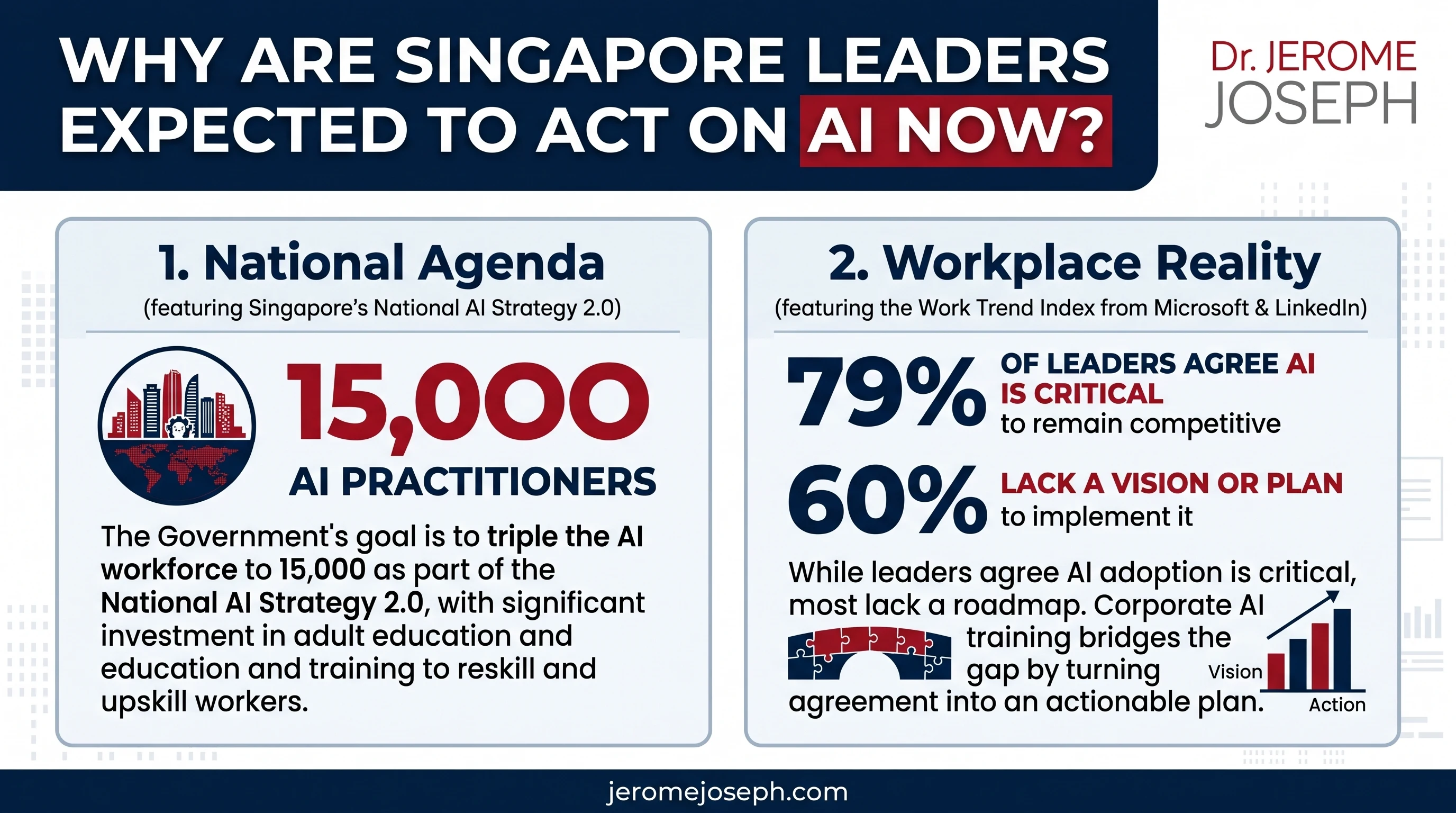
Most AI training for business leaders is judged by how much was covered, not by what changed afterwards. This guide looks at the second part. It explains what a leader in Singapore should be able to do after AI training, why the pressure to act is growing, how to check that the training worked and which questions to ask a provider before booking. It is written for business owners, executives and L&D heads who are choosing training for a leadership team. It does not review tools or compare public courses.
What Should a Business Leader Be Able to Do After AI Training?
A business leader should leave AI training able to do five things: frame the right problem, judge AI output, brief the team, ask the risk questions and know when not to use AI. Tool tips fade within weeks. These five abilities stay, and they are the real test of whether AI training for business leaders was worth the time.
Many Singapore companies already run some kind of AI session. The harder question is what changes on Monday morning. Dr Jerome Joseph, a global brand strategist and keynote speaker with 30+ years of experience across 41 countries, puts the focus on enablement rather than instruction. A leader is not being trained to become a technician. A leader is being trained to make better decisions with AI in the room.
1. Frame the right problem before opening a tool
Most weak AI results start with a weak question. A trained leader can describe the business problem, the outcome wanted and the limits in plain language before anyone types a prompt. This one skill saves more time than any shortcut, because the team stops solving the wrong problem faster.
2. Judge AI output instead of accepting it
AI writes with the same confidence whether it is right or wrong. After training, a leader should be able to check a draft, a summary or a forecast against what they already know, spot what is missing and send it back with a clear instruction. This is the skill that sits at the centre of the seven AI skills leaders need, and it is the one most often skipped when training is rushed.
3. Brief the team clearly and address job worries
Teams watch how their leader talks about AI. A trained leader can explain what AI will be used for, what it will not be used for and how roles may change, without hype and without silence. Silence is usually read as bad news. A clear brief lowers fear and speeds up adoption.