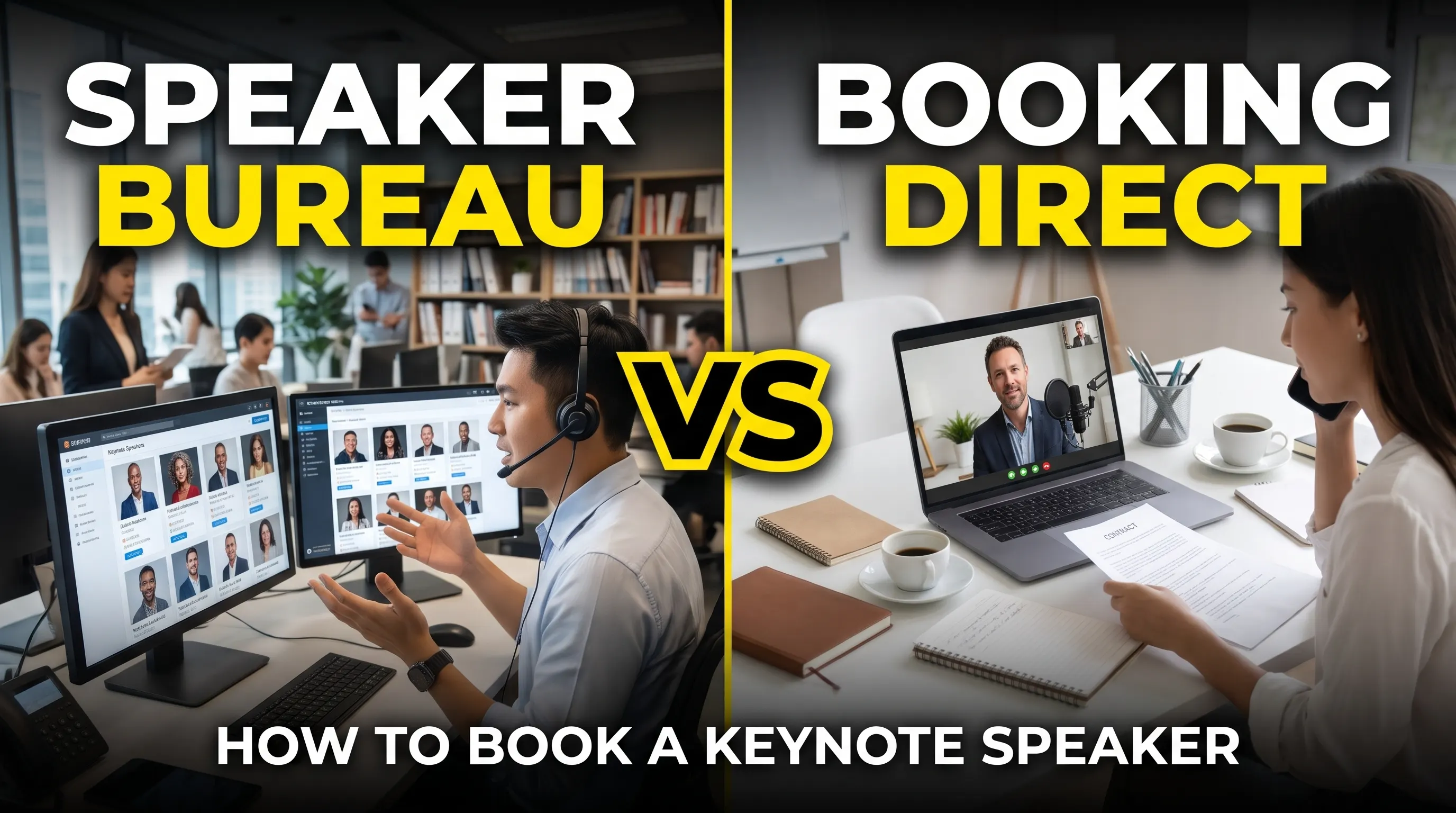
How do you decide between a speaker bureau and booking direct in five questions?
Answer five questions in order. They show how much help you need and how much time you have. Write the answers down before you speak to anyone. A clear answer to each one makes the rest of the process easier.
Do you already know who you want? If yes, booking direct is often quicker. If no, a bureau's wider list may help.
How soon is the event? A short timeline favours fewer layers. A longer one gives you time to compare options.
How much of the contract and logistics can your team carry? If the answer is very little, ask who will manage them on each route.
Do you need a shortlist or one quote? A shortlist suits a bureau. A single quote suits a direct enquiry.
Who will brief the speaker, and when? Whoever it is, give them time. See how to brief a keynote speaker.
What should you ask before you book, whichever route you choose?
Ask who you will speak to, what the fee covers, what happens if plans change, and who will brief the speaker. Ask for each answer in writing, because written answers are easier to compare. The same questions work for a bureau and for a direct enquiry.
Take this list into every conversation:
Who exactly will be on stage at my event?
Is the fee the same on both routes? Please confirm in writing.
What does the fee include, and what is extra?
What are the cancellation and change terms?
Can I speak to the speaker before the event, and when?
What happens if the speaker cannot attend?
Who owns recording and reuse rights?
How far ahead should I book for my dates?
For the full list of what a proposal should contain, read the keynote speaker proposal checklist.
What mistakes do planners make with either route?
Three mistakes cause avoidable trouble: choosing the route before you know what the event needs, assuming the fee differs without asking, and leaving the briefing to the last week. Each one is easy to avoid. Decide the goal first, then the route.
Do | Don't |
|---|
Decide the goal of the session before you pick a route | Pick a route first and fit the goal to it |
Ask each speaker to confirm the fee in writing | Assume one route costs more or less |
Read the cancellation and change terms before you sign | Sign on a brochure or a verbal promise |
Send the brief early and talk it through | Brief the speaker in the final week |
Compare at least two options on the same questions | Judge on a showreel alone |
The same traps show up in common mistakes when hiring a keynote speaker. If your event is in the UAE, read hiring a conference speaker in Dubai, which covers the local calendar and venue points.
Where should you start?
Start with the goal of the session, then the five questions above. Use the question list with every speaker or bureau you speak to. Compare what you hear, in writing, not what you read on a brochure. Keep the process short, and ask everyone the same questions.
A sensible first week looks like this:
Write down the goal, the audience and the date.
Answer the five questions and pick a route.
Shortlist two or three speakers, or ask a bureau for a shortlist.
Send each one the same questions.
If you want to talk to me directly, send your event details and I will take it from there.
Frequently asked questions
What is the difference between a speaker bureau and booking direct?
A speaker bureau matches event organisers with speakers and often manages the contract and logistics. Booking direct means you deal with the speaker or their team yourself. The speaker on stage can be the same in both cases. The difference is who you talk to and who carries the work.
Is it cheaper to book a keynote speaker directly?
It depends, so ask. Several bureaus say the speaker's fee is the same on either route, while other sources say a bureau's commission can add to the cost. Ask each speaker to confirm the fee for both routes in writing, and compare like with like.
When is a speaker bureau the better choice?
A speaker bureau is often the better choice when you do not yet know who you want, when you need a shortlist, or when you want one team to manage the contract and logistics. It suits events with many moving parts and a small planning team.
What should I ask before I book a keynote speaker?
Ask who will be on stage, what the fee covers, what the cancellation and change terms are, who will brief the speaker and what happens if the speaker cannot attend. Ask for every answer in writing, whichever route you choose.
How do I book Dr. Jerome Joseph directly?
Submit the enquiry form on the meeting planners page or book a direct consultation. Availability is confirmed first, then customisation is discussed and the details are finalised. A pre-event strategy call is included with most bookings. The page does not list fees.
Can a keynote be delivered virtually or in hybrid format?
Yes. Dr. Jerome Joseph delivers on Zoom, Teams and Google Meet as well as in person. The meeting planners page says sessions remain high-energy and interactive regardless of format. Share your format with the speaker early so the brief and the tech run-through match it.