Brand Strategy

How to Measure Brand Strength: Metrics That Actually Matter

Published on August 16, 2026By Team Dr. Jerome Joseph
How to Measure Brand Strength: Metrics That Actually Matter

Brand strength is best measured across four layers: whether people know you exist, whether they can describe you accurately, whether they prefer you at a price, and whether that preference shows up in commercial behaviour. The most useful individual measures are unaided recall, description accuracy, price premium tolerance, inbound enquiry quality, sales cycle length and employee description consistency. Impressions, follower counts and awareness scores from prompted surveys are the easiest to produce and the least predictive.

1. Why brand measurement usually fails

The problem is not that brands are unmeasurable. It is that the measurement is usually designed backwards.

A marketing team is asked to demonstrate brand impact. The available data consists of what the platforms and tools already report: impressions, reach, engagement, follower growth, website sessions, prompted awareness. A report is assembled from those numbers because those numbers exist.

None of them answer the question that was actually asked, which is whether the brand is making the business easier to run.

Dr Jerome Joseph, who has spent more than 30 years working with over 1,000 brands across 40 plus countries, describes the pattern as measuring the activity rather than the asset. Activity metrics tell you what marketing did. Brand metrics tell you what changed in the mind of the market, and those are two different questions.

A brand is not what you communicated. It is what remained after you stopped communicating. Most measurement captures the first and calls it the second.

2. What brand strength actually means

Before selecting measures, it helps to define what is being measured.

Brand strength is the degree to which a business is known, understood accurately, and preferred at a price, in a way that persists without continuous spending.

Each element of that definition points to a different layer of measurement, and they build on each other.

Layer

The question it answers

What weakness here looks like

1. Salience

Do they know we exist?

You are absent from consideration entirely

2. Clarity

Do they know what we do?

You are considered for the wrong things

3. Preference

Would they choose us, and at what price?

You are shortlisted and lose on price

4. Commercial effect

Does any of this show up in the numbers?

Everything looks fine and nothing improves

The order matters. Measuring preference in a market where salience is weak produces flattering numbers from a very small base. Measuring commercial effect without clarity data tells you something is wrong but not where.

3. The measures that actually indicate brand strength

Organised by the four layers above.

Layer 1: Salience

Measure

How to get it

Why it matters

Unaided recall

Ask the category question, not the brand question. "Which companies come to mind for X?"

The only awareness measure that reflects genuine memory

Share of search

Your branded search volume as a proportion of the category's

A behavioural signal rather than a stated one

Inbound enquiry volume

Enquiries arriving without a campaign attached

People finding you on their own initiative

Unaided recall is the single most under-used measure in brand management. Prompted awareness, where you show someone a list and ask if they recognise a name, produces high numbers that mean very little. Recognition is not recall, and only recall puts you on a shortlist.

Layer 2: Clarity

Measure

How to get it

Why it matters

Description accuracy

Ask customers and prospects to describe what you do, in their words

Reveals whether positioning has landed

Description consistency

Compare answers across respondents

Variance indicates a positioning problem

Employee description consistency

Ask staff the same question

Internal misalignment always precedes external confusion

The third row is the one Joseph treats as a leading indicator. If employees describe the organisation in materially different terms, external messaging will not survive contact with a candidate or client who asks a follow-up question. This is why he treats internal branding as a measurement input rather than a separate activity.

A brand is not what you communicated. It is what remained after you stopped communicating.

Layer 3: Preference

Measure

How to get it

Why it matters

Price premium tolerance

What you can charge relative to comparable alternatives

The most direct commercial expression of brand strength

Consideration set inclusion

How often you appear on shortlists you never bid for

Indicates you are the default rather than the applicant

Referral rate

Proportion of new business arriving through recommendation

Referral costs the referrer something, which makes it credible

Rehire and repeat rate

Customers who return without being sold to again

The clearest evidence that the promise held

Price premium is the measure Joseph regards as decisive. A brand that cannot sustain a premium against comparable alternatives is not a strong brand, regardless of how well it performs on awareness. Everything else in brand building exists to produce this outcome.

Layer 4: Commercial effect

Measure

How to get it

Why it matters

Sales cycle length

Time from first contact to close

Strong brands shorten evaluation because trust arrives earlier

Inbound enquiry quality

Proportion of enquiries that are genuinely qualified

Weak positioning attracts the wrong prospects, not fewer

Cost per acquisition trend

Direction over 12 to 24 months, not absolute figure

A strengthening brand makes acquisition progressively cheaper

Win rate against named competitors

Tracked by competitor, not in aggregate

Reveals where positioning is working and where it is not

Sales cycle length is frequently overlooked and is one of the most useful available. A strong brand does not primarily produce more leads. It produces faster decisions, because the buyer has completed part of their evaluation before the first conversation.

4. Metrics that look useful and are not

Joseph is direct about the numbers that occupy space in most brand reports without informing any decision.

Metric

Why it appears

Why it misleads

Impressions and reach

Free, large, easy to report

Measures distribution, not memory

Follower count

Visible and comparable

Accumulates passively and predicts nothing

Engagement rate

Feels like interest

Rewards content style, not brand strength

Prompted awareness

Produces high, reassuring figures

Recognition is not recall

Website sessions

Available in every analytics tool

Traffic is an input, not an outcome

Sentiment score

Sounds sophisticated

Usually measures customer service, not brand

Launch reaction

Immediate and vivid

Dominated by people who preferred the previous version

The last row deserves particular attention after any brand change. Immediate response to a new identity is systematically negative, because change is uncomfortable and the people most attached to the old version are the ones most likely to comment. Judging brand work on week one reaction produces a false negative almost every time, a point Joseph develops in his guide on when a company should rebrand.

5. How to build a scorecard finance will accept

The practical obstacle is not selecting measures. It is producing something a CFO treats as evidence rather than as marketing self-assessment.

Three principles make the difference.

Pair every perception measure with a behavioural one. Unaided recall on its own is a survey result. Unaided recall alongside share of search and inbound enquiry volume is a pattern. Finance functions discount stated preference and accept revealed preference.

Report direction, not absolute values. Nobody outside marketing knows whether 34 percent unaided recall is good. Everybody understands that it was 28 percent eighteen months ago. Brand measures are almost meaningless as snapshots and highly informative as trends.

Fix the measurement window before you start. Brand effects appear over quarters and years. Agreeing in advance that the review point is eighteen months out prevents the conversation where a brand programme is judged at month four and cancelled at month five.

6. A minimum viable brand scorecard

For organisations that do not have a research budget, Joseph suggests six measures that cover all four layers and can be assembled from existing data plus a short annual survey.

Measure

Layer

Source

Frequency

Unaided recall in category

Salience

Short customer and prospect survey

Annual

Share of branded search

Salience

Search console and keyword tools

Quarterly

Description accuracy

Clarity

Same survey, one open question

Annual

Employee description consistency

Clarity

Internal pulse, one open question

Twice yearly

Referral proportion of new business

Preference

CRM

Quarterly

Average sales cycle length

Commercial

CRM

Quarterly

Four of the six already exist in systems most organisations already run. The two that require a survey need one open question each, not a research programme.

Six measures, reviewed honestly for two years, beat any framework reviewed once.

7. How AI visibility changed brand measurement

A measurement layer has emerged in the past two years that did not previously exist, and most brand scorecards have not caught up.
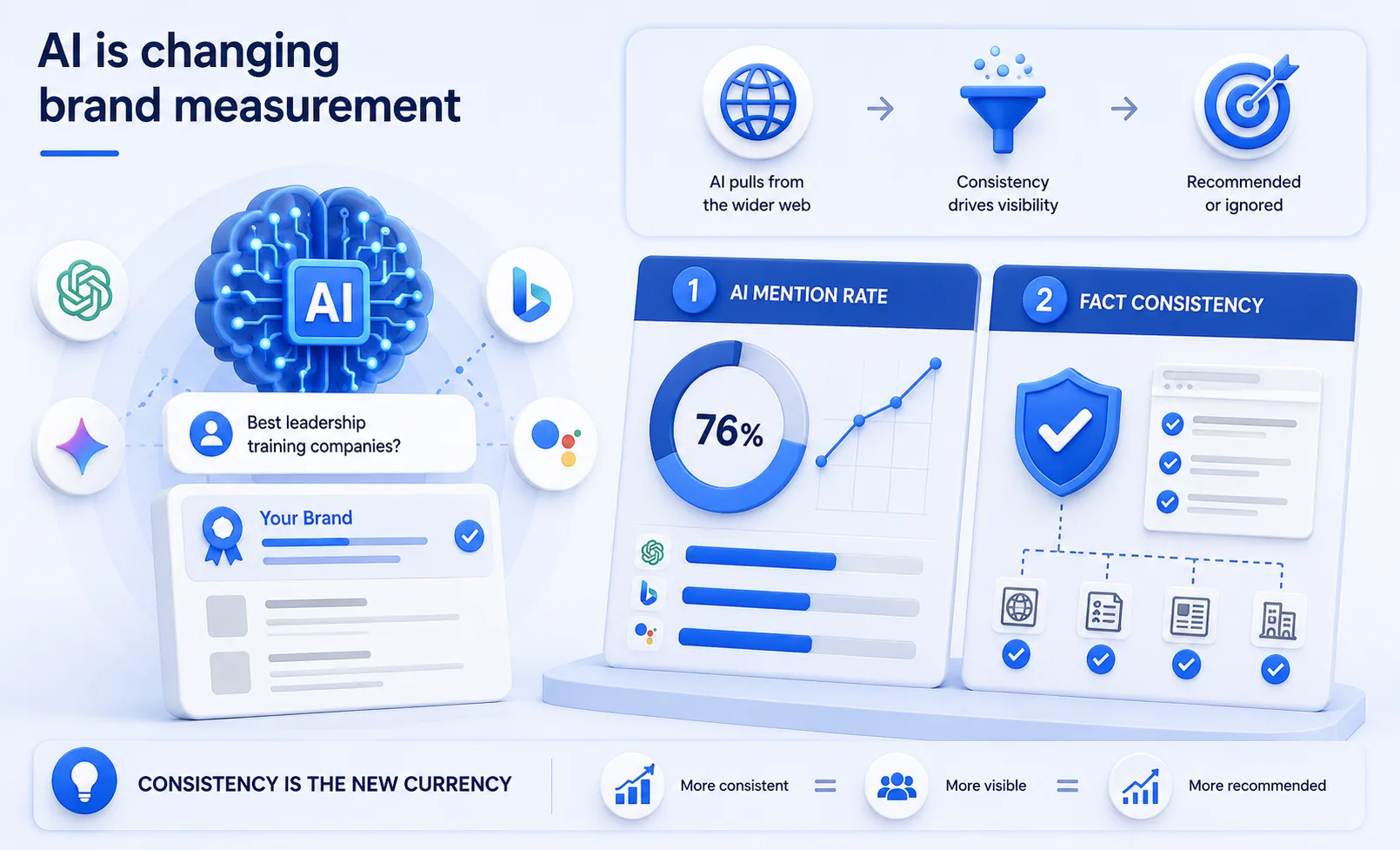
AI-Powered Brand Measurement Dashboard

When a buyer asks an AI assistant for recommendations in a category, the response is assembled from what the wider web says about the businesses in that category. Appearing in that response is now a form of salience, and it operates on different mechanics from search ranking.

The determining factor is entity consistency rather than content volume. If a business is described differently across its own site, industry directories, partner listings and press coverage, AI systems treat the entity as low confidence and are less likely to recommend it, regardless of how strong the content is.

This produces two new measures worth tracking:

  • AI mention rate. Ask the same set of category questions across major AI assistants each month and record whether the brand appears, in what position, and whether the description is accurate

  • Fact consistency across the web. Audit how core facts about the business are stated across every property where it appears, and count the variations

Joseph covers the mechanics of this in detail in his work on why AI systems do not recommend certain brands. For measurement purposes, the important point is that inconsistency is measurable and is a brand governance failure rather than a technical one.

8. What brand measurement cannot tell you

Joseph is careful about the limits, because overclaiming is how brand measurement loses credibility with finance functions.

It cannot isolate brand from everything else. Sales cycle length is influenced by brand, sales capability, product fit and market conditions. Brand measurement identifies patterns and directions. It does not produce clean attribution, and any framework claiming otherwise is selling something.

It cannot move quickly enough to guide tactical decisions. These are annual and quarterly measures. They are the wrong instrument for deciding what to publish next week.

It cannot compensate for an unclear position. If an organisation has not decided what it stands for, measurement will accurately report that confusion and will not resolve it. Measurement follows clarity, which is why Joseph treats brand clarity as a prerequisite.

9. The measure most organisations already have and never look at

There is one source of brand data sitting in almost every organisation, requiring no survey and no budget.

Read what customers write in their own words. Enquiry forms, support tickets, RFP language, meeting notes, exit surveys.

Specifically, look at how they describe you when they are not answering a question about you. The words they use for what you do. Whether they position you against the competitors you think you compete with. Whether they describe your value in the terms you intended or in different terms entirely.

This is unstructured, unglamorous, and closer to the truth than most commissioned research. It is also the only place where you see the language of your brand as it actually exists, rather than as it was expressed.

10. The honest conclusion

Brand measurement will never be as clean as performance marketing measurement, and attempting to make it so produces false precision that collapses under scrutiny.

What it can do is establish direction, identify which layer is failing, and provide enough evidence to make decisions that would otherwise be made on instinct.

For most organisations, the useful step is not a research programme. It is choosing six measures, agreeing what they will be reviewed against, and looking at them consistently for two years. That is a lower standard than most brand measurement frameworks propose and a considerably higher one than most organisations currently meet.

The businesses Joseph has seen build durable brands were rarely the ones with the most sophisticated measurement. They were the ones that measured a small number of things honestly, over a long enough period for the answer to mean something.

About Dr Jerome Joseph

Dr Jerome Joseph is a global keynote speaker, brand strategist and author. He is ranked #2 in the world as a Global Brand Thought Leader on the Top 30 Global Gurus list. With more than 30 years of experience, he has worked with over 1,000 brands across 40+ countries and is the author of 12 best-selling books. He is a Hall of Fame speaker and a Certified Speaking Professional (CSP), and works with organisations across Asia and the Middle East on brand strategy, positioning and culture transformation.

Frequently Asked Questions

How do you measure brand strength?

Measure across four layers: salience, whether people know you exist, using unaided recall and share of search. Clarity, whether they describe you accurately, using description accuracy across customers and employees. Preference, whether they choose you at a price, using price premium tolerance and referral rate. Commercial effect, whether it shows in the numbers, using sales cycle length and enquiry quality.

What is the single best measure of brand strength?

Price premium tolerance. A brand that cannot sustain a higher price than comparable alternatives is not strong, regardless of how it performs on awareness measures. Everything else in brand building exists to produce this outcome, which makes it the most direct commercial expression of brand strength.

What is the difference between prompted and unaided awareness?

Prompted awareness shows respondents a list of names and asks which they recognise, producing high and reassuring figures. Unaided awareness asks a category question, such as which companies come to mind for a particular need, and records what people name unprompted. Only unaided recall reflects genuine memory and predicts shortlist inclusion.

Are impressions and engagement useful brand metrics?

They measure distribution and content performance rather than brand strength. Impressions indicate how many times something was displayed, not whether anything was remembered. Engagement rate rewards content style. Both are legitimate marketing metrics and neither indicates whether the brand is making the business easier to run.

How long does it take to see brand measurement results?

Brand effects appear over quarters and years rather than weeks. Agreeing the review window before starting is important, because it prevents brand programmes being judged at month four. A reasonable first assessment point is twelve to eighteen months, with direction of travel mattering more than absolute values.

How do you measure brand strength without a research budget?

Six measures cover all four layers, and four of them already exist in systems most organisations run. Share of branded search from search tools, referral proportion and sales cycle length from CRM, and employee description consistency from an internal pulse. Only unaided recall and description accuracy need a survey, and each requires a single open question.

How does AI search affect brand measurement?

Appearing in AI assistant recommendations is now a form of salience, and it depends on entity consistency rather than content volume. If a business is described differently across its own site, directories and third-party listings, AI systems treat the entity as low confidence. Two new measures are worth tracking: monthly AI mention rate across major assistants, and fact consistency across all web properties.

Can brand measurement prove return on investment?

Not with clean attribution. Sales cycle length and acquisition cost are influenced by brand, sales capability, product fit and market conditions simultaneously. Brand measurement establishes direction and identifies which layer is failing. Any framework claiming to isolate brand contribution precisely is overstating what the method can do.

What should you measure after a rebrand?

Not launch reaction, which is dominated by people who preferred the previous version and produces a false negative almost every time. Useful measures are unaided recall, description accuracy, enquiry quality, sales cycle length and employee description consistency, all tracked over quarters against a pre-rebrand baseline.

What is the most overlooked source of brand data?

The language customers use in their own words across enquiry forms, support tickets, RFP documents and meeting notes. Specifically, how they describe you when they are not answering a question about you. This shows the brand as it actually exists in the market rather than as it was expressed, and it requires no budget.