Sales

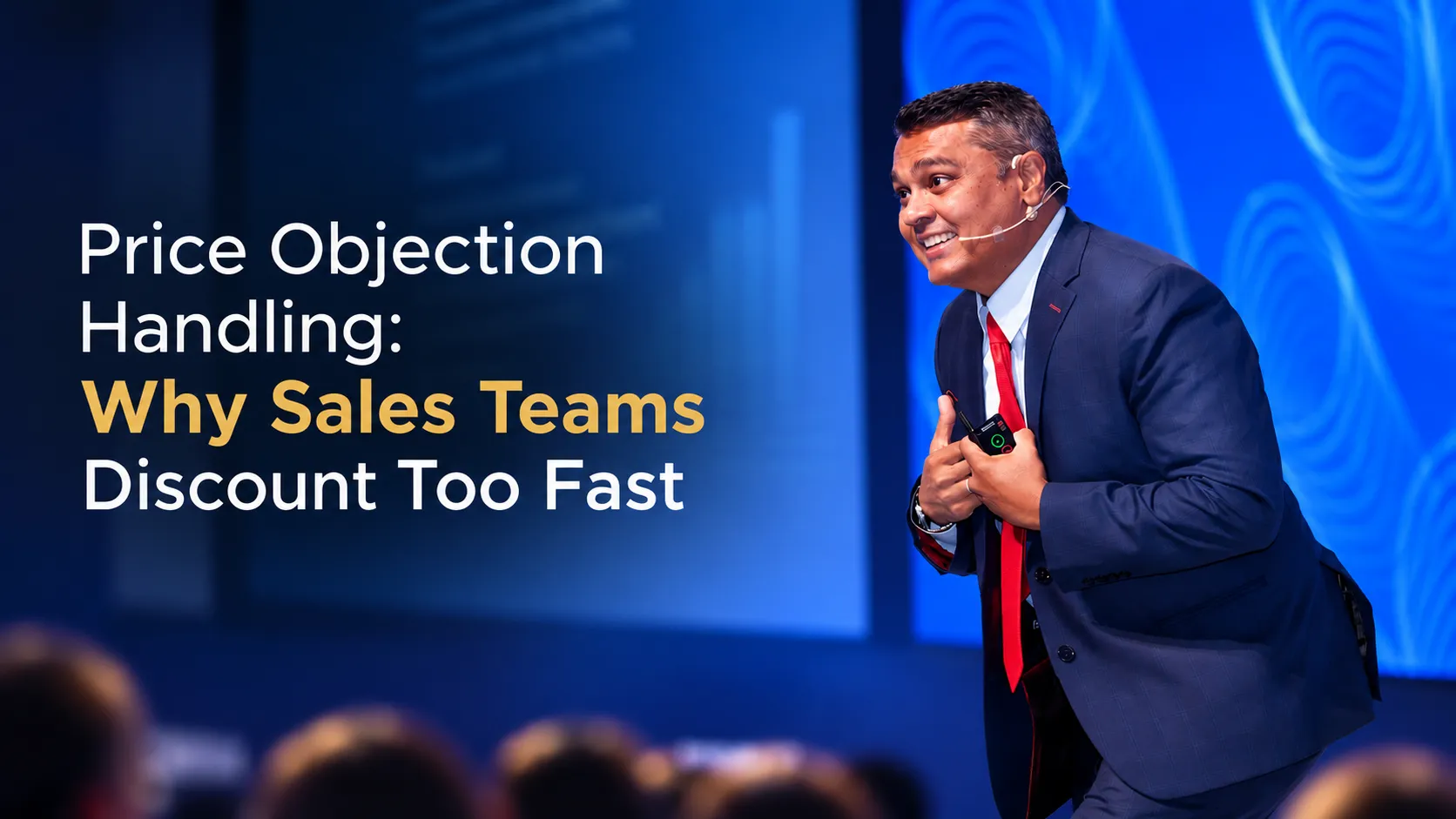
Price Objection Handling: Why Sales Teams Discount Too Fast

Published on October 02, 2026By Team Dr. Jerome Joseph
Price Objection Handling: Why Sales Teams Discount Too Fast

"That's quite expensive."

Four words, and the whole conversation changes.

The salesperson who was relaxed a minute ago starts talking faster. They explain the features again. They walk through the price line by line, defending each number. And when the buyer still looks unsure, they reach for the one thing that always seems to work: a discount. It does work, in a way. The deal often closes. But something leaves the room with that discount, and it is rarely just the margin.

Dr Jerome Joseph, a global keynote speaker and brand strategist who has worked with more than 1,000 brands over 30+ years, wrote about this exact moment in a recent LinkedIn post. His advice was refreshingly simple. Do not explain. Do not defend. Do not discount. Slow down and ask a question.

This article is for the people who lead those salespeople. Sales directors, business owners, heads of commercial teams. Because if your team drops the price every time a buyer hesitates, that is not a personality problem. It is a skills gap, and skills can be trained.

Why Sales Teams Discount the Moment a Buyer Pushes Back

Most discounting is not a decision. It is a reflex. Nobody sits down and plans to give away ten percent. It happens in the moment, under pressure, usually for one of these reasons:

  • The silence after "that's expensive" feels unbearable, so they fill it with words and then with concessions

  • Month-end targets make any closed deal feel better than a lost one

  • Nobody has ever shown them what to say next

  • Deep down, they are not fully convinced the price is fair

That last reason matters more than the other three combined. We will come back to it.

The One Question That Changes a Price Objection

In his post, Dr Jerome Joseph suggested a response that sounds almost too simple:

"I understand. When you say expensive, compared to what?"

Read it again and notice what it does not do. It does not argue. It does not apologise for the price. It does not rush to fix anything. It simply asks the buyer to finish their own thought.

That is the heart of good price objection handling. "Expensive" is a feeling, not a fact. Until the buyer tells you what they are comparing you against, every response you give is a guess. And guessing under pressure is exactly how discounts happen.

The question also shifts who is doing the work. Instead of the salesperson scrambling to justify the number, the buyer now has to explain their concern. More often than not, the real objection turns out to be something very different from price.


Is your sales team giving away margin on every deal?

What "Too Expensive" Usually Means, and What to Say Next

"Expensive" is a vague word. In real sales conversations, it usually hides one of four very different problems. Each one needs a different answer, and only one of them is truly about money.

What the buyer really means

How it often sounds

A better response than a discount

It does not fit the budget

"We only have a fixed amount set aside for this."

"Let's look at what fits inside that budget, and what we could phase in later."

The timing is wrong

"This isn't a priority this quarter."

"What changes next quarter? Let's plan around that."

It costs more than they expected

"I thought this would be a lot cheaper."

"What were you comparing it to? Let me show you what's included."

They do not see the value yet

"I'm not sure it's worth it."

"What result would make this an easy yes for you?"

The first three are practical problems. You can solve them with scope, timing or a clearer comparison, without touching the price. The fourth is the expensive one. When a buyer does not see the value, a discount does not fix it. It just makes something they are unsure about a little cheaper. They are still unsure.

Price Objection Handling Is Really About Value Clarity

Dr Jerome Joseph put it plainly in his post: the real issue is often not the price. It is the lack of clarity around the value. This is where sales and branding meet, and it is why his work as a brand strategist shapes how he trains sales teams.

260310_TPR_D1_0285

Try this with your own team. Ask each salesperson to explain, in one sentence, why a buyer should pay more for your company than for the nearest competitor. If the answers are long, vague or all different, you have found the real source of your discounting. People cannot defend a value they cannot describe.

Fixing this usually starts upstream, with sharper brand strategy that gives the whole company one clear story about why it is worth more. Then it moves into the sales conversation itself.

That is the idea behind consultative selling. When salespeople ask before they pitch, they learn what the buyer actually values, and they can connect the price to that. Trust plays a part too. Buyers who believe in the person across the table push back on price far less, which is why relationship selling still matters in markets like Singapore. The same principle holds in tougher, negotiation-heavy markets. This guide on how to negotiate B2B deals in Egypt without discounting shows how value clarity protects price even when buyers expect to bargain.

What Discounting Really Costs Your Business

A ten percent discount looks like a small price for a closed deal. The real cost is spread out and harder to see:

  • It trains the buyer. Once they learn that pushing back works, they will push back every time, including at renewal.

  • It resets your price. The discounted number becomes the new starting point for the next conversation.

  • It raises a quiet question. If the price dropped that easily, was the original number ever real?

  • It teaches your team the wrong lesson. Every easy discount reinforces the idea that price is the only closing tool they have.

  • It slowly repositions your brand. Companies that always discount end up known as the cheaper option, whether they meant to or not.

None of this shows up on one deal. All of it shows up across a year.

Help your team hold value without losing the deal.

How Sales Leaders Can Train Objection Handling Into the Team

Telling a team "stop discounting" rarely works. Pressure in the moment beats a rule every time. What works is giving people better habits and enough practice that those habits hold up on a live call. Here is a practical way to start.

1. Listen before you fix anything. Sit in on calls or review recordings. Count how often a discount appears within minutes of the first pushback. That number tells you how big the problem really is.

2. Give the team a shared first response. Agree on one opening line, such as "When you say expensive, compared to what?" and practise it until it feels natural rather than scripted.

3. Role-play the four meanings. Pair people up. The "buyer" secretly picks budget, timing, expectation or value. The salesperson has to find out which one it is before offering anything.

4. Make the value easy to say. Write a one-sentence value statement for each product or service. If your team cannot say it without notes, it is not clear enough yet.

5. Check what you reward. If commission only counts volume, people will trade margin for speed. Rewarding the quality of a deal, not just the size of the pipeline, changes behaviour faster than any memo.

6. Get outside help when it does not stick. Some gaps need structured sales training in Singapore or wherever your team is based. Others need ongoing coaching. If you are not sure which one fits, this breakdown of sales coaching vs sales training will help you decide.

For teams that want to build a stronger foundation, these proven sales methodologies are a useful starting point, and a focused negotiation skills course helps once objections turn into real bargaining. Individual salespeople can also learn at their own pace through the Sales Mastery e-learning module.

If you want to reset the whole team at once, a sales kickoff speaker can set the tone for the year ahead and make value-led selling the shared standard from day one.

Get Curious Before You Get Cheaper

The next time a buyer says "that's too expensive," your team has a choice. They can rush to the discount, or they can slow down and find out what the buyer really means.

As Dr Jerome Joseph wrote, great salespeople do not just overcome objections. They uncover what is behind them.

Get curious. Ask. Listen.

And if your team keeps giving away margin they should be keeping, talk to Dr Jerome Joseph's team about building price objection handling into the way they sell.

One last question worth asking your own team this week: what is your go-to response when a buyer pushes back on price?

Frequently Asked Questions

What is price objection handling?

Price objection handling is how a salesperson responds when a buyer says the price is too high. Good price objection handling means finding out what the buyer is really concerned about, such as budget, timing, expectations or value, before offering any change to the price.

What should you say when a customer says it's too expensive?

Start with a question instead of a defence. A simple response such as "I understand. When you say expensive, compared to what?" helps you learn what the buyer is comparing you against, so you can respond to the real concern rather than guessing.

Should a salesperson ever offer a discount?

Sometimes, but it should never be the first response. If a discount is offered, it works best as a trade, for example in exchange for a longer commitment or a reduced scope, rather than a reaction to a single objection.

Why does my sales team discount so often?

Most teams discount because of pressure, month-end targets, discomfort with silence, or because they cannot clearly explain the value of what they sell. When salespeople are not fully convinced the price is fair, they lower it quickly.

How do you train a sales team to handle price objections?

Give the team a shared first response, role-play the different meanings behind "too expensive," help each person explain your value in one clear sentence, and review how deals are rewarded. Structured objection handling training or coaching can make these habits stick.

Does objection handling training work for experienced salespeople?

Yes. Experienced salespeople often have strong instincts but also strong habits, including discounting under pressure. Training helps them notice the habit, practise a better response, and protect margin without losing deals.

Dr. Jerome Joseph - Recognized #2 Global Brand Guru

Dr. Jerome Joseph

Singapore-Based Global Keynote Speaker | Corporate Trainer |
Brand & AI Expert

LinkedInX (Twitter)YouTubeSpotifyFacebookTikTok

Dr. Jerome Joseph is a Singapore-based global keynote speaker, corporate trainer, brand strategist, AI and business transformation expert, and best-selling author.

With more than 30 years of experience, he has worked with over 1,000 brands across 41 countries, helping leaders, organisations and professionals strengthen their brands, embrace AI and improve business performance.

Ranked No. 2 in the world as a Global Brand Thought Leader in 2020 and 2022, Dr. Jerome is a former CEO and Board Member of a publicly listed brand agency, the author of 14 books, a Certified Speaking Professional (CSP), Global Speaking Fellow (GSF), and the youngest inductee into the Asia Speaker Hall of Fame.

He delivers international keynotes, corporate training and advisory programmes in AI, sales, branding, personal branding, leadership and customer experience.

Explore Dr. Jerome Joseph's keynotes, training and advisory programmes at website.