Brand Strategy

What Brand Egypt Teaches Leaders About Legacy and Pride

Published on September 24, 2026By Team Dr. Jerome Joseph
What Brand Egypt Teaches Leaders About Legacy and Pride

Country Number Forty One

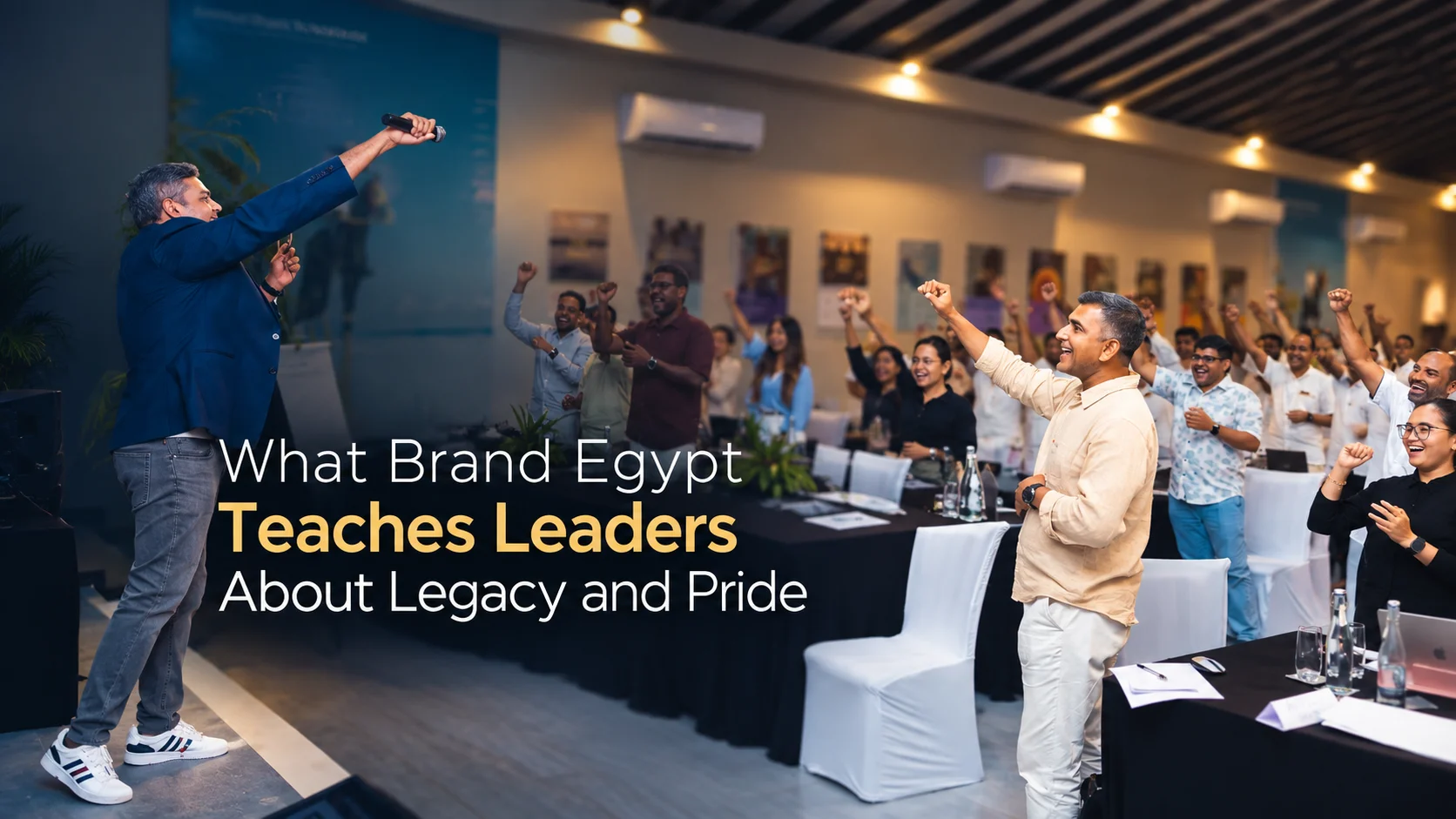
In September 2026, Dr Jerome Joseph travelled to Egypt to deliver one of his signature programmes for a multinational organisation. Egypt became country number 41 in his professional speaking journey. He went there to teach. He came back with a notebook of his own lessons.

Between the programme itself, the pyramids, the Grand Egyptian Museum and the noise and energy of Khan el-Khalili market, three qualities kept appearing. Legacy. Hustle. Pride. Together they describe something worth calling Brand Egypt, and each one has a direct lesson for organisations that want to build brands people remember.

A country is not a company. But a country is absolutely a brand. It has a reputation that took centuries to build, a story people repeat without being asked, and a set of associations that arrive in the mind before any logo does. Say Egypt to someone in Singapore, Dubai or London and they will picture something. That is brand equity, built over a very long time.

Legacy: Build Something That Outlives You

Stand in front of the pyramids and the first thought is not about design. It is about time. These structures were built by people who knew they would never see how the story ended. They built anyway, for a version of the future they could only imagine.

Most organisations do not think this way. Brand decisions get made for the quarter. Campaigns are judged on the month. Logos get refreshed because someone new joined the marketing team. The question that almost never gets asked in a boardroom is the one Egypt asks without speaking: what will still be standing here in fifty years?

Legacy in branding is not nostalgia. It is discipline. It means deciding what the brand will not change, even when change is easier. Dr Jerome Joseph has worked with more than 1,000 brands across 41 countries, and the strongest ones share this trait. They know which parts of the brand are permanent and which parts are seasonal. Everything else becomes negotiable, and that clarity is what makes them consistent for decades.

This is also why internal branding matters more than most leaders expect. A legacy is not held in a logo. It is held by the people who show up every day and behave in a way that protects it. When employees do not know what the brand stands for, the legacy quietly erodes from the inside while the marketing budget keeps growing outside.

Leaders often assume branding is a design exercise. It is not, and a good branding keynote will push teams to think beyond logos toward the decisions that actually create a lasting brand. The same principle sits at the centre of marketing that builds long term value rather than short term noise.

Dr Jerome Joseph delivers keynote sessions in Cairo and across Egypt on exactly this question, and it is usually the one that changes the room.
Build a brand your people are proud to represent.

Hustle: Energy Is a Business Skill

Khan el-Khalili market is a lesson in selling that no classroom can teach. Traders there read people in seconds. They open conversations with strangers, adjust their approach mid sentence, and treat every passer by as a possible customer without ever looking desperate.

27

That is hustle in its honest form. Not aggression, and not pressure. Energy, hunger and the willingness to create an opportunity rather than wait for one.

Many corporate teams have lost this. Processes replaced initiative. Everyone waits for the campaign, the budget approval or the marketing team to generate the lead. The seller who once knocked on doors now waits for a form submission. The brand becomes passive, and passive brands get forgotten.

Hustle in a modern organisation looks different from a market stall, but the instinct is the same. It shows up as a sales person who researches an account before the first call. A marketer who tests a message this week rather than next quarter. A leader who starts the conversation instead of waiting to be invited.

The strongest commercial teams combine that energy with discipline, which is what separates high performing sales teams from busy ones. Energy without method burns people out. Method without energy produces reports and no revenue. Organisations that run structured sales training in Egypt and other competitive markets are usually trying to build exactly this balance.

Pride: Give People Something Worth Representing

The third quality is the one leaders underestimate most.

Egyptians carry visible pride in where they come from. Ask a taxi driver in Cairo about the Grand Egyptian Museum and the answer is not a fact. It is ownership. That pride is not manufactured by a campaign. It comes from believing the thing you belong to is genuinely worth something.

Now ask a simple question about your own organisation. Do employees describe it with pride, or with a shrug?

This is the point where branding stops being a marketing exercise and becomes a leadership responsibility. People cannot fake pride for long. They feel it when the work is meaningful, when the standards are real, and when the brand promise made to customers matches what happens inside the building.

Pride also travels. An employee who is proud of the organisation becomes the most credible marketing channel it has, because nobody trusts an advertisement the way they trust a person. That is the whole basis of personal branding inside a company. When individuals build their own credibility and stay aligned with the organisation's values, the brand reaches places the marketing budget never could.

This applies to founders and senior leaders most of all, which is why personal branding coaching for entrepreneurs has moved from optional to essential. A leader with no visible point of view leaves the story of the company to someone else.

Planning a conference or leadership session in Cairo? Start the conversation.

Turning Three Words Into Three Questions

Legacy, hustle and pride sound like inspiration until a leadership team turns them into questions. Then they become uncomfortable, and useful.

On legacy: what part of this brand must survive the next ten years unchanged, and does everyone in the organisation know what it is?

On hustle: where has the team stopped creating opportunities and started waiting for them?

On pride: if employees described this organisation to a friend tonight, what would they actually say?

Most leadership teams can answer one of these well. Very few can answer all three. The gap between them is usually where the brand is losing ground, quietly, while the numbers still look acceptable.

Why This Matters More in Competitive Markets

Egypt is a useful mirror because it is a market with real pressure. Buyers compare, negotiate and expect value. International competitors arrive with larger budgets. In that environment a brand cannot rely on visibility alone, because visibility is easy to buy and easy to match.

What cannot be copied quickly is a brand with a long memory, an organisation with energy, and people who are proud to represent it. Those three things take years to build and they are the reason some brands survive economic cycles that remove others.

Dr Jerome Joseph covers these themes across his keynote programmes, where the aim is a shift in how a leadership team thinks rather than a list of tips. For event organisers weighing up options, the practical question of what makes a great keynote speaker and how to choose one is worth answering before the date is booked.

Increasingly these conversations also involve technology, which is why an AI keynote speaker for corporate conferences is now a common request. AI is changing how brands reach people. It has not changed why people trust them. More about his work and background is available on his about page.

What Leaders in Cairo Are Asking

In conversations with leadership teams in Cairo, the same concerns come up. Budgets are tighter, buyers negotiate harder, and international brands are competing for the same customers with deeper pockets. The temptation is to respond with more advertising.

Brand Egypt Teaches Leader

The stronger response is usually internal. Teams in Cairo that clarify what their brand stands for, train their people to sell with confidence and give employees a reason to be proud tend to hold their position better than those that simply spend more. It is slower work, and it lasts longer.

Cairo is also a city that understands reputation. Businesses there are often built on relationships that run for decades, where a name carries weight long before a pitch begins. That is legacy working in real time.

The Lesson Egypt Actually Teaches

Egypt did not become memorable by being loud. It became memorable by building things worth remembering, by working with energy, and by giving its people something to be proud of. Any organisation can copy a logo, a slogan or a campaign in a week. Nobody can copy legacy, hustle and pride in a week. That is why they are worth building.

Frequently Asked Questions

What is meant by Brand Egypt?

Brand Egypt refers to the reputation and associations the country carries in people's minds, built over a very long period. Like any brand, it is shaped by history, behaviour and the pride of the people who represent it, not by marketing alone.

What can businesses learn from Egypt about branding?

Three things stand out. Build for the long term rather than the quarter, create opportunities instead of waiting for them, and give employees something they are genuinely proud to represent.

Why does legacy matter in brand strategy?

Legacy forces a brand to decide what will never change. That consistency is what allows customers to trust a brand across decades, and it is usually what separates brands that last from brands that trend.

How does internal branding connect to pride?

Pride comes from inside. When employees understand the brand promise and see it honoured in daily decisions, they represent the organisation with conviction. When they do not, no external campaign can replace that missing belief.

Does Dr Jerome Joseph speak in Egypt?

Yes. Dr Jerome Joseph delivers keynotes and masterclasses in Cairo and across Egypt, covering branding, AI, leadership and sales for corporate audiences and leadership teams.

How many countries has Dr Jerome Joseph spoken in?

Egypt became country number 41 in his professional speaking journey. He has worked with more than 1,000 brands across those 41 countries over more than 30 years.

Dr. Jerome Joseph - Recognized #2 Global Brand Guru

Dr. Jerome Joseph

Singapore-Based Global Keynote Speaker | Corporate Trainer |
Brand & AI Expert

LinkedInX (Twitter)YouTubeSpotifyFacebookTikTok

Dr. Jerome Joseph is a Singapore-based global keynote speaker, corporate trainer, brand strategist, AI and business transformation expert, and best-selling author.

With more than 30 years of experience, he has worked with over 1,000 brands across 41 countries, helping leaders, organisations and professionals strengthen their brands, embrace AI and improve business performance.

Ranked No. 2 in the world as a Global Brand Thought Leader in 2020 and 2022, Dr. Jerome is a former CEO and Board Member of a publicly listed brand agency, the author of 14 books, a Certified Speaking Professional (CSP), Global Speaking Fellow (GSF), and the youngest inductee into the Asia Speaker Hall of Fame.

He delivers international keynotes, corporate training and advisory programmes in AI, sales, branding, personal branding, leadership and customer experience.

Explore Dr. Jerome Joseph's keynotes, training and advisory programmes at website.