6. When is the right time to rebrand?
Timing is generally treated as a scheduling question and is closer to a strategic one.
Good timing | Poor timing |
|---|
Ahead of a planned market or category expansion | During an active crisis |
Following a merger, once integration is underway | In the middle of a major sales cycle |
When a genuine strategic shift has been decided | When leadership is about to change |
At the start of a multi-year plan | When budget is the only reason it is happening now |
When internal alignment already exists | When employees have not been consulted at all |
The most damaging timing error is rebranding during a crisis rather than after it. A rebrand launched while an organisation is under scrutiny reads as an attempt to escape rather than a change of direction, and it invites exactly the commentary it was meant to avoid.
The second most damaging is rebranding before the strategy is settled. If the business is still deciding what it wants to become, a rebrand will express uncertainty in permanent form.
7. Why do rebrands fail?
In Joseph's experience, failure is rarely a design problem. Five recurring causes:
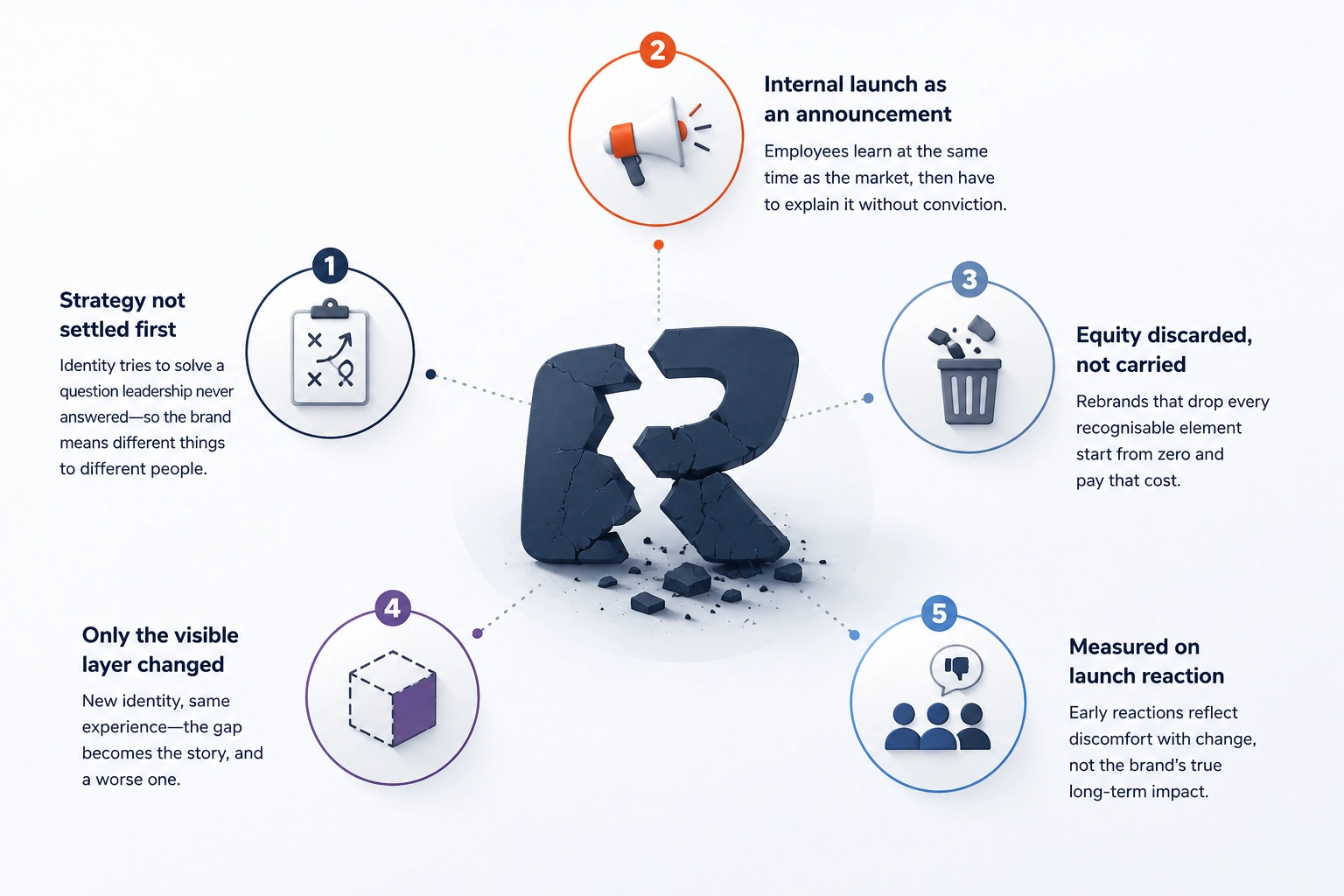
1. The strategy was not settled first. The identity is asked to resolve a question the leadership team had not answered. The result is a brand that means several things to several people.
2. Internal launch was treated as an announcement. Employees learn about the new brand at the same time as the market. They then explain it to customers without conviction, because nobody explained it to them.
3. Equity was discarded rather than carried. Existing recognition, however imperfect, has commercial value. Rebrands that abandon every recognisable element start recognition again from zero and rarely account for that cost.
4. Only the visible layer changed. New identity, unchanged customer experience. The gap between the two becomes the story, and it is a worse story than the one being replaced.
5. Success was measured on launch reaction. Immediate response to a rebrand is dominated by people who preferred the previous version, because change is uncomfortable. Judging a rebrand in week one produces a false negative almost every time.
8. What rebranding costs beyond the invoice
The fee for strategy and design is usually the smallest component. The costs that surprise organisations:
Recognition reset. Every unit of recall accumulated under the old identity has to be rebuilt
Search and discovery disruption. Existing rankings, citations and links are attached to the previous name. This now extends to how AI systems describe the business, which Joseph covers in his work on why AI systems do not recommend certain brands
Internal productivity during transition. Every template, document, signature and asset changes, and the work absorbs months of attention
Partner and channel confusion. Distributors, resellers and referral sources need to be brought along, and rarely are
Legal and registration work. Trademarks, domains, entity names and contracts across every operating market
None of these are reasons not to rebrand. They are reasons to be certain before starting.
9. Rebranding across multiple markets
For organisations operating across Asia and the Middle East, Joseph identifies an additional layer that Western frameworks tend to omit.
A name or positioning that works in one market may carry different associations in another. This extends beyond translation to connotation, existing local competitors with similar names, and cultural expectations about how a company of that type should present itself.
There is also a heritage question. In several Asian markets, longevity and continuity carry substantial weight with both customers and talent. A rebrand that visibly discards a long history can weaken trust in markets where that history was an asset, even while it strengthens perception in markets where it read as dated.
The practical answer is usually a consistent global position with locally calibrated expression, rather than either a single uniform rollout or entirely separate identities.
10. The honest conclusion
Rebranding works when a business has genuinely changed and its brand has not caught up. It fails when it is asked to compensate for something else.
The question worth sitting with is not whether the brand could be better. It almost always could. The question is whether the brand is the constraint.
For a meaningful proportion of organisations that begin this conversation, the answer is no, and discovering that early is the most valuable outcome the process can produce.
For those where the answer is yes, the work is worth doing properly, which means settling the strategy first, bringing employees along before the market, carrying forward what has value, and measuring the result over years rather than weeks.
About Dr Jerome Joseph
Dr Jerome Joseph is a global keynote speaker, brand strategist and author. He is ranked #2 in the world as a Global Brand Thought Leader on the Top 30 Global Gurus list. With more than 30 years of experience, he has worked with over 1,000 brands across 40 plus countries and is the author of 12 best-selling books. He is a Hall of Fame speaker and a Certified Speaking Professional (CSP), and works with organisations across Asia and the Middle East on brand strategy, positioning and culture transformation.
Frequently Asked Questions
When should a company rebrand?
A company should rebrand when the brand no longer describes what the business actually is, when the name or positioning blocks expansion into a new market or category, when a merger has created competing identities, when the market has shifted and the positioning has not, or when a reputation event has made the existing identity unworkable.
What is the difference between a rebrand and a visual refresh?
A visual refresh updates the logo, colours and typography while the positioning stays the same. A rebrand changes what the business stands for, who it serves and what it promises, whether or not the logo changes. Many organisations that commission a full rebrand needed only a refresh or a repositioning.
How often should a company rebrand?
There is no fixed interval, and treating it as a scheduled activity is itself a warning sign. Rebrands should be triggered by a genuine change in the business or its market. Most organisations rebrand meaningfully once in a decade or less, and frequent rebranding erodes recognition faster than it builds it.
Is declining revenue a reason to rebrand?
Usually not. A brand can cause losses at the awareness and consideration stages of a customer journey. Losses at evaluation, negotiation or renewal are almost always product, pricing, sales or service problems. Diagnose where in the journey the loss occurs before assuming the brand caused it.
Should you rebrand after a merger or acquisition?
Generally yes, and the timing is less optional than in other scenarios. Two brands operating as one organisation creates confusion for customers, employees and partners. Delay makes the eventual work harder because both identities continue accumulating separate equity and internal loyalty.
What is the most common reason rebrands fail?
The strategy was not settled before the work began. The identity is then asked to resolve a question leadership had not answered, producing a brand that means different things to different people. The second most common cause is treating the internal launch as an announcement rather than a process.
How long does a rebrand take?
Strategy and identity development typically takes three to six months for a mid-sized organisation. Full rollout across every asset, market and system usually takes twelve to eighteen months. Organisations that compress the strategy phase to accelerate the launch generally pay for it later.
How do you measure whether a rebrand worked?
Not by launch reaction, which is dominated by people who preferred the previous version. Useful measures include unaided brand recall, accuracy of how customers describe what you do, quality of inbound enquiries, sales cycle length, and whether employees describe the organisation consistently. All of these are measured over quarters and years.
What are the hidden costs of rebranding?
Recognition reset, search and discovery disruption including how AI systems describe the business, internal productivity loss during transition, partner and channel confusion, and legal work across trademarks, domains and contracts in every operating market. These frequently exceed the strategy and design fee.
Does rebranding work the same way in every market?
No. A name or position may carry different connotations across markets, and in several Asian markets longevity and continuity carry significant weight with customers and talent. A rebrand that visibly discards a long history can weaken trust where that history was an asset. A consistent global position with locally calibrated expression usually works better than either a uniform rollout or separate identities.