Services

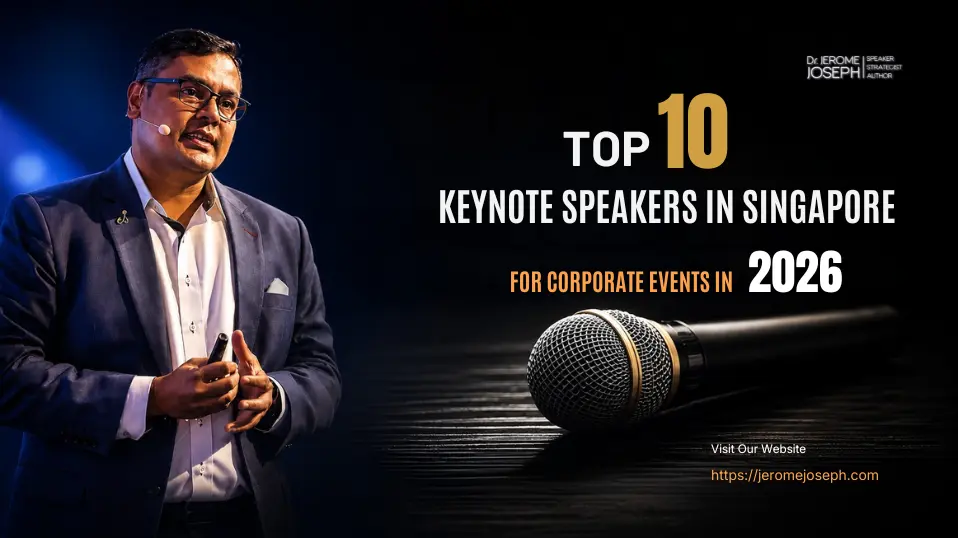
Top 10 Keynote Speakers in Singapore for Corporate Events in 2026

Published on July 30, 2026By Team Dr. Jerome Joseph
Top 10 Keynote Speakers in Singapore for Corporate Events in 2026

I have spent over 30 years on stages in more than 40+ countries, and I have sat on the other side of the table too, as the person signing off on speaker budgets. So I will tell you what I have watched happen far too often in Singapore: an organisation books a speaker because someone on the committee saw a viral clip, the session gets polite applause, and six weeks later nobody in the room can name a single idea from it.

That is not a speaker problem. That is a selection problem.

Singapore sits at the centre of this because it has quietly become the region's default venue for anything serious. Marina Bay Sands, Suntec, the Singapore EXPO and Raffles City host leadership offsites, sales kickoffs and industry conferences almost every week of the year, and most of those events serve audiences from across Hong Kong, Kuala Lumpur, Jakarta, Sydney and the Gulf at the same time. That means the speaker you pick is not addressing one market. They are addressing five.

What actually separates a keynote from a talk

Before you look at any names, get clear on what you are buying. A keynote is not a workshop, and it is not a guest slot. A keynote sets the frame for the entire event, and every session after it is measured against it. If you are unsure which format your agenda needs, I have written a longer breakdown on the difference between a keynote speaker and a guest speaker that will save you a conversation with your committee.

The best keynote does not give an audience information. It gives them a decision they were avoiding.

The five criteria that predict whether a keynote lands

In my experience, these five separate speakers who move a room from speakers who merely entertain one.
360_F_1362120938_nS8Rybaa1Wmz3TtRzJYiJwco2QWPVMsy
  • Original frameworks, not recycled inspiration. Ask what proprietary model the speaker will use. If the answer is a list of anecdotes, keep looking. This is one of the reasons I have documented my own frameworks across 12 best-selling books, so a client can see the thinking before they book.

  • Real operating experience. A speaker who has run a business, carried a P&L or led a transformation will handle the Q&A differently from someone who has only studied the topic.

  • Regional fluency. A keynote written for a Chicago audience will not land the same way in a room split between Singaporean, Indonesian and Emirati leaders. Ask specifically for case studies delivered in Asia.

  • Willingness to customise. Ask what the speaker needs from you before the event. If they do not ask for pre-event interviews with your leaders, you are getting a stock talk. I cover this in more depth in my guide on how to choose the right keynote speaker.

  • Credentialed professional standing. Designations like Certified Speaking Professional, Global Speaking Fellow and Hall of Fame induction are peer-assessed rather than self-awarded, which makes them a useful filter.

What a keynote speaker costs in Singapore

Almost nobody publishes this, which is why budgets get set badly. Here are the ranges commonly quoted across Singapore speaker bureaus in 2026.

Speaker tier

Typical fee range (SGD)

Best fit

Local subject specialist

8,000 to 20,000

Internal town halls, functional team sessions

Established professional keynote speaker

10,000 to 35,000

Annual conferences, leadership summits

Global headliner with international travel

15,000 to 40,000 and above

Flagship customer events, regional kickoffs

Half-day masterclass or workshop add-on

Typically 40 to 70 percent on top of keynote fee

When you need behaviour change, not just energy

Fees move based on session length, depth of customisation, travel and whether you want content licensing or recording rights afterwards. Ask about all four up front. The cheapest quote is rarely the cheapest outcome.
become-keynote-speaker

Here is the list. I am going to start with my own work, because it would be strange to leave it out of a guide on my own site, and then I want to genuinely point you towards nine other speakers based in or regularly working out of Singapore whose credentials stand up to scrutiny. No affiliate arrangements, no paid placements.

1. Dr Jerome Joseph

Focus: Branding, personal branding, AI and brand strategy, sales and leadership

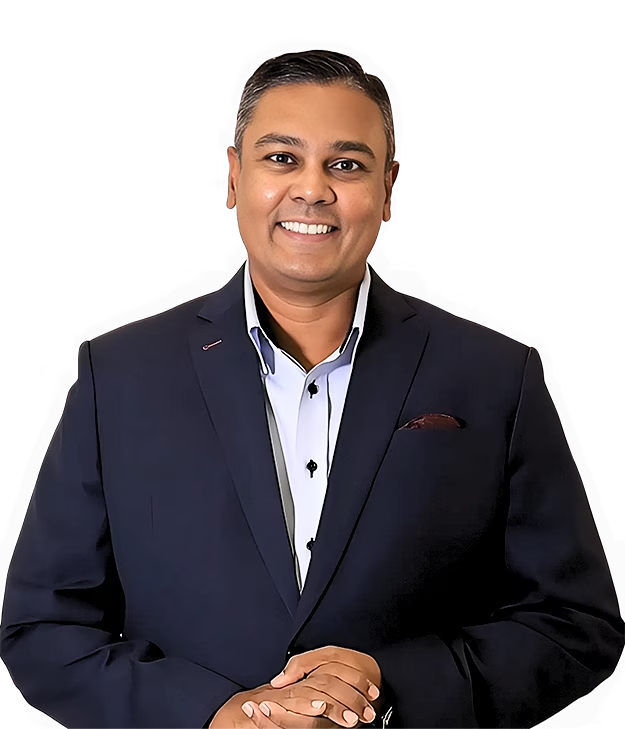
Dr Jerome Joseph is ranked among the world’s Top 5 Brand Gurus in 2026, having previously reached No. 2 in 2020 and 2022. With more than 30 years of experience, he has worked with over 1,000 brands across 40 countries, written 12 books, and been inducted into the Asia Professional Speakers Hall of Fame. He also holds the Certified Speaking Professional and Global Speaking Fellow designations. His work connects brand to behaviour—and behaviour to business results—helping organisations strengthen culture, customer experience, sales performance and growth. More recently, he has expanded this work into AI, showing leaders how to use technology to improve productivity, communication, marketing and customer engagement without losing the human trust and connection that strong brands require.

Best for: Brand transformation launches, leadership summits, sales kickoffs, C-suite offsites across Asia and the Gulf. You can see the full range of session formats on my keynotes page.

2. Ron Kaufman

Focus: Service culture and customer experience

Singapore-based, and one of the most credentialed names in the region. He is the author of the New York Times bestseller Uplifting Service along with fourteen other books, and Global Gurus has ranked him the world's number one customer service guru for multiple consecutive years. He moved to Asia in 1990 to help Singapore Airlines and the Singapore government build a national service quality training organisation, which is about as deep as local credibility gets. He holds CSP and Global Speaking Fellow designations and is an APSS Hall of Fame inductee.

Best for: Service transformation programmes, frontline and hospitality conferences.

3. Simone Heng

Focus: Human connection, belonging, workplace culture

Born in Singapore, and one of the youngest female Certified Speaking Professionals in the world, a designation held by fewer than 800 speakers globally. She spent fifteen years as an international broadcaster with Virgin Radio Dubai, HBO Asia and CNBC before moving to the stage full time. She has spoken across six continents for organisations including Google, Meta, Amazon, KPMG, Spotify and Salesforce, and has appeared at Harvard, SXSW, TEDx and the United Nations.

Best for: Culture and engagement conferences, hybrid workforce sessions, events with a strong wellbeing theme.

4. David Lim

Focus: Resilience, leadership under pressure, peak performance

David Lim is one of Singapore's best-known leadership speakers and the leader of the first Singapore Everest Expedition. His remarkable journey, which included overcoming severe setbacks during the expedition, has become a powerful example of resilience, determination and adaptability under pressure. Over the years, he has transformed those experiences into practical leadership lessons for organisations across Asia.

Rather than relying purely on motivational stories, David focuses on teamwork, decision-making, risk management and maintaining focus during periods of uncertainty. His ability to connect extreme challenges with everyday business realities has made him a respected voice among corporate leaders.

Best for: Change management programmes, crisis leadership sessions and executive leadership retreats.

5. Andrew Chow

Focus: Social media, public relations, digital brand visibility

Andrew Chow is a Certified Speaking Professional and former President of Asia Professional Speakers Singapore. Over the years, he has built a strong reputation in social media strategy, public relations and executive branding, helping leaders and organisations strengthen their online presence and credibility.

His presentations focus heavily on LinkedIn strategy, personal branding and digital authority building. Unlike many marketing speakers, Andrew combines practical techniques with long-term reputation-building strategies that professionals can apply immediately.

Best for: Marketing conferences, branding events, leadership programmes and sales teams building their digital presence.

6. Mark Stuart

Focus: Marketing, innovation, hybrid facilitation

Mark Stuart is recognised for combining keynote speaking, training and facilitation into a highly engaging presentation style. As a Certified Speaking Professional, he has worked extensively with organisations navigating innovation, leadership development and workplace transformation.

His expertise in hybrid and virtual presentations has made him especially valuable to companies managing teams across multiple locations. His sessions combine practical frameworks with interactive exercises designed to keep audiences involved from beginning to end.

Best for: Innovation programmes, leadership conferences and large-scale hybrid events.

7. Tom Abbott

Focus: Sales performance and sales coaching

Singapore-based with over a decade of speaking experience, Tom Abbott is an internationally recognised sales expert, coach and author who has worked extensively across the Asia-Pacific region. His presentations focus on prospecting, negotiation, client relationships and building sustainable sales performance across diverse markets.

Best for: Sales kickoffs and revenue team enablement. This sits close to my own sales training work in Singapore, so shortlist both and pick based on the outcome you want to achieve and the style that best fits your audience.

8. Eric Feng

Focus: Social media, digital influence, modern selling

Eric Feng is widely recognised for his work in social selling, digital influence and personal branding. With hundreds of thousands of followers across social media platforms, he has become a familiar voice among entrepreneurs, sales professionals and financial advisers throughout the region.

His presentations focus on helping professionals use digital platforms to build credibility, expand networks and create long-term business opportunities. His energetic presentation style makes his sessions particularly popular at sales and entrepreneurship events.

Best for: Financial services conferences, entrepreneurship programmes and personal branding events.

9. Rob Lilwall

Focus: Adventure-led resilience and perseverance

Rob Lilwall is an adventurer, filmmaker and author whose expeditions have taken him across some of the world's most demanding environments. His experiences include cycling across continents, crossing deserts and documenting extraordinary journeys that test both physical and mental endurance.

His presentations transform those experiences into lessons on perseverance, adaptability and maintaining optimism in difficult situations. His storytelling ability makes him an especially effective choice for conferences seeking an inspiring opening keynote.

Best for: Leadership conferences, resilience programmes and corporate kickoffs.

10. Sha En Yeo

Focus: Positive psychology, wellbeing, team dynamics

Sha En Yeo specialises in positive psychology, workplace wellbeing and employee engagement. Her work combines scientific research with practical applications that help organisations improve communication, strengthen resilience and build healthier workplace cultures.

Her presentations frequently focus on emotional intelligence, psychological safety and sustainable performance. As organisations place greater emphasis on employee wellbeing, her work has become increasingly relevant for modern leaders.

Best for: Human resources conferences, wellbeing initiatives and leadership development programmes.

Why Singapore Became Asia's Default Keynote Stage

Why Singapore Became Asia's Default Keynote Stage

Singapore does not just host events, it hosts regional decisions. A single leadership summit at Marina Bay Sands or Suntec will often carry delegates from Kuala Lumpur, Jakarta, Hong Kong, Mumbai and Dubai in the same room, which changes what a keynote has to do. The speaker is no longer addressing one culture or one market. They are addressing several at once, and the content has to survive all of them. That is why regional fluency matters more here than raw celebrity, and why event teams in Singapore should always ask a shortlisted speaker for case studies delivered in Asia rather than case studies delivered anywhere.
A Keynote Creates Intent. Follow-Through Creates Change.

A Keynote Creates Intent. Follow-Through Creates Change.

The most common disappointment after a corporate event is not a bad speaker. It is a good speaker with nothing built around them. Sixty minutes on a stage can absolutely shift how a room thinks, but it cannot rewire how that room works. The organisations that get real returns treat the keynote as the opening move rather than the whole play. They schedule a follow-on masterclass or coaching track within four weeks, they brief the speaker on the specific behaviour they want changed, and they design at least one later session that explicitly builds on the keynote's framework. Plan that architecture before you sign the speaker, not after.

Matching the speaker to the event, not the other way round

Most shortlists fail because the committee starts with names instead of starting with the outcome. Work backwards from what you want the audience doing on Monday morning.

1520160998751

If your event goal is

Look for a speaker in this territory

Relaunching or repositioning a brand internally

Branding and internal branding, with brand behaviour frameworks

Getting leaders to actually use AI rather than talk about it

AI applied to strategy, branding and sales, not general tech futurism

Lifting a sales team's conversion and confidence

Sales performance, with live coaching or role-play capability

Building executive visibility and influence

Personal branding for senior leaders

Shifting frontline service standards

Service culture and customer experience

Rebuilding morale after restructuring

Resilience, human connection, positive psychology

If your goal is the fourth one, that is the area where I do most of my one-to-one work, and my personal brand coaching practice runs alongside the keynote as a follow-through. A keynote creates intent. Coaching converts it.

Four mistakes I see Singapore event teams make

  • Booking on showreel alone. A well-edited three-minute reel tells you about the editor, not the speaker. Ask for an unedited twenty-minute segment.

  • Skipping the pre-event brief. If your speaker has not spoken to at least two of your leaders before the event, expect a generic session.

  • Treating the keynote as the whole intervention. A 60-minute talk changes mood. A keynote plus a follow-on masterclass changes behaviour, which is why I usually recommend pairing them and why I run masterclasses as a companion format.

  • Leaving the agenda unplanned around the keynote. Put the keynote early, then design at least one session that explicitly builds on it.

If your speaker's content can be delivered unchanged to a bank, a hospital and a logistics firm in the same week, you have not booked a keynote. You have booked a recording.

A note for meeting planners

Ask every shortlisted speaker for four things in writing: their customisation process, their AV and stage requirements, their travel and accommodation terms, and their policy on recording and content reuse. That last one catches a surprising number of teams out after the event. I keep all of this in one place for planners on my meeting planners page, and if your event sits outside Singapore, I have also mapped the broader regional picture in my guide to the best keynote speakers in Asia and where I think keynote speaking in Asia is heading next.

jj

Singapore has genuine depth of speaking talent now. That is good news, and it also means the burden has shifted to you. Choose on framework, fit and follow-through, not on fame.

If you would like to talk through whether your event needs a keynote, a masterclass or both, get in touch and we can map it against your agenda.

About Jerome

Dr Jerome Joseph is a global keynote speaker, brand strategist and author. He is ranked #2 in the world as a Global Brand Thought Leader on the Top 30 Global Gurus list, and is the only Asian brand guru on that list. Across more than 30 years he has worked with over 1,000 brands in more than 40+ countries and authored 12 best-selling books on branding, sales, leadership and influence. He is an Asia Professional Speaker Hall of Fame inductee, a Certified Speaking Professional and a Global Speaking Fellow, and a former CEO and board member of a publicly listed brand agency group. He speaks and consults on brand strategy, internal branding, personal branding, branded customer experience and the application of AI to branding and sales. Having shared stages and shortlists with many of the speakers named in this guide, he knows exactly how much the right selection decision changes what an audience carries home.

Frequently Asked Questions

Who are the top keynote speakers in Singapore in 2026?
Singapore's most credentialed keynote speakers include Dr Jerome Joseph on branding, AI and personal branding, Ron Kaufman on service culture, Simone Heng on human connection, David Lim on resilience, Andrew Chow on social media and PR, Mark Stuart on innovation, Tom Abbott on sales, Eric Feng on digital influence, Rob Lilwall on perseverance, and Sha En Yeo on positive psychology. The right choice depends on your event outcome rather than on ranking.

How much does a keynote speaker cost in Singapore?
Fees commonly range from around SGD 8,000 to 20,000 for local subject specialists, SGD 10,000 to 35,000 for established professional keynote speakers, and SGD 15,000 to 40,000 or more for global headliners requiring international travel. Session length, depth of customisation, travel and content or recording rights all affect the final figure.

What is the difference between a keynote speaker and a corporate trainer?
A keynote speaker sets the strategic frame for an event and shifts how an audience thinks about a problem, usually in 45 to 90 minutes for a large room. A corporate trainer builds specific skills through practice and feedback, usually in smaller groups over a longer period. Many events benefit from a keynote to create intent followed by a masterclass to build capability.

How far in advance should we book a keynote speaker in Singapore?
For established speakers, three to six months ahead is realistic, and popular dates in the September to November conference season are often taken nine to twelve months out. Booking early also leaves time for the pre-event interviews that make customisation possible.

What credentials should we look for in a professional keynote speaker?
Peer-assessed designations are the most reliable filter, because they cannot be self-awarded. Look for Certified Speaking Professional, Global Speaking Fellow, and Hall of Fame induction by a national or regional speakers association. Beyond that, look for original published frameworks, documented client work in Asia, and real operating experience in the speaker's subject area.

Can Singapore-based keynote speakers deliver events across Asia and the Middle East?
Yes, and most established Singapore-based speakers do. Singapore's position as a regional hub means speakers here routinely deliver in Malaysia, Indonesia, Vietnam, Hong Kong, India and across the Gulf. Dr Jerome Joseph, for example, has delivered programmes in more than 40+ countries.

CARA AI - Talk to Dr. Jerome Joseph AI Assistant
CARA AI