After 30 years working with over 1,000 brands across 40 +countries and impacting more than 1.2 million people, Dr Jerome Joseph has had a front-row seat to how keynote speaking in Asia has evolved. Not from the audience side. From the stage. And the shift he is seeing right now is the most significant change to the profession since the move from overhead projectors to PowerPoint. The change is not about AI tools, though AI is part of it. It is about what audiences across Asia are now willing to accept, and what they are no longer willing to sit through. That shift is forcing event organisers, conference planners, and speakers themselves to completely rethink what a keynote is actually for.
Leadership
What 30 Years of Keynote Speaking Reveals About Asia’s Changing Stage
Published on July 08, 2026By Team Dr. Jerome Joseph

WATCH VIDEO NOW
1. What Keynote Audiences in Asia Are No Longer Willing to Accept
The most consistent shift across markets from Singapore to India to the Middle East is this: audiences have become significantly faster at detecting when a speaker is delivering a performance rather than sharing genuine insight. The tolerance for polished delivery without real substance has dropped sharply, and it has dropped faster in Asia than anywhere else.
Asian business audiences are among the most informed in the world. Many are already consuming global thought leadership content daily through podcasts, YouTube, and LinkedIn before they walk into a conference room
A keynote that summarises trends they already know, wrapped in high-energy delivery, lands as entertainment at best and a waste of time at worst
The speakers who are getting standing invitations to return to the same organisations are the ones who bring something the audience cannot get from a 10-minute YouTube video, which means specific, first-hand, experience-based perspective that no amount of research can replicate
Authenticity is not a buzzword in this context. It is the audience's ability to detect whether the person on stage has actually lived what they are talking about, and they are getting faster at detecting when the answer is no
Then | Now |
|---|---|
Polished delivery was enough | Substance is non-negotiable |
Room energy carried the session | Content must hold up on camera |
Research citations built credibility | First-hand experience is the differentiator |
2. How AI Is Changing What Event Organisers Expect From a Speaker
AI has changed two things simultaneously for event organisers in Asia. It has made it possible to research a speaker more thoroughly than ever before, and it has made it easier to see through generic positioning that would previously have been harder to verify.
Before AI, an event organiser might book a speaker based on a showreel, a bio, and a recommendation. Today, they can read every piece of content that speaker has published, watch hours of footage, and have AI summarise their core ideas in minutes
This means speakers who have been saying the same thing for five years in different packaging are now being caught out in the research phase rather than after the booking
The event organisers who are getting the best audience feedback are the ones who are now asking speakers not just what they will cover but what perspective they will bring that the audience cannot find anywhere else
For organisations specifically looking at AI as a keynote theme, the bar has moved from explaining what AI is to showing how it actually applies to the audience's specific industry, role, and leadership challenge
3. Why Hybrid and Digital Formats Have Raised the Bar, Not Lowered It
The expectation after the shift to hybrid events was that audiences would accept slightly lower energy and engagement in exchange for the convenience of attending remotely. The opposite has happened. Having watched world-class content delivered through a screen, hybrid audiences in Asia now compare every speaker to the best content they have ever consumed online.
A keynote delivered to a hybrid audience is competing not just with other speakers but with every piece of content that audience has ever found genuinely valuable on any platform
Speakers who rely on room energy to carry their delivery have struggled in hybrid formats because the camera flattens energy and amplifies everything that is missing when the room dynamics are removed
The keynotes that have worked consistently across hybrid formats are built around ideas so specific and well-structured that they hold attention without needing audience energy to sustain them
For event organisers, this means the question to ask a speaker before booking them for a hybrid event is not just whether they can present but whether their content holds up on its own when the room is empty and the camera is the only audience
4. What the Most Effective Keynotes in Asia Look Like in 2026
Across 30 years and more than 40 countries, the format that consistently produces the strongest post-event feedback and the highest rate of repeat invitations has changed significantly over the past three years.
The strongest keynotes now open with a specific, surprising, or counterintuitive claim rather than a broad context-setting section. Asian business audiences have limited patience for lengthy scene-setting before the speaker gets to the point
The most effective content in 2026 is built around one central, memorable framework that the audience can take away and apply, not a collection of five to seven separate ideas that compete for attention
First-hand stories, specific client situations, and named outcomes carry significantly more weight than research citations alone. Audiences want to know what the speaker has personally seen happen, not just what the data says
The Q&A session is increasingly where the most valuable exchange happens, because it is the one part of the programme that cannot be pre-packaged. The speakers who are strongest in Q&A are the ones with the deepest genuine expertise, and audiences know it
For conference planners looking to book keynote speakers who fit this profile, Dr Jerome Joseph's AI keynote speaker programmes are specifically built around this depth-first approach rather than broad motivational content

5. What Event Organisers Should Be Asking Before They Book Anyone
The single biggest mistake event organisers across Asia make is evaluating a keynote speaker on delivery quality alone. A high-energy, polished presenter who leaves the audience with nothing specific to act on is not a successful keynote, regardless of how good the applause sounded in the room.
Ask what specific, non-obvious insight the speaker will share that the audience cannot find in a five-minute search. If the answer is vague, the content probably is too
Ask for evidence of repeat bookings from the same organisations. The most reliable signal that a keynote produced real value is that the organisation invited the speaker back
Ask how the keynote will be customised for your specific audience, industry, and current challenge. Generic content that gets re-skinned with the audience's logo on the title slide is not customisation
Ask what the audience will be able to do differently on Monday morning as a result of the session. A keynote that cannot answer this question clearly is entertainment, not investment
For organisations booking across the Asia region including Singapore and the Middle East, Dr Jerome Joseph's keynote programmes for corporate events and leadership summits in Dubai are built around measurable outcomes rather than event-day experience alone
“The best keynotes are not performances. They are conversations between someone who has genuinely lived something and an audience that needs exactly what that experience produced."
Final Thoughts
The future of keynote speaking in Asia is not about more technology on stage or more elaborate production. It is about a fundamental shift in what audiences are willing to accept and what event organisers are starting to demand. The speakers who will be relevant in this environment are the ones who have built something real over time, genuine expertise, specific perspective, and the kind of first-hand insight that cannot be manufactured or researched from the outside.
After 30 years on stages across Asia and beyond, the most consistent observation is that the best keynotes are not performances. They are conversations between someone who has genuinely lived something and an audience that needs exactly what that experience produced.
To explore how Dr Jerome Joseph works with event organisers and conference planners across Asia, visit the keynote speaker page or get in touch directly.
What is changing about keynote speaking in Asia?
Audiences are no longer willing to accept polished delivery without genuine substance. The tolerance for generic trend-summaries and motivational content has dropped sharply, and event organisers are increasingly demanding speakers who bring specific, first-hand, experience-based insight that the audience cannot find anywhere else.
How has AI changed keynote speaking in Asia?
AI has made it possible for event organisers to research speakers far more thoroughly before booking, which means speakers with generic positioning are being identified and filtered out earlier. It has also raised audience expectations for keynotes on AI-related topics, where the bar has moved from explaining what AI is to showing how it applies to the audience's specific situation.
What makes a keynote speaker effective in Asia specifically?
Cultural awareness, genuine expertise rather than researched expertise, and the ability to deliver content that holds up in hybrid formats without relying on room energy. Asian business audiences are among the most informed in the world and detect inauthenticity faster than most speakers expect.
What should event organisers ask before booking a keynote speaker?
Ask what specific insight the speaker brings that the audience cannot find through a basic search. Ask for evidence of repeat bookings from the same organisations. Ask how the content will be genuinely customised, not just re-skinned, for the specific audience and challenge.
How long has keynote speaking been evolving in Asia?
The region has always had strong demand for keynote speakers, but the most significant shift has happened in the last three years as hybrid events, AI tools, and significantly more sophisticated audiences have changed what a keynote needs to deliver to be considered genuinely valuable.
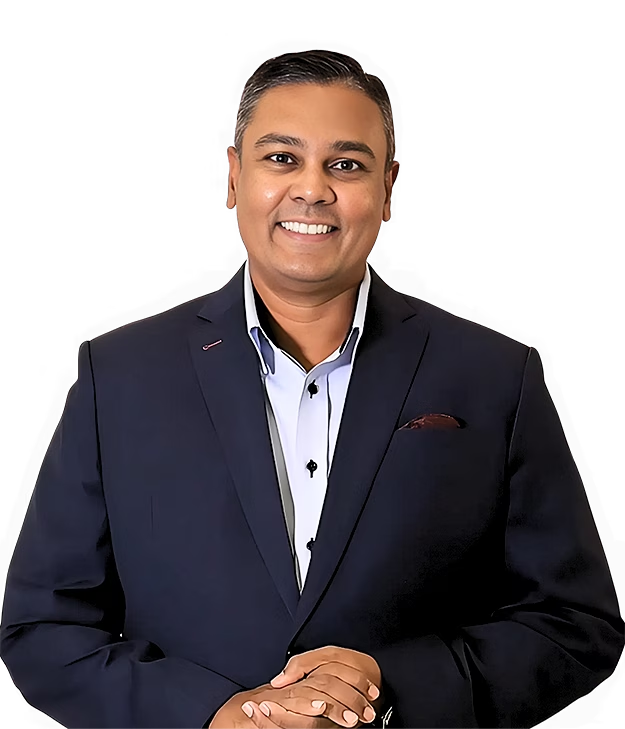
Dr. Jerome Joseph
Singapore-Based Global Keynote Speaker | Corporate Trainer |
Brand & AI Expert


Dr. Jerome Joseph is a Singapore-based global keynote speaker, corporate trainer, brand strategist, AI and business transformation expert, and best-selling author.
With more than 30 years of experience, he has worked with over 1,000 brands across 41 countries, helping leaders, organisations and professionals strengthen their brands, embrace AI and improve business performance.
Ranked No. 2 in the world as a Global Brand Thought Leader in 2020 and 2022, Dr. Jerome is a former CEO and Board Member of a publicly listed brand agency, the author of 14 books, a Certified Speaking Professional (CSP), Global Speaking Fellow (GSF), and the youngest inductee into the Asia Speaker Hall of Fame.
He delivers international keynotes, corporate training and advisory programmes in AI, sales, branding, personal branding, leadership and customer experience.
Explore Dr. Jerome Joseph's keynotes, training and advisory programmes at website.
Related Posts