Leadership

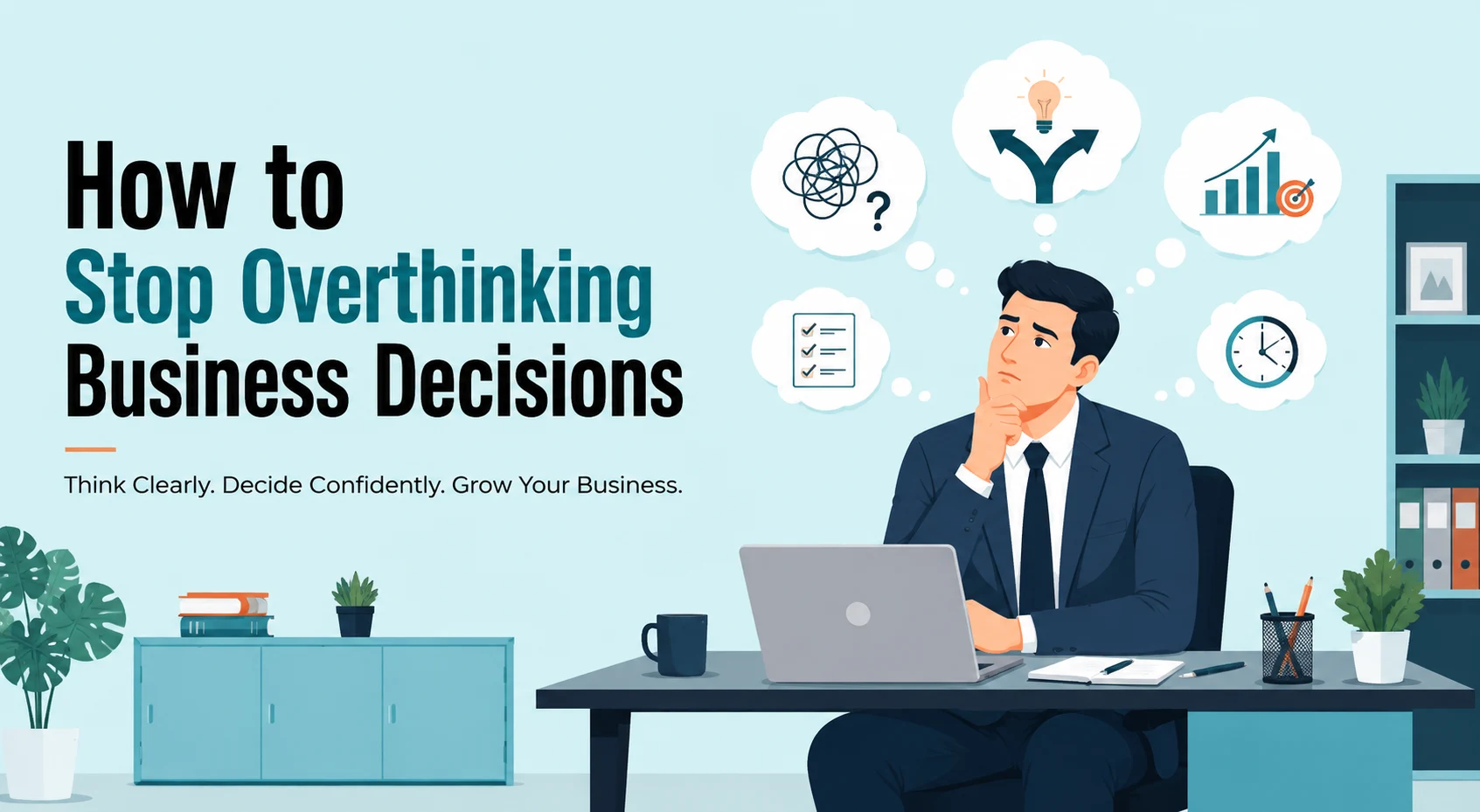
How to Stop Overthinking Business Decisions

Published on August 21, 2026By Team Dr. Jerome Joseph
How to Stop Overthinking Business Decisions

Overthinking is usually not about the decision. It is about avoiding the risk of being wrong. The fastest way to fix it is to sort decisions into two groups. If the decision can be reversed, decide today with the information you have. If it cannot be reversed, slow down properly and get the missing information. Most people do the opposite.

1. Overthinking is not careful thinking

Careful thinking has an end point. You gather what you need, weigh it, and decide. Overthinking has no end point. You go over the same three options on Monday, again on Wednesday, and again the following week. Nothing new arrives. You just feel the weight of it again. Dr Jerome Joseph has spent more than 30 years working with over 1,000 brands across 40 plus countries. He says the pattern is easy to spot from the outside and almost impossible to spot from the inside.

Here is the test. Ask yourself what new information you are waiting for.

If you can name it, you are thinking carefully. Wait for it. If you cannot name anything, you are not gathering information. You are delaying the moment where you might be wrong.

2. Why smart people get stuck the most

This surprises people, but it is consistent. The more capable someone is, the more they tend to overthink. Not because they are slower. Because they can see more. An experienced business owner looks at a decision and sees eight things that could go wrong. Someone with less experience sees two. The second person decides quickly and often does fine. Experience gives you a longer list of risks. It does not automatically give you a way to weigh them.

There is a second reason too. The more you have built, the more you have to lose.

Someone starting out has nothing at risk. Someone with a team, customers and a reputation feels every decision landing on all three. So they wait.

While you are still thinking about it, you have not made a mistake yet. That is the real appeal of overthinking, and it is why it feels responsible.

Dr Jerome Joseph shared this thought in a short post on LinkedIn recently.

While you are still thinking about it, you have not made a mistake yet. That is the appeal, and that is the trap.

3. The rule that solves most of it

Almost every decision falls into one of two buckets. Once you sort it, the answer usually becomes obvious.

Reversible decision

Hard to reverse

Examples

Trying a new supplier, changing a price, testing a channel, hiring a freelancer

Signing a long lease, buying a business, hiring a senior leader, changing your brand name

Cost of being wrong

Small, you undo it

Large, you live with it

How to decide

Fast, with what you know now

Slowly, with proper information

What to spend

An hour

Weeks

Now look at how most people actually behave. They spend three weeks deciding on a reversible thing, like whether to test a new marketing channel. Then they sign a five year lease in a fortnight because the deadline forced them.

They are slow on the cheap decisions and fast on the expensive ones.

Dr Jerome Joseph suggests writing the decision down and asking one question. If this turns out to be wrong, how hard is it to undo? If the answer is "fairly easy", decide today. You will learn more from doing it than from thinking about it.

4. The waiting that never ends

There is a specific version of this that costs the most. Waiting for the right time. The right time to raise prices. The right time to hire. The right time to launch the new service. The right time to put yourself forward. The observation Dr Jerome Joseph makes after three decades is simple. The right time almost never announces itself. Business conditions are always mixed. There is always something uncertain. There is always a reason it could be a better quarter to do this. So the person waiting for clear conditions waits permanently, and calls it timing. That does not mean timing never matters. It does. But there is a difference between waiting for something specific and waiting for a feeling.

Waiting for something specific: we will hire after the contract is signed in March.

Waiting for a feeling: we will hire when things feel a bit more stable.

The first has a date. The second does not, and it never will.

5. What comparison does to your thinking

There is one more thing that slows people down, and it is worth naming. Watching competitors. A business owner checks what a competitor launched, how they priced it, what they posted. Then they go back to their own decision and it looks smaller.

Confused Businessman Under Questioning Clouds

Two problems come from this.

It moves the goalposts. You were solving your problem. Now you are trying to match someone else, whose situation you cannot actually see.

It leads to copying. And copying is the fastest way to become one of several similar options, which means customers have nothing left to compare except price.

Dr Jerome Joseph makes this point often in his brand work. If you look like everyone else, you have handed the decision to price. That is why brand positioning is about choosing what you will not do, as much as what you will. The competitor's move is information. It is not a target.

There is no line item for the decision you did not make. That is why it goes unnoticed for years.

6. Four things that help

None of these are complicated. That is the point.

Give the decision a deadline. Not a vague one. A date and a time. "I will decide by Thursday 4pm." Decisions expand to fill whatever time you give them, and most of them will happily take a year.

Write down what you would need to know. One line. If you can write it, go and get it. If you sit there and cannot write anything, you already have enough. Decide.

Set a limit on advice. Three people, then stop. Beyond three, you are not gathering input. You are looking for someone to agree with you so it feels less like your decision.

Make small decisions quickly on purpose. Not because they matter, but because it builds the habit. People who decide fast on small things find it easier when something big arrives.

Balancing Ambition and Achievement

7. When you should slow down

Being fair, there are times to take longer.

When you cannot undo it. Long commitments, senior hires, anything legal. Slow is correct here.

When you are angry or exhausted. Decisions made in either state get revisited. Sleep first.

When you genuinely do not know something important. If you can name the missing piece, go and find it. That is not overthinking, that is doing the work.

When other people carry the consequence. If your team lives with the outcome, ask them. That takes time and it is time well spent.

The difference is always the same. Are you waiting for something, or are you waiting?

8. What it actually costs

Overthinking feels free. It is not. Every month you delay a price increase is a month of the old revenue. Every quarter you wait to hire is a quarter of work you personally absorb. Every year you wait to be more visible is a year someone less qualified spends becoming the obvious choice.

None of this appears on any report. There is no line item for the decision you did not make. That is exactly why it goes unnoticed for years.

Dr Jerome Joseph puts it plainly. The competitor is rarely the thing holding a business back. More often it is the gap between what the owner knows they should do and when they finally do it. That gap is where most of the loss sits, and it is entirely within your control.

9. Where to start

If one thing from this is worth doing, it is this. Write down the decision you have been carrying for more than a month. Just one. Next to it, write what you are waiting for. If you can name it, go and get it this week. If the space is blank, you already know enough. Set a deadline for Friday and decide.

The version of you that keeps postponing is not being careful. It is being comfortable. And comfortable is expensive. Dr Jerome Joseph explores the deeper version of this, where the hesitation comes from what someone believes about themselves rather than about the decision, in the hidden cost of limiting beliefs.

About Dr Jerome Joseph

Dr Jerome Joseph is a global keynote speaker, brand strategist and author. He is ranked #2 in the world as a Global Brand Thought Leader on the Top 30 Global Gurus list. With more than 30 years of experience, he has worked with over 1,000 brands across 40+ countries and is a 14X best-selling author. He is a Hall of Fame speaker and a Certified Speaking Professional (CSP), and works with leaders across Asia and the Middle East on branding, leadership and decision making.

Frequently Asked Questions

How do you stop overthinking business decisions?

Sort the decision into one of two groups. If it can be reversed easily, decide today with the information you have. If it cannot be reversed, slow down properly and get the missing information. Most people do the opposite, spending weeks on cheap decisions and rushing expensive ones because a deadline forced them.

Why do smart people overthink more?

Experience shows you more of what could go wrong. Someone with thirty years in business sees eight risks where a newer owner sees two. Experience gives you a longer list of risks without automatically giving you a way to weigh them. There is also more at stake once you have a team, customers and a reputation.

What is the difference between careful thinking and overthinking?

Careful thinking has an end point, because you are waiting for something specific. Overthinking has no end point, because nothing new is arriving. The test is whether you can name the information you are waiting for. If you cannot name it, you already have enough to decide.

Is waiting for the right time a real strategy?

Only when you are waiting for something specific with a date attached, such as a contract being signed in March. Waiting until conditions feel more stable is not timing, because that feeling rarely arrives. Business conditions are always mixed and there is always a reason to wait another quarter.

How long should a business decision take?

Give it a deadline with a date and a time rather than leaving it open. Decisions expand to fill whatever time they are given. Reversible decisions deserve about an hour. Decisions that are hard to undo deserve weeks, and that time should be spent gathering specific information rather than re-reading the same options.

How many people should I ask before deciding?

Around three. Beyond that you are usually not gathering input, you are looking for someone to agree with you so the decision feels less like yours. If four people have given you their view and you still cannot move, the problem is not information.

Related Posts