7. What actually changes a belief
In Jerome's experience, beliefs do not change through persuasion, including self-persuasion. They change through evidence, and evidence requires action taken before a person feels ready.
This inverts the preferred order. Most people want to feel confident and then act. What generally happens is that they act, awkwardly and without confidence, and confidence arrives afterwards as a consequence rather than a prerequisite.
Three approaches that work:
1. Start with the smallest available version.
Not the presentation to the board. The comment in the team meeting. A belief does not need a dramatic disproof. It needs a small one, repeated often enough to become unignorable.
2. Notice what actually happened, not what was feared.
People holding limiting beliefs are remarkably efficient at discounting contrary evidence. The comment went fine, and they conclude it was a small comment. The presentation landed, and they conclude the audience was generous. This is how a belief survives sustained contact with facts, and it is worth watching for deliberately.
3. Change the sentence before the feeling changes.
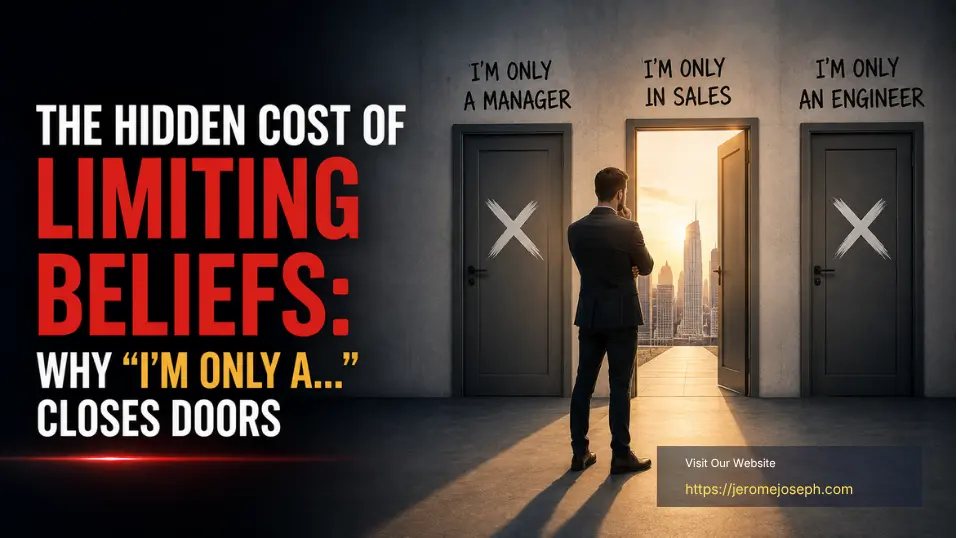
The man at that event could not have felt equal to the CEO on demand. He could have said "I am an insurance agent," without the word only, while still feeling exactly as he did. The sentence is available immediately. The feeling may follow later, or not at all, and the sentence works either way.
8. Why this is a personal branding problem, not only a mindset one
There is an irony in that story which Jerome did not point out at the time, and has regretted since.
The man was in a room specifically to build connections. His profession, more than either of the other two, depends almost entirely on trust developed through relationships. In that particular setting, he arguably had the most to gain and the clearest use for the skill on display.
But he had already decided he was the least interesting person at the table, and so removed himself from the activity that would have served him best.
The connection most professionals miss:
Layer | What it is | What happens if the layer below is broken |
|---|
Reputation | What others say about you when you are not there | Cannot form at all |
Positioning | How the market understands your value | Built on a diminished base |
Self-description | How you introduce yourself and your work | This is where the damage begins |
Belief | What you privately think you are worth | The foundation everything rests on |
How a person describes their work is their personal brand at its most basic level. If that description opens with a diminishment, everything built on top of it inherits the framing. Positioning cannot compensate for a self-description that undercuts itself before it begins.
9. What leaders can do about this in their teams
The individual version of this problem is well documented. The organisational version receives far less attention, and Jerome argues it is where the larger cost sits.
In any team, a portion of people are systematically underselling their own contribution. That has direct consequences:
Good ideas surface late or not at all, because the person holding them assumed they were obvious
Capable people do not put themselves forward for stretch work, and the same three names are considered every time
Client-facing staff undersell the organisation because they undersell themselves
Talent is lost quietly, because someone concluded they were not the sort of person who gets promoted
Three practical interventions:
Ask directly rather than waiting for volunteers. The people most likely to raise their hands are rarely the people with the most to contribute. Naming someone specifically bypasses the belief entirely.
Notice the qualifiers in your own team's language. When someone prefaces an idea with "this is probably obvious," that is useful information about how they see their own standing. It can be addressed without ever discussing beliefs.
Reward the attempt separately from the outcome. If only successful contributions are recognised, the calculation for a cautious person remains unchanged.
10. Who do you want to be?
Jerome ends that talk with a question, and it remains the most useful conclusion available.
Everyone in that room had fears. Fears about their work, about whether they could achieve what they had set out to achieve, about whether they were becoming the person they had hoped to be. That is not unusual and it is not a defect.
What differs between people is not the presence of fear. It is what they do while afraid.
Jerome has met people who overcame considerable obstacles, far greater than embarrassment at a networking event, and reached their goals regardless. They did not manage it by feeling differently. They managed it by acting despite feeling exactly as they felt.
The question is not whether you have limiting beliefs. Everyone does. The question is which set you are going to act from.
About Dr Jerome Joseph
Dr Jerome Joseph is a global keynote speaker, brand strategist and author. He is ranked No. 2 in the world as a Global Brand Thought Leader on the Top 30 Global Gurus list. With more than 30 years of experience, he has worked with over 1,000 brands across 40+ countries and is the author of 12 best-selling books. He is a Hall of Fame speaker and a Certified Speaking Professional (CSP), and works with leaders across Asia and the Middle East on personal branding, leadership and belief.
Frequently Asked Questions
What is a limiting belief?
A limiting belief is a conviction about yourself that restricts what you attempt, typically held without evidence and rarely examined. It presents itself as realism rather than as an opinion, which is what makes it difficult to notice. Common examples include believing you are underqualified, that you do not belong in a particular room, or that your contribution is not worth making.
What is the difference between a limiting belief and a realistic assessment?
A realistic assessment is supported by specific evidence and is open to revision when the evidence changes. A limiting belief is held without evidence, resists contrary information, and tends to apply broadly rather than to a specific situation. A useful test is whether you can state what would need to happen for you to change your mind. If nothing would, it is a belief rather than an assessment.
How do limiting beliefs affect your career?
The main cost is behavioural rather than emotional. A limiting belief removes options before they are consciously considered. Roles are not applied for, introductions are not requested, ideas are not raised in meetings. These do not feel like decisions at the time. They feel like accurate readings of the situation, which is exactly why they are expensive.
How do I identify my own limiting beliefs?
Listen for what you apologise for. Small qualifiers such as "only", "just", or "this is probably obvious, but" are the belief speaking out loud. Pay attention to your own language for a week without trying to correct it. The same qualifier tends to recur, which indicates where the belief sits.
Can limiting beliefs actually be changed?
Yes, though rarely through self-talk alone. Beliefs generally change through evidence, and evidence requires acting before you feel ready. Start with the smallest available version of the action, notice what actually happened rather than what you feared, and change the language you use about yourself before waiting for the feeling to change.
Why are limiting beliefs a personal branding issue?
How you describe your work is your personal brand at its most basic level. If that description begins with a diminishment, everything built on top of it inherits that framing. Positioning and reputation cannot compensate for a self-description that undercuts itself before it begins.
Is a limiting belief the same as imposter syndrome?
They overlap but are not identical. Imposter syndrome specifically involves believing your achievements are undeserved and that you will eventually be exposed. Limiting beliefs are broader and include convictions about capability, belonging and worth that may have nothing to do with achievement. Imposter syndrome can be understood as one particular category of limiting belief.
What can leaders do about limiting beliefs in their teams?
Ask people directly rather than waiting for volunteers, since those most likely to raise their hands are rarely those with the most to contribute. Notice qualifiers in team language, such as prefacing ideas with "this is probably obvious." Recognise the attempt separately from the outcome, because when only successes are acknowledged, cautious people have no reason to change.
How long does it take to change a limiting belief?
There is no fixed timeline, because change depends on accumulated evidence rather than elapsed time. What tends to shift quickly is language, which can change immediately and works regardless of how a person feels. The underlying conviction usually follows over months of repeated contrary experience, provided the person is actually registering that evidence rather than discounting it.