The seven at a glance
Skill | Core question it answers | Most common failure |
|---|
Problem framing | What are we actually solving? | Starting with the tool |
Prompt discipline | How do I get useful output? | Giving up after one weak answer |
Output evaluation | Is this actually correct? | Mistaking fluency for accuracy |
Decision speed calibration | Should this be fast? | Applying tool tempo to irreversible decisions |
AI-assisted communication | Does this still sound like me? | Losing voice entirely |
Workforce transition | What do people need to hear? | Avoiding the question |
Knowing when not to use it | Is this the wrong instrument? | Uniform application |
Do leaders need to learn coding?
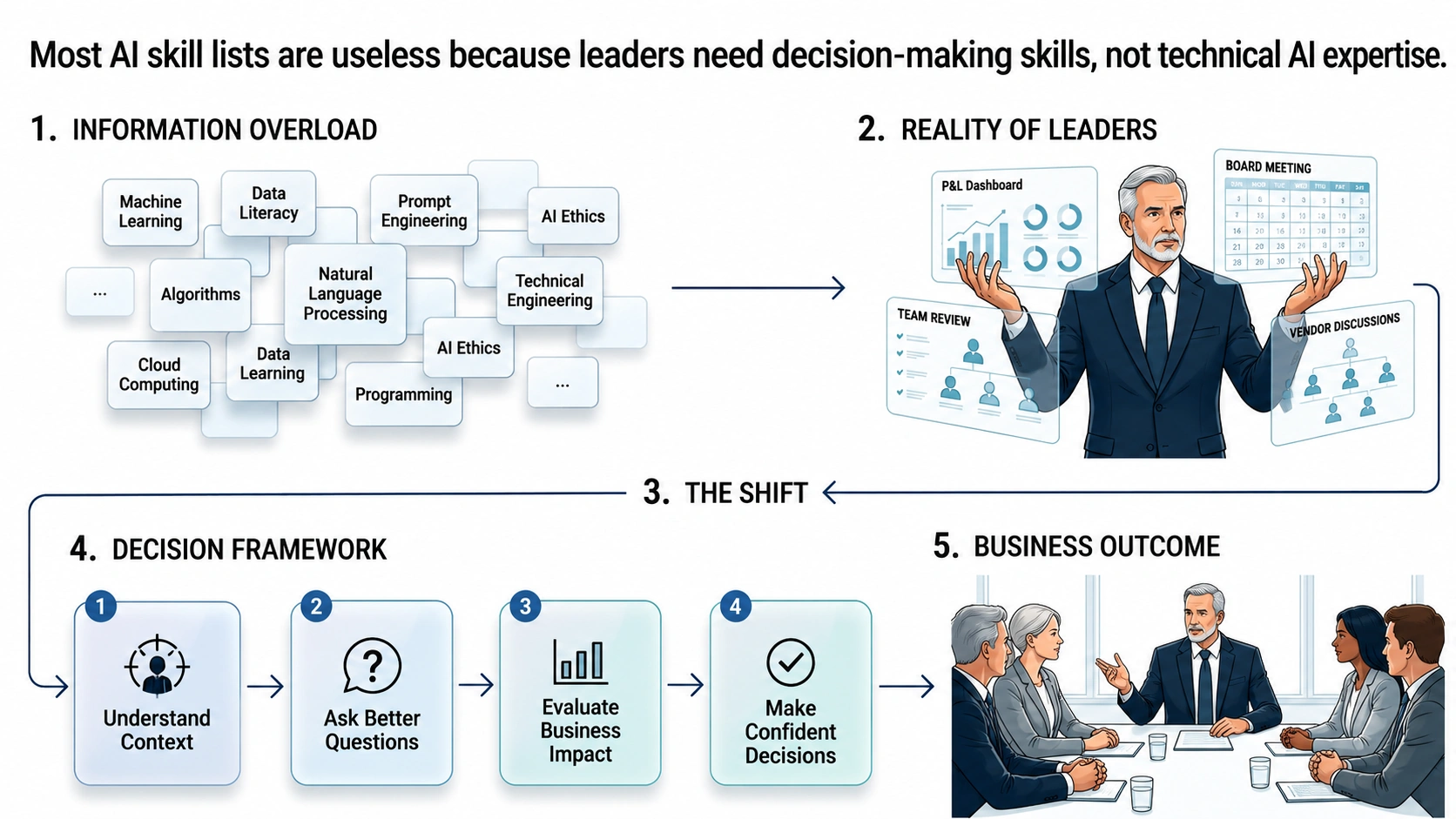
No. This question comes up in almost every session I run and the answer has not changed. Understanding how a system works technically is genuinely useful for the people building it. For a leader making decisions about it, technical depth is a poor substitute for judgement and frequently a distraction from it. I have met leaders with real technical understanding who made poor AI decisions because they were fascinated by capability and never asked what problem they were solving. What is worth developing is enough familiarity to know what the technology can and cannot do, which is a much lower bar and considerably faster to reach through direct use than through a course.
Are AI courses worth the investment?
This depends entirely on the type, and most are not.

Generally not worth it: Courses that teach specific tool interfaces, which are obsolete within a year. Technical courses built for practitioners, which teach the wrong layer. Certification programmes with no applied component, which produce a credential and no capability.
Generally worth it: Programmes built around the participant's actual work, where people bring a real problem and leave having made progress on it. Sessions that include the workforce and communication dimensions rather than treating AI as purely technical. Anything with structured follow up over weeks rather than a single day.
That last point is the one organisations most often skip. A single day builds awareness. Awareness decays. Whether the capability actually forms depends on what happens in the eight weeks afterwards, which is why I draw a firm line between training and coaching in this context as much as in sales.
For organisations building this across a leadership team rather than individually, the structure matters more than the content, and I have written about that in the context of corporate AI training programmes.
Where to start if you are behind
If you read the seven above and recognised gaps, here is the order I would suggest.
Start with skill one, problem framing, because it costs nothing and prevents the most expensive mistakes. Pick a real problem in your function this week and write it down in a sentence with no technology words in it. Then move to skills two and three together, prompt discipline and output evaluation. These require hands-on use and roughly two weeks of consistent daily practice on real work rather than experiments. Twenty minutes a day is sufficient.
Skill six, workforce transition, is the one I would prioritise next if you lead people, because the cost of getting it wrong compounds quietly and is difficult to reverse once trust has gone. The remaining three develop naturally with use, provided you are paying attention.
One closing observation
The leaders I have watched succeed with AI over the last few years have something in common, and it is not enthusiasm or technical aptitude.
They are comfortable saying they do not know. In a vendor meeting they will ask what sounds like a basic question rather than nodding through it. In a project review they will ask someone to explain the number rather than accepting it. That willingness to look uninformed in the short term is, as far as I can tell, the single strongest predictor of getting this right. It is also the hardest thing to ask of senior people, who have generally been rewarded for the opposite for their entire careers. None of the seven skills above are difficult. That one disposition underneath them is.
About Dr Jerome Joseph
Dr Jerome Joseph is a global keynote speaker, brand strategist and author. He is ranked No. 2 in the world as a Global Brand Thought Leader on the Top 30 Global Gurus list. With more than 30 years of experience, he has worked with over 1,000 brands across 40+ countries and is the author of 12 best-selling books. He is a Hall of Fame speaker and a Certified Speaking Professional (CSP), and works with leadership teams across Asia and the Middle East on AI adoption, branding and capability building.
Frequently Asked Questions
What AI skills do leaders need in 2026?
Leaders need seven capabilities: problem framing, prompt discipline, output evaluation, decision speed calibration, AI-assisted communication, workforce transition management, and knowing when not to use AI. None of these are technical skills. They are judgement capabilities applied to a new category of tool.
Do business leaders need to learn coding to use AI effectively?
No. Technical depth is useful for people building AI systems, not for leaders making decisions about them. What leaders need is enough familiarity to understand what the technology can and cannot do, which is reached faster through direct hands-on use than through technical courses.
Which AI skill should a leader develop first?
Problem framing. It costs nothing to practise and prevents the most expensive mistakes. Most failed AI initiatives begin with a technology and search backwards for a problem, rather than beginning with a clearly stated business problem.
Why do senior leaders often fail at AI adoption despite investment?
The most common cause is delegation. Leaders who treat AI as a technology function's responsibility and never personally use the tools cannot evaluate what they are being told. This removes judgement at exactly the point where it is most needed.
Are AI courses worth it for business leaders?
Only when built around the participant's actual work with structured follow up over weeks. Courses teaching specific tool interfaces become obsolete quickly, and technical courses designed for practitioners address the wrong layer. A single day builds awareness, which decays without reinforcement.
How should a leader handle team concerns about AI and job security?
Address the question directly rather than waiting for it to be raised. Be honest about what is uncertain while being specific about the next six months. Avoiding the topic is itself a form of communication, and people generally fill the silence with the worst available interpretation.
What is the biggest risk when leaders use AI output?
Mistaking fluency for accuracy. AI systems produce confident, well-structured output regardless of whether the underlying content is correct. Leaders who forward polished output without verification because it reads well create the most preventable form of AI risk.
When should a leader avoid using AI?
In conversations requiring genuine presence, decisions dependent on relationships and context the system cannot access, and situations where the process of thinking something through personally is the point. Applying the tool uniformly because it is available produces worse outcomes in these categories.