Leadership

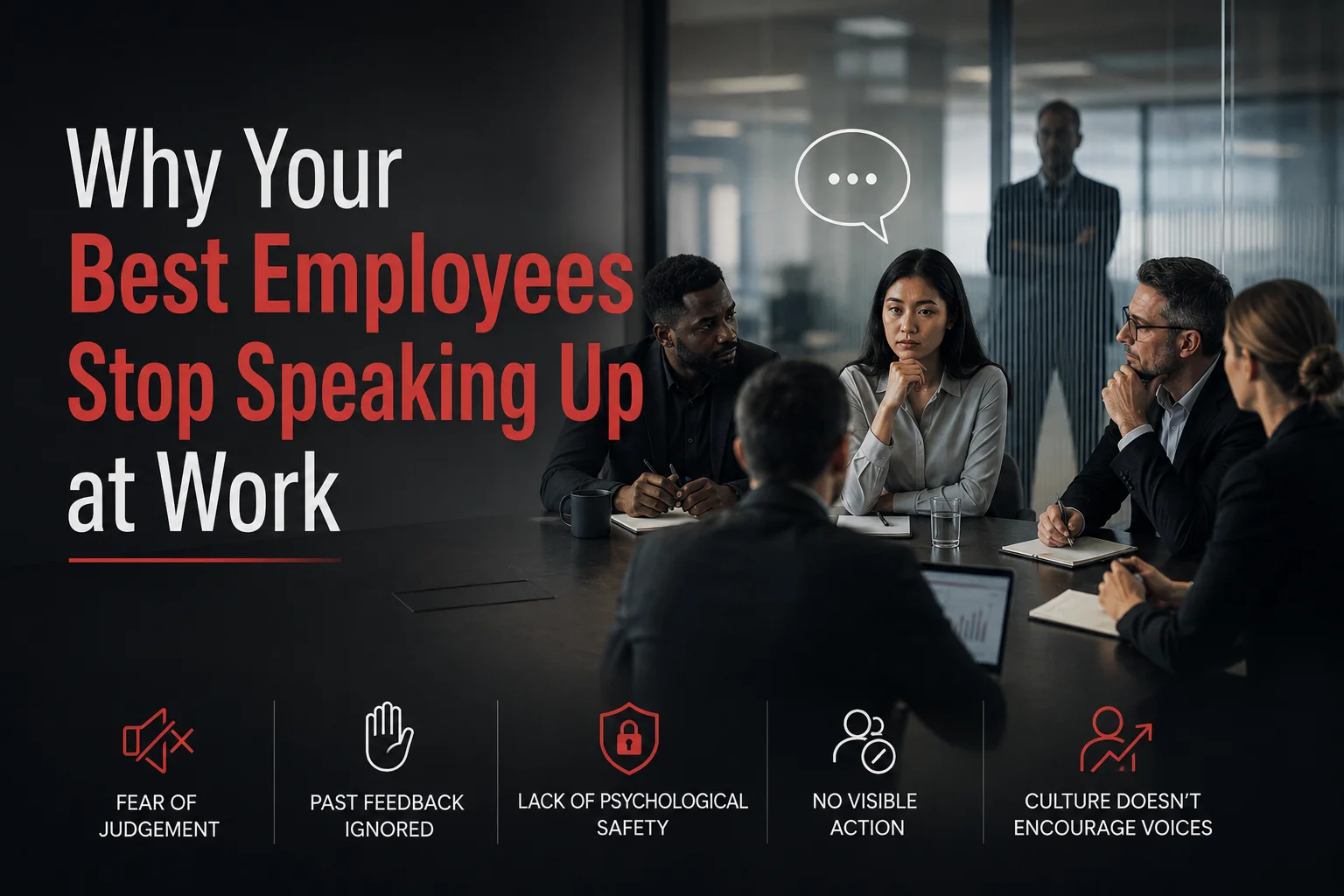
Why Your Best Employees Stop Speaking Up at Work

Published on August 25, 2026By Team Dr. Jerome Joseph
Why Your Best Employees Stop Speaking Up at Work

There is a warning sign that many leaders miss because it does not appear on a dashboard.

Your best employees stop speaking up.

They stop challenging ideas in meetings. They stop pointing out problems. They stop suggesting improvements. They stop telling leaders when a process is not working. The employee may still attend meetings, complete assignments and meet deadlines, so from the outside, everything can appear normal.

But something important has changed. The organisation has lost access to what that employee really thinks.

Silence at work does not always mean agreement. Sometimes it means employees have stopped believing that speaking up will make a difference.

For leaders, this is a serious issue. High-performing employees are often closest to customers, processes, teams and operational problems. They may see risks and opportunities long before those issues appear in reports. When those employees become silent, the organisation does not simply lose ideas. It can lose early warnings, honest feedback and valuable business intelligence.

Your Best Employees Often See Problems First

High-performing employees are usually close to the work. They see customer frustrations, inefficient processes, team challenges and operational gaps that senior leaders may not see from their position. That makes their perspective extremely valuable. They can identify a problem before it becomes expensive, suggest an improvement before competitors discover it and warn leaders about risks before those risks become visible in performance numbers.

But there is a condition.

They need to believe that speaking up is worth it. If employees repeatedly raise concerns and nothing changes, they eventually learn a lesson. Their problem is not necessarily that leadership disagrees with them. The problem is that they stop seeing a reason to keep contributing.

That is when employee silence becomes dangerous.

Employees Remember What Happens When Someone Speaks Up

Employees pay attention to consequences. Imagine someone challenges a senior leader during a meeting. The leader becomes defensive, dismisses the idea and quickly moves to the next topic. The employee may not challenge that leader again.

Now imagine another employee raises a serious operational problem and suddenly becomes responsible for fixing it without additional authority or support. Other employees notice that too. One person's experience can become an unwritten lesson for everyone else.

If employees see that disagreement creates negative consequences, they will naturally become more careful about what they say. Over time, the organisation may develop a culture where people agree publicly and discuss their real concerns privately.

That is not alignment.

It is silence.

An Open-Door Policy Is Not Enough

Many leaders genuinely believe they encourage open communication. They tell employees that their door is always open and that honest feedback is welcome. But employees judge openness by behaviour, not statements. If a leader becomes defensive when challenged, an open-door policy means very little. If difficult feedback is ignored, employees learn that speaking up is pointless. If people who disagree are labelled negative or difficult, others learn to keep their opinions to themselves.

A culture of openness cannot simply be announced.

It has to be experienced.

Build Leaders Who Create Stronger, More Open Teams

Why Good Employees Become Quiet

There is rarely one reason why employees stop speaking up. Usually, silence develops through a series of experiences that gradually change how employees view communication with leadership. One common reason is that employees feel ignored. They may raise the same issue several times without seeing any meaningful action. Eventually, the problem may still exist, but the employee's motivation to keep raising it disappears.

Another reason is the fear of disagreement. Employees do not necessarily need to experience formal punishment to become quiet. Being excluded from important conversations, being labelled difficult or simply feeling uncomfortable after challenging a decision can be enough to change future behaviour.

Some employees also become silent because identifying problems creates additional responsibility. If the person who points out every problem automatically becomes responsible for solving it, employees may eventually decide that staying quiet is easier.

The most serious stage comes when employees stop believing that anything will change. At that point, they are not simply quiet. They have stopped expecting their voice to matter.

5. Silence Can Look Like Alignment

One of the biggest leadership mistakes is confusing silence with agreement. A quiet meeting can look successful. Nobody argues. Nobody challenges the strategy. Everyone appears to be aligned. But what if employees are simply waiting for the meeting to end?

What if they disagree but do not believe disagreement is welcome? What if they have already discussed their concerns privately with colleagues? Leaders can easily mistake a lack of visible resistance for genuine commitment.

Strong teams do not necessarily have fewer disagreements. They have better disagreements. People can challenge assumptions, raise concerns and propose alternatives without turning every difference of opinion into a personal conflict.

The goal is not to make everyone agree. The goal is to make sure important perspectives are heard before important decisions are made.

6. High Performers Do Not Always Leave First

When organisations talk about losing high performers, they usually focus on resignation. But disengagement can begin much earlier.

An employee may remain with the company while emotionally stepping back from it. They stop volunteering ideas, stop mentoring others and stop challenging poor decisions. They continue doing their assigned work, but they no longer contribute beyond what is required. That employee may still appear productive. But the organisation has lost something valuable.

It has lost discretionary contribution. This is why leaders should pay attention to changes in behaviour, not only turnover. If an employee who once challenged assumptions suddenly agrees with everything, that does not necessarily mean they have become more satisfied.

They may simply have become more cautious.

7. The Communication Problem May Actually Be a Leadership Problem

Organisations often respond to communication problems by introducing another communication workshop. Training can certainly help employees communicate more effectively. But sometimes the real problem sits higher in the organisation.

If leaders do not listen, better presentation skills will not solve the problem. If managers punish disagreement, another feedback form will not create openness. If employees do not trust that concerns will be handled fairly, collecting more feedback will not automatically change behaviour. Communication is not only about speaking.

It is also about what happens when someone speaks. This is why strong leadership and communication have to work together. Leaders need to create the conditions where people can communicate clearly, challenge assumptions and raise difficult issues without feeling that they are putting their position at risk.

8. Leaders Need to Make Disagreement Useful

The goal should not be to create a workplace where everyone feels comfortable all the time. Comfort and constructive challenge are not the same thing.

A healthy team should be able to say, "I think this strategy has a problem," or "Our customers are telling us something different." Employees should be able to question unrealistic deadlines, inefficient processes and assumptions that may no longer be valid. These statements are not signs of disloyalty.

They can be signs that employees care enough about the organisation to challenge it. The leader's responsibility is not to eliminate disagreement. It is to make constructive disagreement useful.

Strengthen Communication, Culture and Leadership

How Leaders Can Get Employees Speaking Again

Creating a culture where employees speak openly does not require complicated systems. It starts with everyday leadership behaviour.

First, leaders should actively ask for different perspectives. Instead of asking, "Does everyone agree?" they can ask, "What are we missing?" That simple change gives employees permission to identify weaknesses rather than simply confirm the leader's position.

Second, leaders should recognise valuable contributions, including the contributions that identify problems. If employees see that preventing problems receives less recognition than fixing them later, they may eventually stop raising concerns.

Third, leaders should avoid immediately defending every decision. When someone challenges an idea, asking, "Tell me more about why you see it that way," can create a much better conversation than immediately explaining why the employee is wrong.

Fourth, leaders need to close the feedback loop. If employees raise an issue, they should know what happened next. Even when the organisation cannot implement a suggestion, explaining the reasoning shows that the contribution was taken seriously.

Finally, leaders need to create room for thoughtful mistakes. Employees will not offer original ideas if every imperfect suggestion is treated as incompetence. Innovation, leadership and problem-solving all require people to contribute before they have complete certainty.

Internal Culture Shapes Employee Voice

Employee voice is closely connected to organisational culture. When employees understand what the organisation stands for, they have a stronger framework for making decisions and challenging behaviours that conflict with those values. This is where internal branding becomes important. A strong internal brand connects the organisation's promise with employee behaviour, leadership expectations and everyday workplace culture.

Employees should understand not only what the company wants customers to believe, but also what the organisation expects its people to demonstrate. When that connection is strong, employees can challenge decisions from a shared understanding of the company's purpose rather than simply expressing personal preferences.

The Five-Question Employee Voice Test

Leaders can use five simple questions to understand whether employees genuinely feel able to speak up.

Question

What It Reveals

Do employees challenge senior leaders?

Whether disagreement feels safe

Are bad-news conversations encouraged?

Whether leaders want reality or reassurance

What happens after someone raises a concern?

Whether feedback leads to action

Do managers value honest disagreement?

Whether leadership behaviour supports openness

Have high performers become noticeably quieter?

Whether disengagement may already be developing

If the answers raise concerns, leaders should avoid immediately blaming employees for being disengaged. The better question is:

What have we done that taught people to stay quiet?

That question moves the conversation from blame to leadership responsibility.

The Real Cost of Employee Silence

When employees stop speaking up, organisations lose more than ideas. They can lose early warnings.

A frontline employee may know about a customer problem before the executive team sees the numbers. A manager may know that a process is failing before the performance report identifies it. A team member may recognise a cultural problem before an employee survey reveals it. Silence delays access to that information.

That makes employee voice more than an HR topic. It is a business intelligence issue. Leaders who hear difficult information early have more time to respond. Leaders who hear it only after the problem becomes visible may already be dealing with the consequences.

What Strong Leaders Understand

Strong leaders do not need employees who agree with them all the time. They need employees who are willing to tell them when they are wrong. They need people who will challenge an unrealistic deadline, question an inefficient process, identify a customer problem and raise a risk before it becomes a crisis.

That requires trust, but it also requires humility. A leader who can say, "I had not considered that," sends a powerful signal. So does a leader who changes a decision because an employee presented better information.

Employees learn from these moments. They learn whether their voice matters.

The Bigger Leadership Lesson

Your best employees may not always announce that they are disengaged. They may simply become quieter. The person who once challenged ideas stops doing so. The employee who always offered suggestions starts saying, "Whatever you think." The team member who used to warn leaders about problems stops bringing them up.

These are not necessarily signs that everything is fine. They may be signs that employees have learned to protect their energy, reputation or career by staying silent.

A leader should never be satisfied because nobody is challenging the plan. Sometimes silence means the team has stopped believing its voice matters.

The strongest organisations create cultures where employees can disagree without being dismissed, raise concerns without being punished and contribute ideas without worrying about how leadership will react. Because when employees speak honestly, leaders hear reality sooner.

And when leaders hear reality sooner, they can make better decisions. That is the real value of employee voice.

It is not about making everyone feel heard. It is about making sure the organisation can still hear what it needs to know.

6 FAQs

1. Why do good employees stop speaking up at work?

Employees may stop speaking up when their ideas are repeatedly ignored, disagreement is discouraged, concerns create additional responsibility or they no longer believe their feedback will lead to meaningful change.

2. Is employee silence always a sign of agreement?

No. Silence can mean agreement, but it can also indicate disengagement, uncertainty, frustration or a belief that speaking up will not make a difference.

3. How can leaders encourage employees to speak up?

Leaders can encourage employee voice by actively asking for different perspectives, listening without becoming defensive, recognising constructive feedback and closing the loop after employees raise concerns.

4. Why is psychological safety important for employee communication?

Psychological safety helps employees feel more comfortable raising concerns, challenging ideas and contributing suggestions without unnecessary fear of negative consequences.

5. How does leadership affect employee communication?

Leadership behaviour strongly influences whether employees feel comfortable communicating honestly. Leaders who listen, respond constructively and demonstrate openness make it easier for employees to share important information.

6. Why should business leaders care about employee silence?

Employee silence can prevent leaders from receiving early warnings about customer problems, operational risks, cultural issues and inefficient processes. Strong employee voice helps organisations identify problems and opportunities earlier.