Leadership

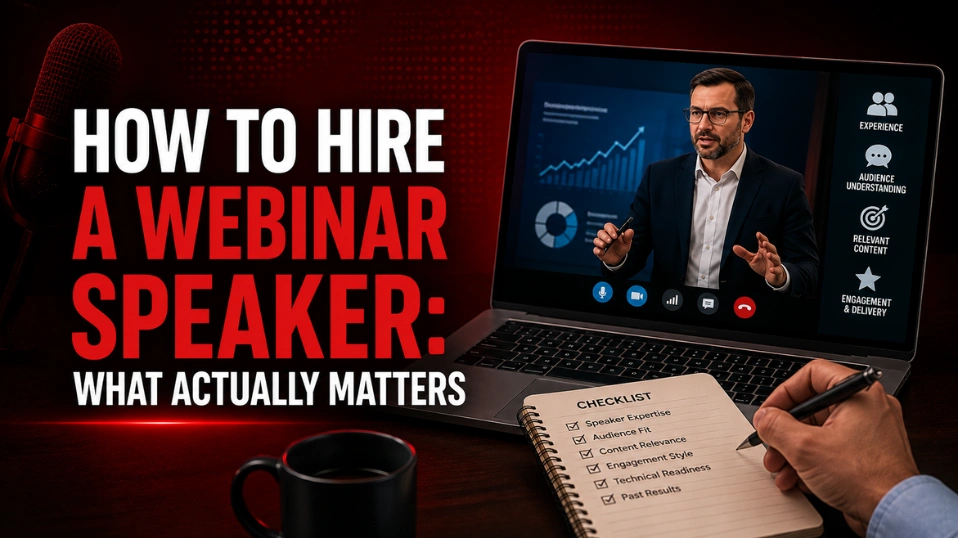
How to Hire a Webinar Speaker: What Actually Matters

Published on August 10, 2026By Team Dr. Jerome Joseph
How to Hire a Webinar Speaker: What Actually Matters

To hire a webinar speaker, define whether the session is lead generation or education, look for someone with demonstrable virtual delivery experience rather than stage credentials alone, brief them on your drop-off point, agree who handles the Q&A, and budget between 40 and 70% of the same speaker's in-person keynote fee.

Now the detail, because the most common mistake here is treating a webinar as a keynote delivered through a laptop. It is not the same job, and the people who are excellent at one are not automatically good at the other.

I have spent more than 30 years working with over 1,000 brands across 40+ countries, and I have delivered both formats often enough to say plainly that virtual sessions demand a different skill set. Some of the finest stage speakers I know are mediocre on a webinar. A few people who are unremarkable in a ballroom are outstanding on screen.

If you are hiring, understanding why that is true will save you a great deal of money.

1. What is a webinar speaker?

A webinar speaker delivers a presentation to a remote audience over a video platform, typically for 30 to 60 minutes, usually with a Q&A component and often as part of a marketing or learning programme rather than a standalone event.

That definition sounds unremarkable. The important part is what it implies.

A webinar audience has not travelled anywhere. They have not blocked out a day, booked a flight, or told their manager they will be unreachable. They are sitting at their desk with email open, a meeting in forty minutes, and a browser tab that closes with one click.

This single fact changes everything about what makes a speaker effective in the format.

At a conference, the audience is committed by circumstance. They will stay for a slow opening because leaving is socially awkward and there is nowhere else to be. In a webinar, there is no social cost to leaving and there is always somewhere else to be.

A webinar speaker therefore has to earn attention continuously rather than once. That is a genuinely different discipline from stagecraft.

2. How is a webinar speaker different from a keynote speaker?

The roles overlap but the skills required diverge in specific ways.

Dimension

Conference keynote

Webinar

Audience commitment

High, they travelled

Low, one click to leave

Typical length

45 to 60 minutes

30 to 45 minutes

Energy source

The room feeds the speaker

The speaker generates it alone

Feedback available

Faces, posture, laughter

A participant count and a chat box

Opening tolerance

Two to three minutes

Under sixty seconds

What carries it

Presence and storytelling

Pace, specificity and structure

Q&A

Optional, often rushed

Central, frequently the best part

Look at the energy row in particular. On stage, a good speaker reads the room and the room reads back. That exchange is most of what makes live speaking work.

In a webinar, the speaker is talking into a camera in an empty room, receiving almost no signal. Some experienced stage speakers find this genuinely difficult and their delivery flattens without them realising. Others adapt easily. There is no way to predict which from a conference showreel, which is why the showreel is close to useless as an evaluation tool here.

If you are choosing between formats for an upcoming event, I have written separately about the difference between a keynote speaker and a guest speaker, which covers a related but distinct decision.
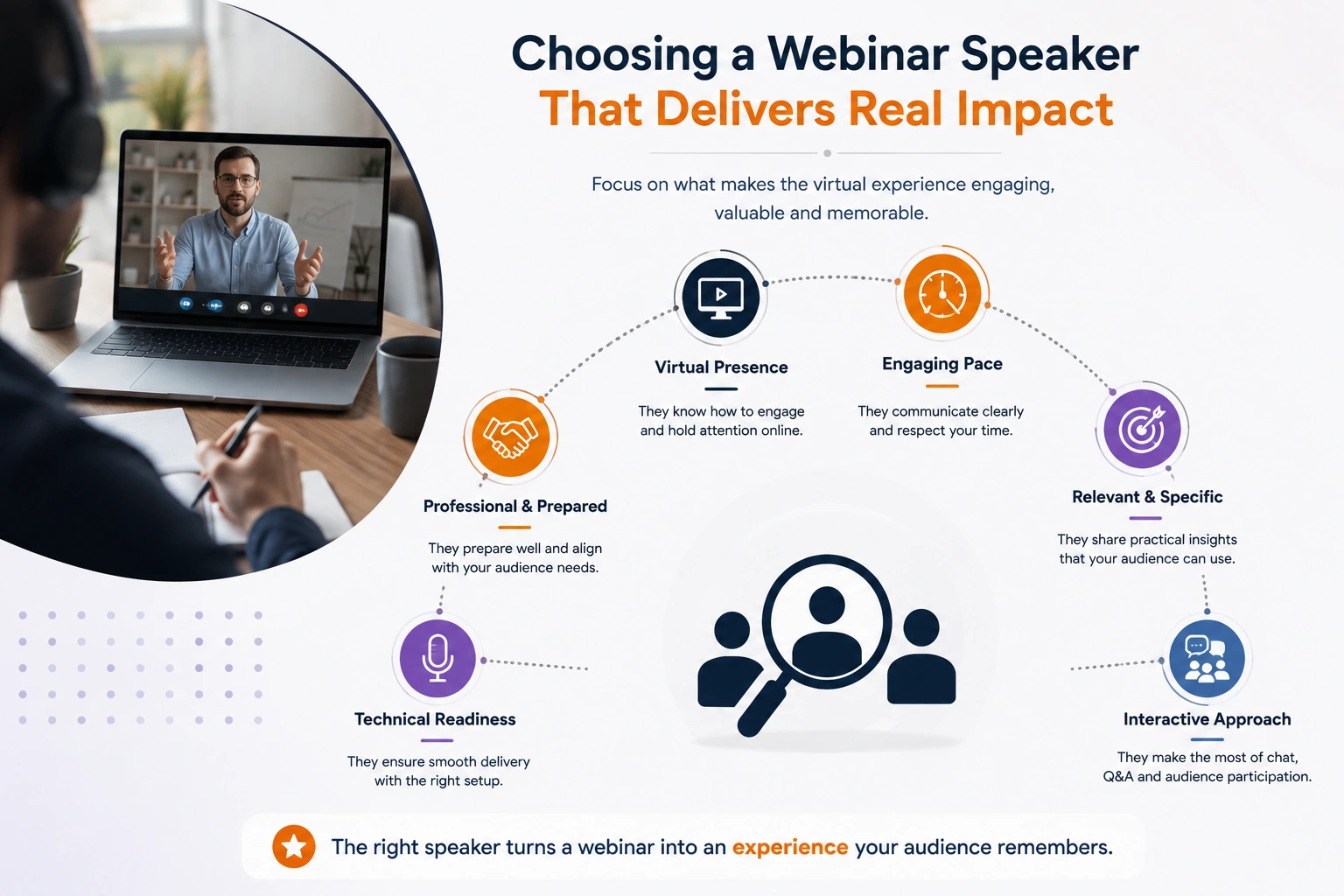
3. What should you look for when hiring a webinar speaker?

Six things, in rough order of importance.

Choosing a Webinar Speaker for Impact

Demonstrable virtual delivery experience. Not a claim that they do virtual sessions. Ask how many they delivered last year and request a recording of one, not a stage clip. A speaker who cannot produce a webinar recording has probably not done many.

Pace discipline. Watch that recording with a stopwatch mentality. How long before the first substantive point arrives? In a webinar, anything over sixty seconds of throat clearing loses a portion of the audience permanently. The good ones start with something useful and introduce themselves afterwards, if at all.

Specificity. Virtual audiences punish abstraction far more harshly than live ones, because generalities are the easiest thing in the world to half-listen to while checking email. Look for a speaker whose examples are concrete, named and numbered.

Comfort with the chat. Some speakers ignore the chat entirely and lose the interactive advantage of the format. Others get derailed by it. The ones worth hiring acknowledge it naturally and weave questions in without losing structure.

Technical competence. Sound quality matters more than video quality and both matter more than most people assume. A speaker with a poor microphone will exhaust your audience within ten minutes regardless of content quality. Ask what they use.

Willingness to be briefed. A speaker who accepts a webinar booking without asking about your audience, your drop-off pattern, or what happens after the session is planning to deliver something generic.

4. What questions should you ask before booking?

Five that separate serious candidates quickly.

How many virtual sessions did you deliver in the past twelve months? The answer tells you whether this is a real capability or a pandemic-era leftover on their website.

Can I see a recording of a full webinar, not a highlight reel? Highlight reels hide pace problems. A full recording does not.

What is your first minute? A speaker who has thought about the format will have a clear answer. One who has not will describe their introduction.

How do you handle Q&A? You are looking for someone who treats it as part of the session rather than an afterthought. In my experience the Q&A is frequently the most valuable segment of a webinar, and the speakers who plan for it get much better outcomes.

What do you need from us? Good answers include audience context, prior session data, a run-through, and clarity on who moderates. No answer is a warning.

5. How much does a webinar speaker cost?

Fees vary enormously by market, profile and format, so treat what follows as a structural guide rather than a price list.

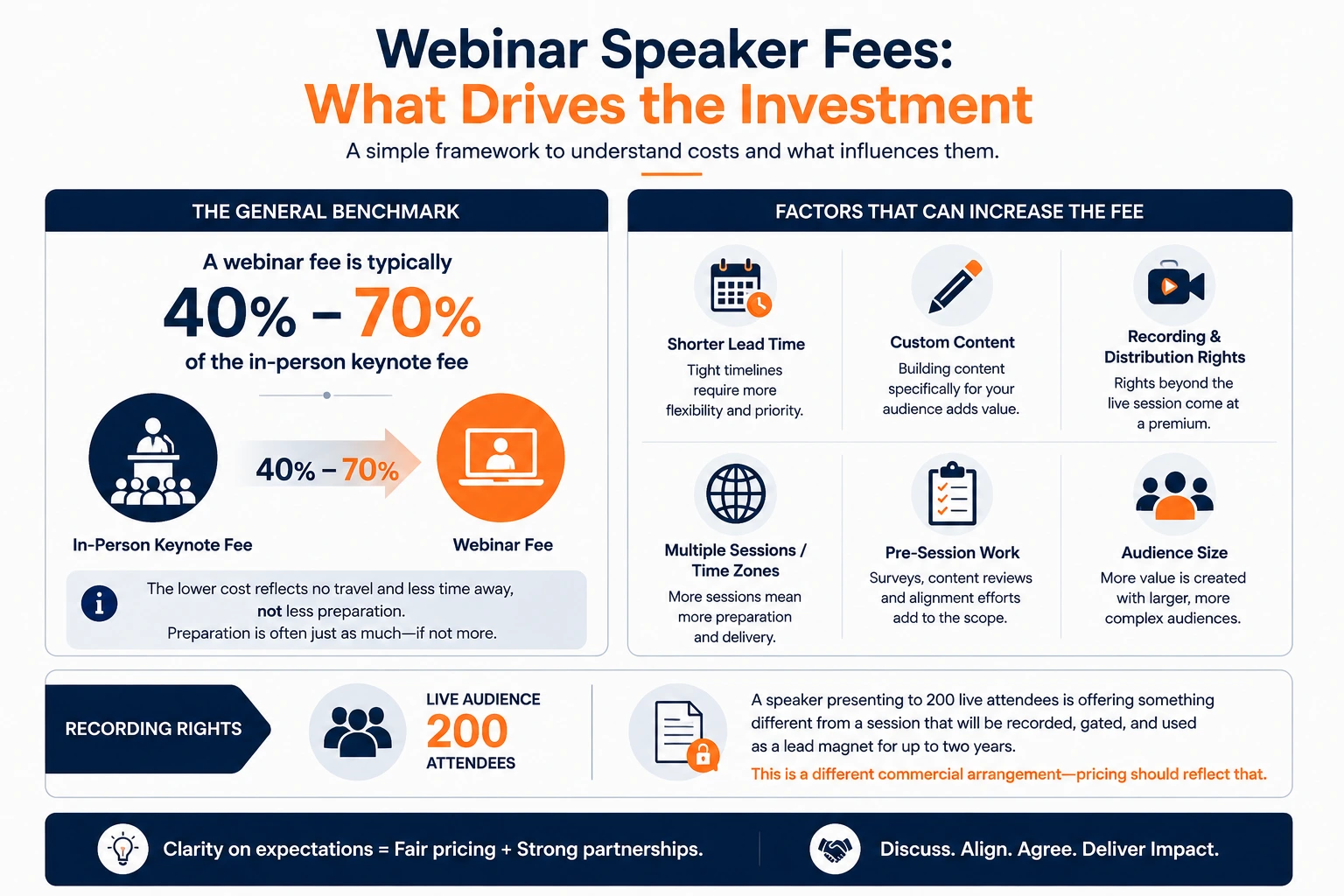
Webinar Speaker Fees

As a general pattern, a speaker's webinar fee sits somewhere between 40 and 70 percent of their in-person keynote fee for a comparable audience. The reduction reflects the absence of travel and time away rather than a reduction in preparation, which is often similar or greater.

Factors that move the number upward include a shorter lead time, a request for custom content built specifically for your audience, recording and distribution rights beyond the live session, multiple sessions across time zones, and any pre-session work such as a survey or content review.

Recording rights in particular are worth clarifying early. A speaker delivering to 200 live attendees is agreeing to something different from a speaker whose session will be gated and used as a lead magnet for two years. Neither is unreasonable. They are simply different commercial arrangements, and disputes here usually stem from the topic never being raised.

6. What are the most common webinar hiring mistakes?

Four that I see repeatedly.

Hiring on stage reputation alone. The most common and most expensive. A speaker's conference reputation tells you very little about their virtual capability. Evaluate the format you are actually buying.

Briefing on topic instead of audience. Telling a speaker the subject is not a brief. What they need is who is attending, what those people already know, why they registered, and what typically causes them to leave.

Ignoring your own data. If you have run webinars before, you know your average attendance duration and roughly where people drop off. That information is genuinely valuable to a speaker and almost nobody shares it. If your audience typically leaves at the eighteen minute mark, a good speaker will restructure around it.

Treating the session as the deliverable. A webinar that generates 300 registrations and no follow up has produced a list, not an outcome. The decision about what happens afterwards should be made before you book, because it changes what the session should do. Sessions designed to open a conversation are built differently from sessions designed to close one.

7. Lead generation or education: which webinar are you running?

This is the question that determines almost everything else, and it is frequently left unanswered because the honest answer is that organisations want both.

A lead generation webinar exists to attract prospects and create a reason to speak with them afterwards. The audience is largely unfamiliar with you. Attendance is broad and shallow. Success is measured in qualified conversations.

An education webinar exists to develop capability in an audience that already knows you, usually customers or internal staff. Success is measured in whether behaviour changed.

These require different speakers, different structures and different definitions of a good session.

The lead generation format needs breadth, a compelling frame, and a reason to continue the conversation. Going too deep loses an audience that has not yet decided you are worth their attention.

The education format needs depth and application. Staying at the level of interesting overview wastes the time of people who already agreed you are credible.

Where organisations run into trouble is briefing a speaker for one and measuring them against the other. If you tell a speaker to generate interest and then judge the session on whether attendees learned a practical skill, you have set a test nobody could pass.

Decide which one you are running before you write the brief. If you genuinely need both, run two sessions.

8. How far in advance should you book?

For a named external speaker, six to eight weeks is comfortable. Four weeks is workable. Under two weeks usually means either accepting an off-the-shelf session or paying a premium for the disruption.

The lead time matters less for the speaker's calendar than for the promotion window. Most webinar registration happens in the final ten days before the event, but the audience needs to have heard about it before then. A speaker booked three weeks out leaves very little room for that sequence to work.

If the session requires custom content, add two weeks. Good customisation involves the speaker actually understanding your audience, which takes a conversation, some reading, and time to think rather than a form.

9. What makes a webinar actually work?

After delivering a considerable number of these, my honest view is that the single biggest factor is not the speaker at all. It is whether anyone decided what the session was for.

The webinars that work have a clear answer to one question: what should be different for the attendee after this hour? Not what will they have heard, what will be different.

Everything else follows from that. The structure, the depth, the examples, the call to action, the follow up sequence. When that question has been answered, briefing a speaker is straightforward and evaluating candidates is straightforward.

When it has not been answered, no speaker can rescue it. They will deliver something competent and the session will feel like it went fine and nothing will happen afterwards, which is the fate of most webinars.

That is a planning problem rather than a talent problem, and it is entirely fixable before you start looking at speakers. If your event is part of a broader capability programme rather than a standalone session, the same logic applies at a larger scale, which I have covered in the context of corporate training programmes and in a practical guide to hiring an AI speaker for events.

About Dr Jerome Joseph

Dr Jerome Joseph is a global keynote speaker, brand strategist and author. He is ranked #2 in the world as a Global Brand Thought Leader on the Top 30 Global Gurus list. With more than 30 years of experience, he has worked with over 1,000 brands across 40+ countries and is the author of 12 best-selling books. He is a Hall of Fame speaker and a Certified Speaking Professional (CSP), and delivers both in-person and virtual sessions for organisations across Asia and the Middle East.

Frequently Asked Questions

How do you hire a webinar speaker?

Define whether the session is for lead generation or education, shortlist speakers with demonstrable virtual delivery experience, request a full webinar recording rather than a stage showreel, brief them on your audience and typical drop-off point, agree recording rights in advance, and confirm who moderates the Q&A.

How much does a webinar speaker cost?

A webinar fee typically sits between 40 and 70% of the same speaker's in-person keynote fee for a comparable audience. The reduction reflects the absence of travel rather than reduced preparation. Custom content, recording rights, short lead times and multiple time zone sessions all increase the fee.

Is a webinar speaker the same as a keynote speaker?

No. The roles overlap but require different skills. A conference audience is committed by circumstance, while a webinar audience can leave with one click and no social cost. Webinar delivery depends more on pace, specificity and structure, and less on stage presence. Many strong stage speakers are less effective virtually.

How long should a webinar be?

Thirty to forty five minutes of presentation with fifteen minutes of Q&A works for most business audiences. Sessions beyond an hour see significant drop-off regardless of content quality, because attendees are at their desks with competing demands rather than in a dedicated event environment.

What should be in a webinar speaker brief?

Who is attending and at what level, what they already know about the subject, why they registered, your typical attendance duration and drop-off point, what happens after the session, and whether leadership is aligned on the topic. Most briefs describe only the topic, which is the least useful information.

How far in advance should a webinar speaker be booked?

Six to eight weeks is comfortable, four weeks is workable, and under two weeks usually means accepting standard content or paying a premium. Add two weeks if custom content is required. The constraint is usually the promotion window rather than the speaker's availability.

What is the most common mistake when hiring a webinar speaker?

Hiring on stage reputation alone. A speaker's conference standing indicates very little about their virtual capability, and a highlight reel from a live event hides the pace problems that cause webinar audiences to leave. Always request a full recording of a virtual session.

Should the webinar be recorded and reused?

That depends on the commercial agreement. A speaker delivering to a live audience is agreeing to something different from one whose session will be gated and used as a lead magnet for years. Raise recording and distribution rights during the initial conversation rather than after the session.

CARA AI - Talk to Dr. Jerome Joseph AI Assistant
CARA AI