Brand Strategy

What Makes a Great Branding Speaker, and How to Choose One for Your Event

Published on August 03, 2026By Team Dr. Jerome Joseph
What Makes a Great Branding Speaker, and How to Choose One for Your Event

The booking decision that quietly decides your event's outcome

In my 30 years of working with more than 1,000 brands across 40 countries, I have been in the room both as the speaker and as the consultant who arrives six months later to clean up. And there is a pattern I keep seeing. The organisation held a big annual conference, brought in someone charismatic to talk about brand, and the feedback scores were excellent. Then nothing moved. No behaviour changed. No decision got made differently. The brand looked exactly the same in Q4 as it did in Q1.

The problem was almost never the speaker's energy. It was the fit. Somebody booked a motivational act when what the business needed was a branding speaker with operating experience.

Those two things get confused constantly, and I understand why. Both stand on the same stage, hold the same microphone, and get the same applause. But they are solving different problems. A motivational speaker is hired to change how a room feels. A branding speaker is hired to change how a room thinks about the business it works in. Feeling fades by the weekend. Thinking, if it is structured well, survives.

What a branding speaker actually does on stage

Let me be specific about the job, because vague definitions are how bad bookings happen.

360_F_1362120938_nS8Rybaa1Wmz3TtRzJYiJwco2QWPVMsy

A branding speaker takes the abstract idea of "brand" and makes it operational for the specific people sitting in front of them. That means translating brand from a marketing department concern into something a finance manager, a customer service lead, and a regional sales head can each act on the following week.

The work usually covers four territories. First, brand strategy, which is the set of choices about who you are for and what you refuse to be. Second, brand experience, which is what customers actually encounter versus what your positioning statement claims. Third, internal branding and culture, which is whether your people behave in a way that matches the promise, an area I have written about at length on my internal branding speaker page. Fourth, personal branding for leaders, because in most organisations the leadership team is the brand's most visible and least managed asset.

A speaker who can only do one of those four is a specialist, and that is fine if your event has one narrow objective. A speaker who claims all four but cannot give you a client example for each is a generalist wearing a specialist's jacket.

Why the motivational route disappoints so often

The uncomfortable truth is that a general inspiration session is easier to book and easier to enjoy. Nobody argues with it. Nobody feels exposed. The scores come back high.

d4e49639-7fee-4c44-8953-304903fd7ff4

But brand work is uncomfortable by design. If a branding speaker does the job properly, at least a few senior people in the room should leave slightly unsettled, because they have just realised that the gap between what the brand promises and what the organisation delivers is wider than they assumed. That discomfort is the product. It is what creates the follow-up meeting.

I have covered the structural difference between speaker types before in a piece on the difference between a keynote speaker and a guest speaker, and the same principle applies here. The label matters less than the outcome you are buying. Decide the outcome first, then find the speaker who has evidence of producing it.

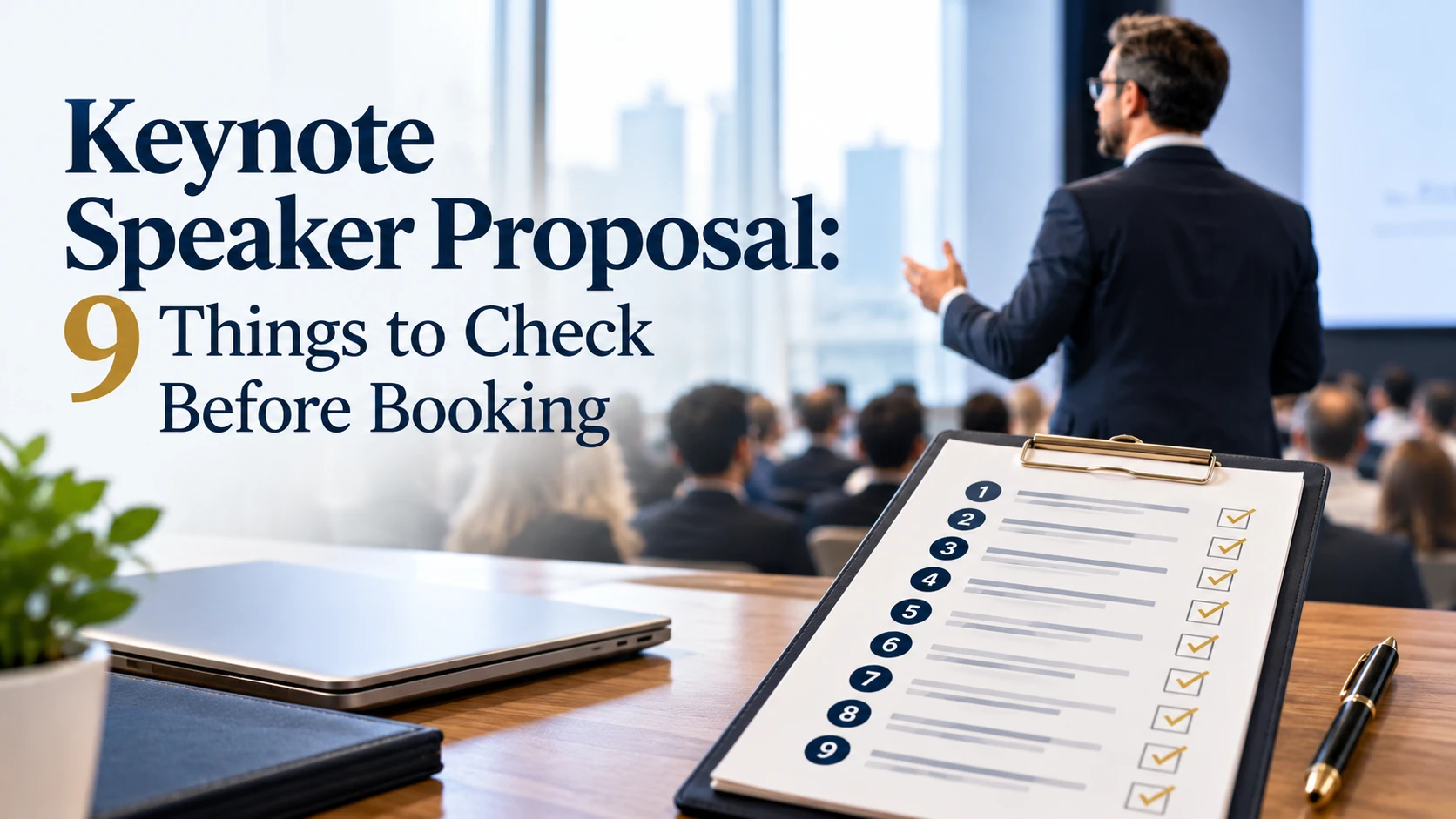
Seven things to evaluate before you book a branding speaker

Here is the sequence I would use if I were sitting on the other side of the table, evaluating someone like me.

1. Operating experience, not just observation

Ask whether the speaker has ever owned a brand outcome with money and consequences attached. There is a real difference between someone who has studied brands and someone who has run one, been accountable for the numbers, and had to defend the strategy to a board. I ran a publicly listed brand agency as CEO before I did this full time, and almost every useful story I tell on stage comes from that period, not from reading.

Question to ask: "Tell me about a brand decision you personally made that failed, and what it cost."

A speaker with real operating history answers this in about twelve seconds. A speaker without one deflects into theory.

2. A named framework they can actually explain

Good branding speakers travel with frameworks, not just anecdotes. A framework is what your team uses on Tuesday when the speaker has gone home. Anecdotes are entertainment.

Ask them to walk you through their core model in three minutes on the call. If it cannot survive a three minute explanation without slides, it will not survive contact with your organisation. My own body of work sits across 12 best-selling books on branding, and every keynote I deliver maps back to a structure someone can pick up and apply without me in the room.

3. Industry range, with evidence

Brand principles are universal. Brand applications are not. What works for a bank does not transfer cleanly to a manufacturing group or a hospital network.

Ask for three clients in adjacent sectors to yours and what specifically changed after the engagement. Vague answers about "great feedback" are a signal. Specific answers about a repositioning, a culture programme, or a customer experience redesign are a different signal entirely.

4. Audience calibration

A room of 400 frontline staff and a room of 30 executives need completely different sessions on the same topic. The frontline session needs behavioural clarity. The executive session needs strategic tension and honest challenge.

Ask how the speaker would change the same keynote for each audience. If the answer is "I would simplify it," keep looking. If they describe changing the argument, not just the vocabulary, you are talking to someone who understands the difference.

5. Willingness to do discovery

Any branding speaker worth booking will ask to speak to a handful of your people before the event. Not for flattery. For material.

When I prepare, I want to know what the internal complaints are, what the last strategy deck promised, and where the leadership team disagrees with itself. That is where the useful content lives. A speaker who is happy to arrive cold and deliver the standard set is selling you a commodity.

6. What happens after the applause

Ask what the speaker leaves behind. A workbook, a diagnostic, a set of questions for team leads to run in their next meeting, a follow-up session. Something.

This is where most events lose their return. The energy is highest in the ninety minutes after the keynote and almost nobody has a plan for it. For personal branding sessions in particular, I usually hand executives a structured self assessment, similar to the 10 point personal brand audit checklist I use with coaching clients, so the thinking continues without me.

Check the record independently. Speaking accreditations such as Certified Speaking Professional and Hall of Fame status are earned against measurable criteria, not self awarded. Rankings, published books, and named client work are all verifiable in about ten minutes.

I mention this partly because the speaking industry has a claims inflation problem, and partly because your CEO will search the name before the event. Make sure what they find matches what you promised internally.

Four myths I hear in almost every booking conversation

Myth: The bigger the name, the bigger the impact.
Reality: Name recognition sells tickets. It does not create behaviour change. I have watched genuinely famous speakers deliver sessions that a room enjoyed and forgot within a week, because the content had no connection to what that specific business was struggling with. Relevance beats fame at every price point.

Myth: Branding is a marketing topic, so the marketing team should own the booking.
Reality: The sessions that shift organisations are the ones where operations, HR, and sales are in the room with equal standing. Brand lives in hiring decisions and service recovery scripts far more than it lives in campaign approvals. This is exactly why the role of a branding keynote speaker in building a strong company identity is a leadership conversation rather than a marketing one.

Myth: We need something inspirational, not technical.
Reality: These are not opposites. The most inspiring moment in a brand keynote is usually the one where someone in the audience suddenly sees a structural problem they had been working around for years. Clarity is inspiring. Vagueness dressed as enthusiasm is not.

Myth: One keynote is enough.
Reality: One keynote is a starting gun. It is superb at creating shared language and shared urgency across a large group at the same moment, which is genuinely hard to achieve any other way. But the follow through has to be designed. Book the keynote knowing what happens in week two.

How to brief a branding speaker properly

Give them three things and the quality of what you get back changes dramatically.

Tell them the business problem, not the theme. "We want a session on branding" produces a generic session. "Our regional teams are inconsistent in how they present us to clients and we are losing pitches to a smaller competitor" produces a session with teeth.

Tell them the internal politics. Who disagrees with whom, what has already been tried, what is off limits. Every organisation has a topic everyone avoids in the town hall. A skilled speaker can often address it from the stage in a way that no internal person safely can, which is one of the most valuable things an outside voice offers.

Tell them what success looks like six weeks later. If you cannot articulate that, the speaker cannot design for it.

Measuring whether it worked

Feedback forms measure enjoyment. They are close to useless as a measure of impact. Instead, look at three things in the weeks after.

Did the language show up? When people start using the speaker's framework vocabulary in unrelated meetings, the ideas have taken hold. Did any decision change? A postponed rebrand, a revised onboarding process, a new customer feedback loop all count. Did anyone escalate a problem they had been sitting on? Brand sessions often give people permission to name something they already knew.

If none of those three happened, the session was entertainment. Useful, occasionally, but not what you paid for.

Making the final call

When you get down to a shortlist, the deciding question is simple. Which of these speakers has actually done the thing they are going to talk about, at a scale comparable to yours, and can prove it?

Charisma is a delivery mechanism. Experience is the payload. You need both, but only one of them is difficult to fake. If you want to see how I structure sessions for different audiences and objectives, my keynote topics page lays out the current programmes, and for leadership focused work the personal branding keynote speaker page covers how those sessions run.

About Dr Jerome Joseph

Dr Jerome Joseph is a global keynote speaker, brand strategist and author, ranked No. 2 in the world as a Global Brand Thought Leader on the Top 30 Global Gurus list. With over 30 years of experience, he has worked with more than 1,000 brands across 40 countries and impacted over 1.2 million people worldwide. A Hall of Fame speaker and Certified Speaking Professional (CSP), and a former CEO of a publicly listed brand agency, he is the author of 12 best-selling books on branding, leadership and influence. His work sits at the intersection of brand strategy, culture, personal branding and the impact of artificial intelligence on modern business.

Frequently Asked Questions

What is a branding speaker?
A branding speaker is a keynote speaker who specialises in brand strategy, brand experience, internal culture and personal branding, and who translates those subjects into decisions and behaviours an audience can act on. The distinction from a general motivational speaker is that the objective is applied change rather than short term energy.

How is a branding speaker different from a marketing speaker?
Marketing speakers typically focus on channels, campaigns, demand generation and measurement. Branding speakers focus on positioning, meaning, experience and culture, which sit upstream of marketing execution. Many events benefit from the brand session first, because it defines what the marketing is supposed to communicate.

How much does it cost to book a branding speaker?
Fees vary widely based on the speaker's track record, session length, travel requirements and whether workshops or advisory work are included. Rather than comparing headline fees, compare what is included in the engagement, such as pre event discovery, customisation, materials and any follow up sessions.

Should we book a keynote or a workshop?
A keynote is best for creating shared language and urgency across a large group in a single session. A workshop is best for producing specific outputs with a smaller team. Many organisations run a keynote for the full audience followed by a workshop with the leadership group on the same or following day.

How far in advance should we book?
For established international speakers, three to six months is typical for peak conference season, and longer for major annual events. Early booking also allows proper discovery time, which is what makes the session specific to your organisation rather than generic.

How do we know if the session actually worked?
Look beyond feedback scores. Track whether the speaker's frameworks and vocabulary appear in unrelated internal meetings afterwards, whether any concrete decision or process changed within six weeks, and whether people raised issues they had previously avoided. Those are the real indicators of impact.

CARA AI - Talk to Dr. Jerome Joseph AI Assistant
CARA AI