7. The five things that actually strengthen an employer brand
Ordered by impact rather than by ease.
1. Manager quality, above everything else.
The single largest determinant of whether someone describes their employer positively is their direct manager. Every other factor is secondary. An organisation with excellent policies and inconsistent managers has an inconsistent employer brand, described accurately as "depends who you report to."
2. Exit experience.
Former employees carry the brand for years and speak with more credibility than current ones, precisely because they have nothing to gain. How someone is treated in their final two weeks disproportionately shapes what they say for the following five years. Most organisations invest heavily in onboarding and almost nothing here.
3. Internal consistency.
When employees describe the organisation in similar terms, a coherent brand exists. When descriptions vary widely by team, there is no employer brand, only a set of local reputations.
4. Visible decision-making.
People form their view of an organisation's values from what it does under pressure, not from what it publishes. A single visible decision that contradicts a stated value costs more than a year of positive communication. A single decision that honours one at real cost is worth more than any campaign.
5. Then, and only then, communication.
Content amplifies whatever is already true. Applied to a healthy reality it accelerates advantage. Applied to a gap it accelerates exposure.
8. Does employer branding work the same way across Asia?
Most available frameworks originate in North American and Western European contexts, and Joseph cautions against importing them without adjustment.
Across 40+ countries, what talent evaluates varies meaningfully by market:
Factor | Where it carries more weight |
|---|
Organisational stability and longevity | Japan, Singapore, much of North Asia |
Speed of progression and title | India, parts of Southeast Asia |
International exposure and mobility | Middle East, emerging market hubs |
Family perception of the employer | India, Korea, Middle East |
Manager relationship over company brand | Across most of Asia |
Learning and skill acquisition | Universally high, particularly among younger talent |
A single employer brand expression applied uniformly across Asia will overperform in some markets and underperform in others, usually without anyone identifying why. The underlying positioning can remain consistent. The emphasis has to be local.
The family dimension is the one most frequently missed by organisations applying Western frameworks. In several Asian markets, a candidate's decision involves people who will never see the careers page and who evaluate the employer by reputation alone.
9. A step by step starting point
For an organisation that wants a first step rather than a full programme:
Step | Action | Time required |
|---|
1 | Ask ten recent joiners the four gap questions | One week |
2 | Group answers into promise gaps and delivery gaps | One afternoon |
3 | For each gap, decide honestly: change delivery or change promise | One meeting |
4 | Rewrite the promise to match what is actually true and distinctive | Two weeks |
5 | Audit every touchpoint against the revised promise | Ongoing |
6 | Measure regretted attrition and referral rate, not applications | Quarterly |
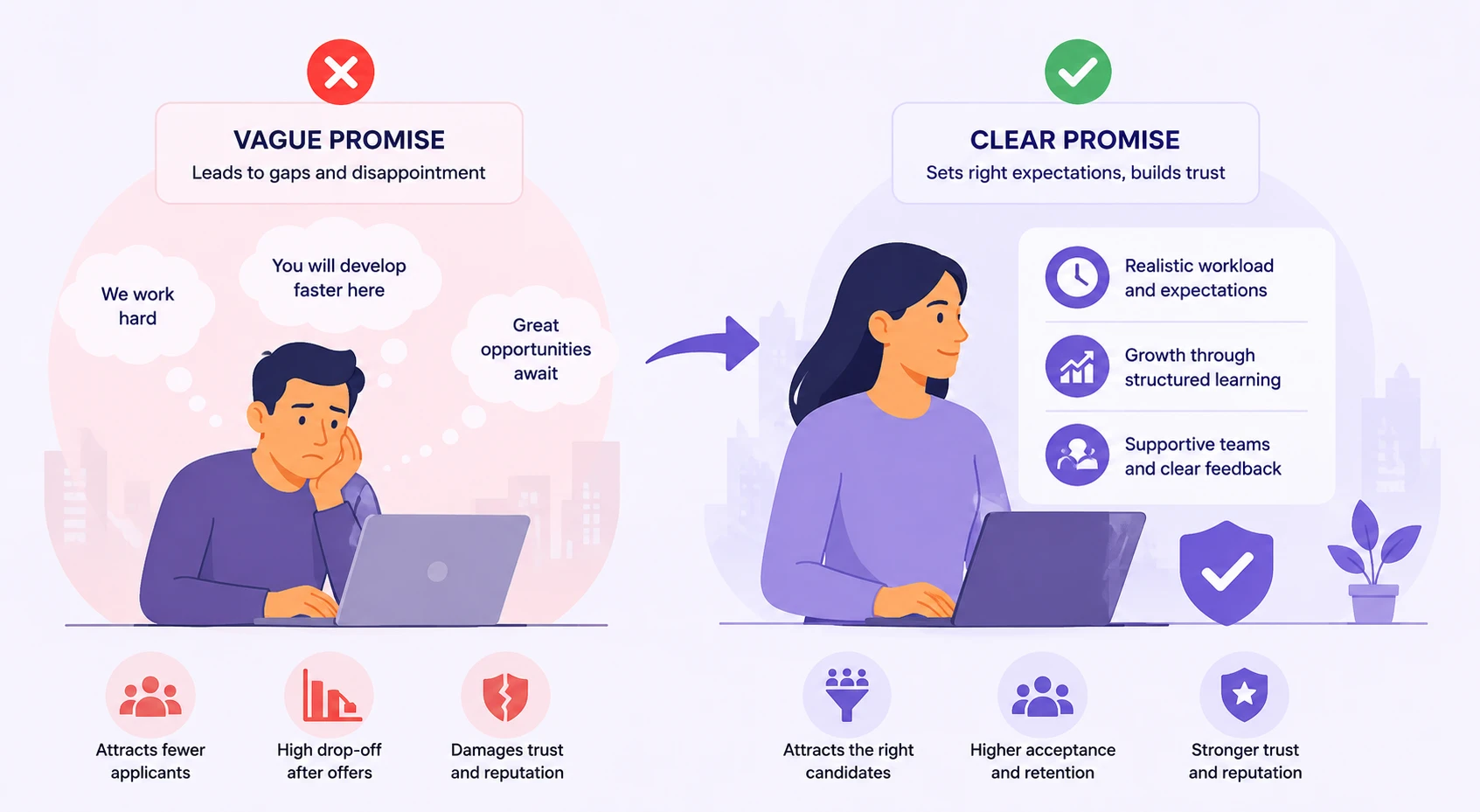
Step three is where most initiatives fail, because changing the promise feels like a retreat and changing the delivery feels like ambition. In practice, an accurate promise builds a stronger employer brand than an aspirational one the organisation cannot yet honour.
10. The honest conclusion
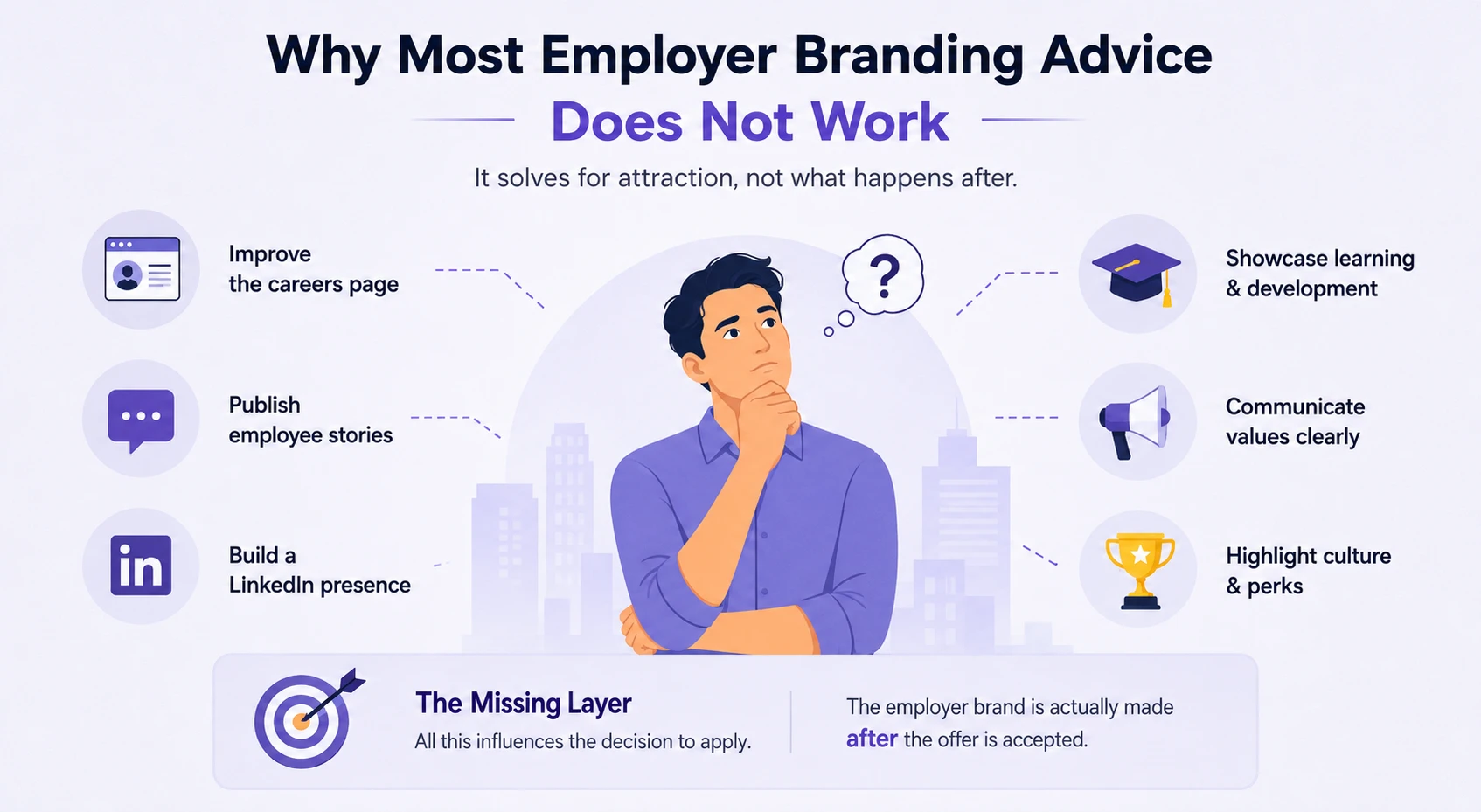
An employer brand cannot be built through communication, and it cannot be repaired through communication either.
What it can be is described accurately. For most organisations, accurate description would represent a substantial improvement over what they currently publish, and it costs nothing beyond the willingness to hear what recent joiners actually say.
The organisations that get this right tend not to be the most attractive employers in any abstract sense. They are the ones where what a candidate expects and what an employee finds are close enough that nobody feels misled, and where the people who leave still speak well of the place.
That is the entire mechanism. Everything else is amplification.
About Dr Jerome Joseph
Dr Jerome Joseph is a global keynote speaker, brand strategist and author. He is ranked #2 in the world as a Global Brand Thought Leader on the Top 30 Global Gurus list. With more than 30 years of experience, he has worked with over 1,000 brands across 40+ countries and is the author of 12 best-selling books. He is a Hall of Fame speaker and a Certified Speaking Professional (CSP), and works with organisations across Asia and the Middle East on brand strategy, internal branding and culture transformation.
Frequently Asked Questions
What is an employer brand?
An employer brand is the reputation an organisation holds as a place to work, formed primarily by what current and former employees say when the organisation is not present. It is distinct from what the organisation publishes about itself, which is recruitment marketing. The employer brand is the delivery record rather than the promise.
How do you build an employer brand?
Start by measuring the gap between what candidates are promised and what new employees find, using four questions asked of recent joiners. Group the answers into promise gaps and delivery gaps. For each one, decide honestly whether to change the delivery or change the promise. Rewrite the promise to match what is genuinely true, then audit every touchpoint against it. Communication comes last, not first.
What is the difference between employer branding and recruitment marketing?
Recruitment marketing is what an organisation says about working there, controlled by the organisation and delivered through careers pages, job advertisements and social content. Employer branding is what employees actually experience and repeat to others. Recruitment marketing is a promise. The employer brand is whether that promise held.
Is a careers page part of your employer brand?
A careers page expresses the employer brand but does not create it. If what the page describes matches what employees experience, it amplifies an existing strength. If there is a gap between the two, a more persuasive careers page increases the number of people who encounter the disappointment.
How do you measure an employer brand gap?
Ask people who joined in the last six to twelve months four questions: what they expected before joining, what surprised them in the first month, what they would warn a friend about, and what they told people when asked how the job was going. The answers describe the gap directly rather than through a proxy metric.
Should you change the promise or change the delivery?
Both are valid, and the choice should be made honestly rather than aspirationally. Changing delivery is often unrealistic within existing constraints. Changing the promise to something specific and true reduces application volume but eliminates the gap, which is the factor that actually damages employer reputation.
Why is employer branding a branding problem rather than an HR problem?
Treated as an HR function, employer branding becomes a communications exercise operating only at the promise layer. Treated as a branding discipline, it requires positioning before promotion, consistency across every touchpoint, internal alignment before external expression, and measurement over years rather than quarters.
What has the biggest impact on an employer brand?
Manager quality, more than any other factor. The direct manager relationship determines most of how an employee describes their employer. An organisation with strong policies and inconsistent managers has an inconsistent employer brand, usually described by employees as depending entirely on who you report to.
Does employer branding work the same way across Asia?
No. What talent prioritises varies by market. Organisational stability carries more weight in Japan and Singapore, progression speed in India and parts of Southeast Asia, international exposure in the Middle East. Family perception of the employer influences decisions in several Asian markets and is routinely missed by frameworks developed elsewhere. The underlying positioning can stay consistent while the emphasis is localised.
What should an employer brand be measured by?
Regretted attrition, referral rate and rehire rate, reviewed quarterly. Application volume and click-through measure recruitment marketing rather than employer brand, and a strong promise with a weak delivery record will show healthy application numbers while the underlying reputation deteriorates.

.webp "How to Build an Employer Brand That Actually Attracts Talent")