Summary
AI corporate learning programmes help companies build practical artificial intelligence skills across leadership and teams. These programmes focus on business AI capability building, executive AI training, and non technical AI training. They improve decision making, innovation, and productivity while supporting digital transformation goals.
Why Organisations Need Business AI Capability Building Today
Artificial intelligence is reshaping industries such as finance, retail, healthcare, logistics, and education. Organisations that fail to build internal AI capability risk falling behind competitors.
Business AI capability building focuses on helping employees understand how AI impacts business models, customer experience, marketing strategy, and operational efficiency.
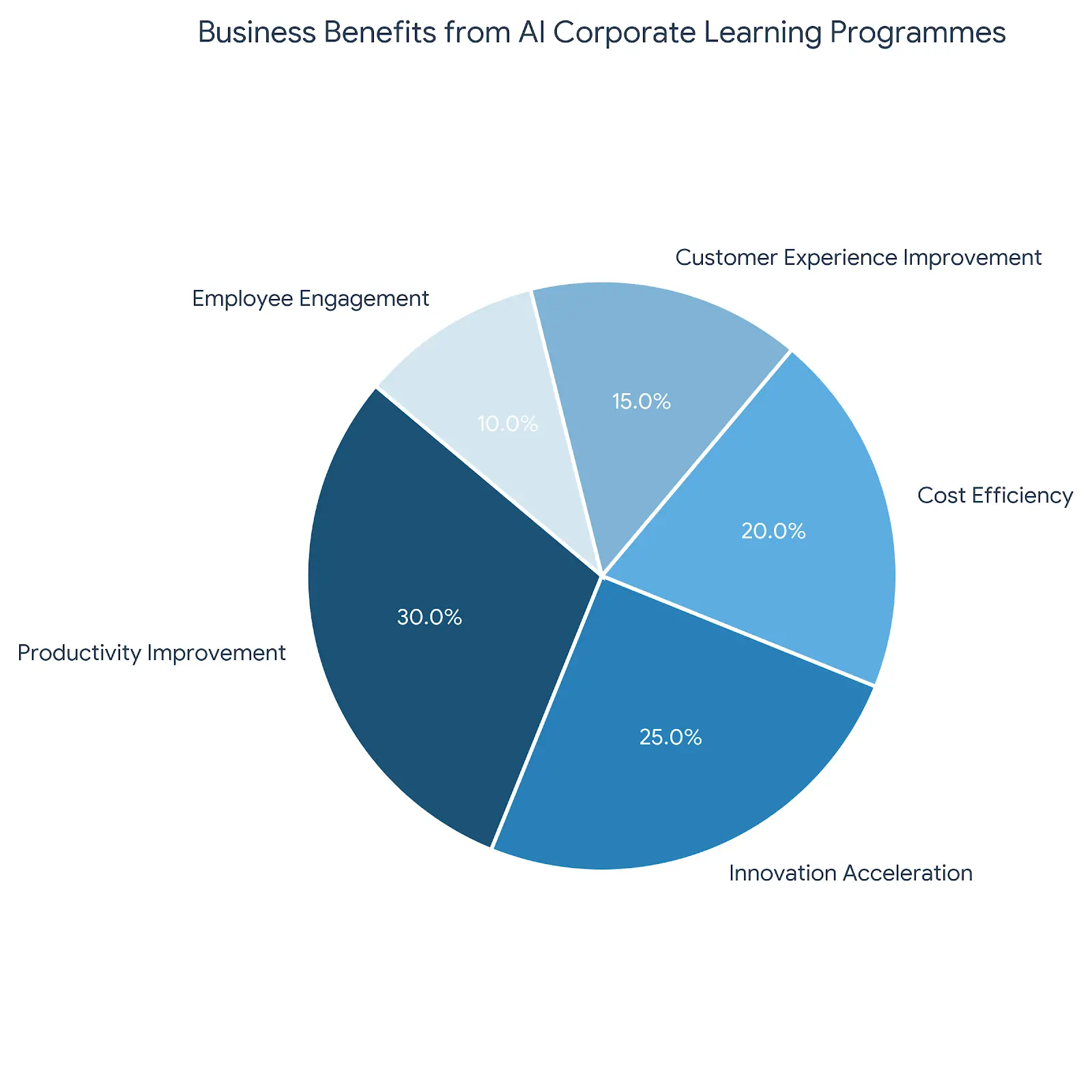
Key outcomes include:
• Better strategic decision making
• Faster innovation cycles
• Improved productivity
• Stronger digital leadership
• Reduced fear and resistance to AI
Many companies invest in software but underestimate the importance of training. Technology adoption fails when people do not understand how to use it meaningfully.
What Are AI Corporate Learning Programmes?
AI corporate learning programmes are structured training initiatives designed to help leaders and employees understand artificial intelligence from a business perspective. These programmes focus on practical applications rather than technical coding skills.
They typically include:
• AI awareness workshops
• Industry specific use case training
• Leadership strategy sessions
• Hands on experimentation
• Ethical and governance discussions
These programmes are especially valuable for organisations that want transformation at scale rather than isolated AI experiments.
Executive AI Training for Leadership Teams
Executive AI training helps senior leaders understand how artificial intelligence affects strategy, innovation, customer experience, and organisational culture.
Leaders do not need to become data scientists. They need clarity on:
• AI opportunities and risks
• AI investment prioritisation
• Change management
• Workforce transformation
• AI driven business models
When leadership teams are confident about AI, the entire organisation becomes more confident.
Traditional Leadership Training vs Executive AI Training
Factor | Traditional Leadership Training | Executive AI Training |
Focus | People management | AI driven strategy |
Tools | Communication frameworks | AI use cases and tools |
Outcome | Better team leadership | Digital transformation readiness |
Time horizon | Short term performance | Long term innovation |
Importance of Non Technical AI Training
Non technical AI training is designed for employees who do not have technical backgrounds. This includes sales teams, marketing professionals, HR leaders, finance managers, and operations teams.
These programmes focus on practical understanding rather than algorithms.
Employees learn:
• How AI can automate repetitive tasks
• How AI can improve customer insights
• How to use AI tools responsibly
• How to collaborate with technology teams
This approach reduces fear and builds confidence. When employees see AI as a partner rather than a threat, adoption improves significantly.
Key Components of Successful AI Corporate Learning Programmes
Organisations often ask what makes an AI training initiative successful. Based on global corporate training practices, the most effective programmes include:
• Industry specific case studies
• Interactive workshops
• Real business problem solving
• Leadership alignment sessions
• Continuous learning frameworks
Generic AI Training vs Corporate AI Learning Programme
Criteria | Generic AI Course | Corporate AI Learning Programme |
Customisation | Low | High |
Business relevance | Limited | Strong |
Leadership involvement | Minimal | Strategic |
Implementation focus | Theory | Practical adoption |
Cultural impact | Low | Transformational |
Role of AI Thought Leadership in Corporate Learning
AI transformation requires guidance from experts who understand both technology and business realities.
Thought leaders who combine keynote speaking, leadership development, and AI strategy bring a unique perspective. According to the brand overview insights, Dr Jerome Joseph is positioned as a global authority helping organisations navigate AI driven transformation with practical frameworks and real world execution experience.
This combination of inspiration and structured training often leads to deeper organisational impact.
How Organisations Can Start Their AI Learning Journey
Companies that want to begin business AI capability building should follow a structured approach.
Step 1
Assess current AI awareness levels
Step 2
Align leadership on AI vision
Step 3
Design customised AI corporate learning programmes
Step 4
Implement executive AI training
Step 5
Scale non technical AI training across teams
Step 6
Measure adoption and business outcomes
Future of AI Corporate Learning Programmes in Hong Kong
Hong Kong is a global financial and innovation hub. Organisations in the region are increasingly focusing on building AI ready leadership and workforce capability.
Future trends include:
• AI leadership certification programmes
• Role based AI learning tracks
• AI governance and ethics training
• AI driven productivity workshops
• Continuous digital learning ecosystems
Companies that invest early will gain a strategic advantage.
FAQs
What are AI corporate learning programmes?
AI corporate learning programmes are structured training initiatives that help organisations understand and use artificial intelligence for business growth and innovation.
Why is business AI capability building important?
It helps organisations stay competitive, improve productivity, and make better strategic decisions in a technology driven economy.
Who should attend executive AI training?
Senior leaders, business heads, and decision makers who need to understand AI strategy and transformation impact.
Is non technical AI training useful for employees?
Yes. It helps employees understand practical AI applications without needing coding or technical expertise.
How long does an AI training programme take?
It depends on organisational goals. Some programmes run for a few days while capability building initiatives may continue for several months.
Can AI training improve employee productivity?
Yes. Employees learn to use AI tools that automate repetitive tasks and enhance decision making.
What industries benefit most from AI corporate training?
Finance, healthcare, retail, manufacturing, logistics, education, and technology sectors all benefit significantly.
How do organisations measure AI training success?
They track metrics such as adoption rates, innovation initiatives, productivity improvement, and employee confidence.
Does AI training replace traditional leadership training?
No. It complements leadership training by adding digital and strategic capability.
How can organisations start AI capability building in Hong Kong?
They can begin with awareness workshops, leadership alignment sessions, and customised corporate learning programmes.