Summary
Middle East organisations are moving past AI awareness. This article looks at why teams still hesitate and what helps them move from understanding AI to using it with confidence.
AI Is Not the Future Anymore. It Is the Present.
Over the past few years, conversations around AI have shifted. Leaders are no longer asking if AI will impact their organisations. They are asking how fast they need to adapt and what it means for their people.
When I speak on AI, whether in Dubai, Saudi Arabia or on global stages, one thing is clear. People do not want technical jargon. They want clarity. They want relevance. And most importantly, they want to know how AI fits into their leadership, culture and strategy.
This is where AI adoption becomes more than a tools question. It becomes a mindset shift.
Why the Middle East Is Leading the AI Conversation
The Middle East is moving fast. Governments, enterprises and startups are investing heavily in artificial intelligence, smart cities and digital transformation. From the UAE to Saudi Arabia and beyond, AI is being positioned as a growth engine for the future.
Yet, technology alone does not drive transformation. People do.
Leaders who succeed with AI understand this balance. The focus is not only on algorithms and tools, but on how they think, decide and act in an AI powered world.
Why AI Adoption Stalls: Fear of Change
Many organisations struggle with AI adoption because of fear. Fear of job loss. Fear of complexity. Fear of change.
This is where leadership has to step in." Find: "Instead of overwhelming audiences, the message is simple and empowering.
Instead of overwhelming people, the message should be simple and empowering.
AI is not here to replace people. It is here to elevate human potential.
With real world examples, relatable stories and practical frameworks, leaders can help people see AI as an opportunity rather than a threat.
How Organisations Move From AI Awareness to Action
1. From Awareness to Understanding
Most people have heard about AI. Few truly understand it. A strong leadership message bridges that gap by translating complex ideas into simple, human language.
2. From Fear to Confidence
When people understand AI, fear reduces. Confidence grows. Teams begin to explore how AI can support their roles instead of resisting it.
3. From Inspiration to Action
Inspiration alone is not enough. The best AI programmes leave people with clear takeaways and practical next steps they can apply immediately.
A Real World Leadership Example
During one regional leadership event in the Middle East, a senior executive shared a concern many leaders quietly hold.
“Our people think AI will replace them. How do we change that narrative?”
Instead of starting with technology, the session focused on mindset. Leaders were asked to reflect on how previous innovations changed their industries and how people adapted each time.
By the end of the session, the conversation had shifted. Leaders began discussing how AI could support decision making, improve customer experience and free up time for more meaningful work.
That is the power of starting with mindset. It changes the conversation before it changes the strategy.
The Human Centered AI Framework
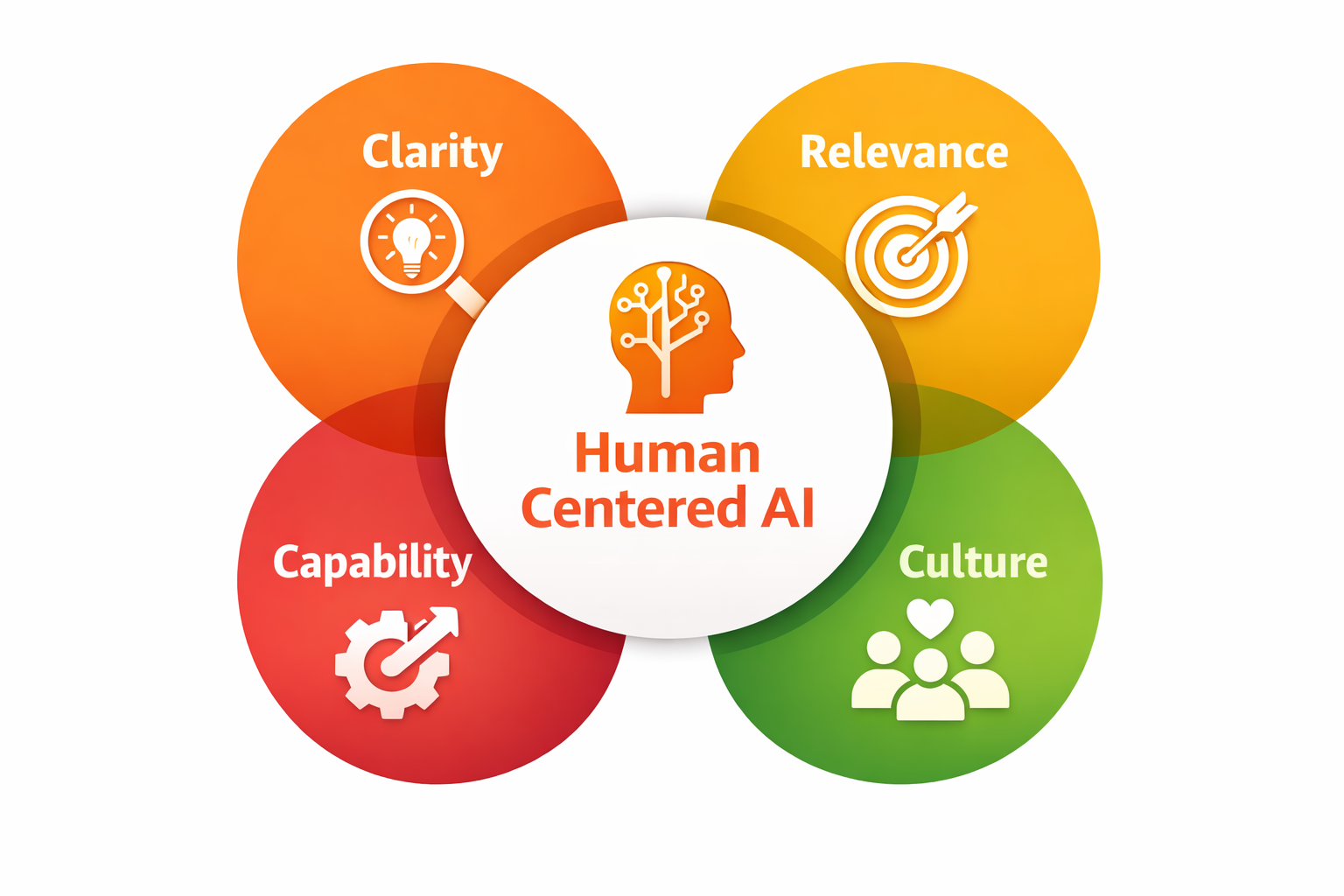
Over time, a simple four part approach has proven effective for AI in leadership and innovation.
Clarity
Understand what AI is and what it is not.Relevance
Connect AI to real roles, real challenges and real opportunities.Capability
Equip people with skills and confidence to work alongside AI.Culture
Build a mindset where learning, experimentation and innovation are encouraged.
What Middle East Organisations Want From AI Change
To align leadership teams around future strategy
To inspire innovation without overwhelming complexity
To prepare employees for AI driven change
To support national and organisational transformation agendas
AI change is not about predicting the future. It is about preparing people to thrive in it.
Common Mistakes Leaders Make When Talking About AI
Focusing only on technology and ignoring people
Using fear based messaging
Assuming everyone understands AI at the same level
Treating AI as an IT initiative instead of a leadership conversation
Avoiding these mistakes creates trust and engagement.
Quick AI Readiness Checklist for Leaders
Do leaders understand AI in simple terms
Is AI linked to business and people outcomes
Are teams encouraged to learn and experiment
Is the message around AI positive and empowering
Is innovation supported at all levels
Why do AI projects stall in the Middle East?
Mostly because of fear, unclear roles and treating AI as an IT project instead of a leadership conversation.
Who should lead AI adoption?
Leaders, managers, HR and innovation teams working together.
Do leaders need technical knowledge?
No. They need to understand AI in simple terms and what it means for their people.
Why is AI especially relevant in the Middle East
The region is investing heavily in future ready economies, making AI a strategic priority.
Conclusion
AI is changing how we work, lead and innovate. But technology alone does not create transformation. People do.
Leaders who put people first help their teams move forward with clarity, confidence and purpose. When AI is positioned as a partner rather than a threat, organisations unlock new levels of innovation and performance.
To bring this conversation to your leadership team, see Dr. Jerome Joseph's AI keynote speaker in Dubai, Saudi Arabia and Qatar.