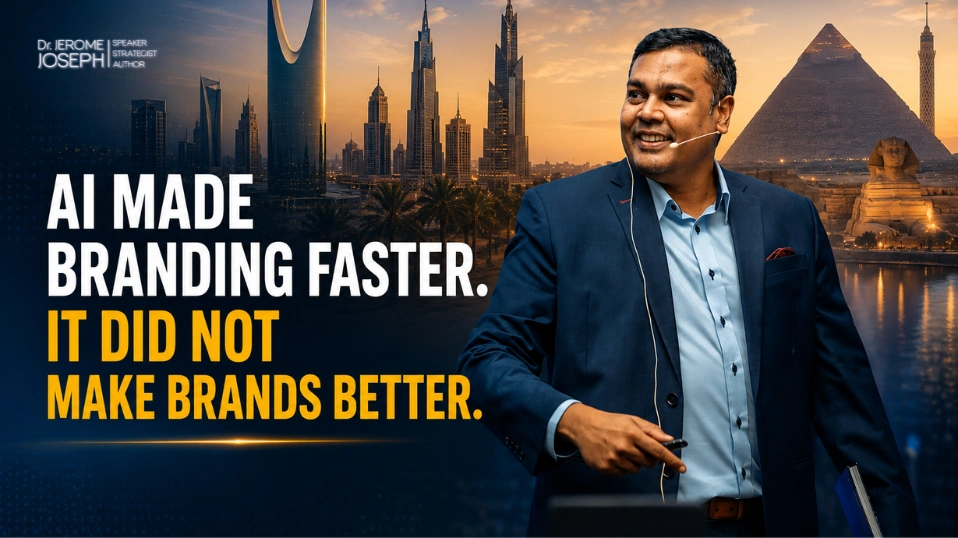
Dr Jerome Joseph is heading to Saudi Arabia this month to run a public workshop on branding in the age of AI, followed by a sales programme in Egypt. He shared the plan in a recent LinkedIn post, and buried in it was a question that most companies have not stopped to ask.
He wrote it plainly. How do we use AI not simply to do things faster, but to build better brands, communicate more powerfully and market more intelligently?
That question matters because most businesses have already answered a different one. They asked how AI could help them work faster. They got their answer. Campaigns that took three weeks now take three days. Copy that needed a writer now needs a prompt. Design concepts that needed a studio now arrive in minutes.
All of that is real. None of it has made brands stronger.
The problem nobody expected
When a new technology arrives, the early advantage goes to whoever adopts it first. That window is usually short. With AI it was unusually short.
The tools are cheap. They are available everywhere. A five person company in Kuala Lumpur has access to the same models as a multinational in London. There is no waiting list and no licence that keeps a competitor out.
So the advantage disappeared almost as soon as it appeared. Everybody got faster at the same time.
Dr Jerome Joseph has spent more than 30 years working with over 1,000 brands across 40+ countries, and he describes what happened next in simple terms. When every company gets faster together, nobody gets ahead. The whole market just moves quicker while staying in exactly the same order.
Worse, something else happened at the same time.
Everything started sounding the same
Walk through any industry's marketing today and read ten company websites in a row. Notice how similar they feel. The same reassuring tone. The same three word value propositions. The same clean structure. The same confident promises about transformation and partnership.
This is not a coincidence. AI models are trained on what already exists. When a business asks a model to write like a professional brand, it produces the average of every professional brand it has ever seen. That average is competent. It is also completely forgettable.
The result is an industry full of companies that sound polished and identical.
For a business owner this creates a real problem. If a customer cannot tell the difference between three suppliers by reading their websites, the decision falls to price. Price is the worst place for any brand to compete, because there is always somebody willing to charge less.
Speed was supposed to be an advantage. Instead it produced sameness, and sameness produced price pressure.
.avif "2-5-scaled-1 (1)")