


























































How much does the industry actually change the session?
I am often asked whether a keynote is genuinely rebuilt for each sector or simply reframed. The honest answer is that the frameworks stay consistent and roughly 40 percent of the material changes. What stays the same is the underlying structure and the strategic argument. What changes is every example, the sequence of the argument, the objections addressed, and the language used to describe the same concept.

That last point matters more than it sounds. The same idea might be described as "governance" to a bank, "protocol" to a hospital, "process control" to a manufacturer and "guardrails" to a technology company. These are the same concept. Using the wrong word for the room signals that the speaker does not know the industry, and once an audience decides that, very little else lands.
Which sectors are growing fastest as sources of AI keynote demand
Based on the pattern of enquiries I have seen over recent years:
Fastest growing: Government and public sector, driven by national digital strategies across Singapore, the UAE and Saudi Arabia
Consistently highest volume: Banking and financial services
Most likely to convert into ongoing work: Professional services and government, because both tend to need capability building rather than a single event
Most demanding brief: Technology, because the bar for depth is highest
Most underserved: Manufacturing, where the workforce dimension is frequently mishandled
I include the last point because it represents a genuine gap. Manufacturing audiences receive a great deal of AI content built for office environments, very little of which addresses what the technology means for a plant floor.
What this means if you are booking a speaker
If you are an event organiser evaluating AI keynote speakers, the industry question is worth using as a filter. Three practical suggestions.

Ask for a sector-specific example, not a showreel. Any speaker can produce an impressive video. Ask instead what they said to an audience in your sector last year and what the objection in the room was. The answer will tell you quickly whether they have been there.
Check whether they ask you questions. A speaker who accepts an AI brief without asking about your audience's current adoption stage is going to deliver a generic session. In my case I will not confirm a booking without understanding where the audience actually sits, because the same session delivered to the wrong stage simply does not work.
Be honest in the brief about internal tension. If half your leadership is sceptical, say so. That is useful information and a good speaker will build around it rather than pretending the room is unified. Organisers frequently omit this, and it is the single most useful thing you can share.
If you are running an event elsewhere in the region, the sector dynamics shift somewhat, and I have covered the regional differences separately for Asia and for the Middle East, where government-led demand is currently much stronger than in most Asian markets.
A closing observation
The industries that hire AI keynote speakers most often are not necessarily the ones furthest ahead in adoption. Frequently they are the ones where the gap between leadership ambition and organisational capability is widest, and where someone external is needed to name that gap out loud.
That is often the real brief, even when it is not written down. The organisation knows something needs to shift, and it is easier to hear from a visitor than from the person in the next office.
I have found this to be true in every one of the seven sectors above, and it has very little to do with AI specifically.
About Dr Jerome Joseph
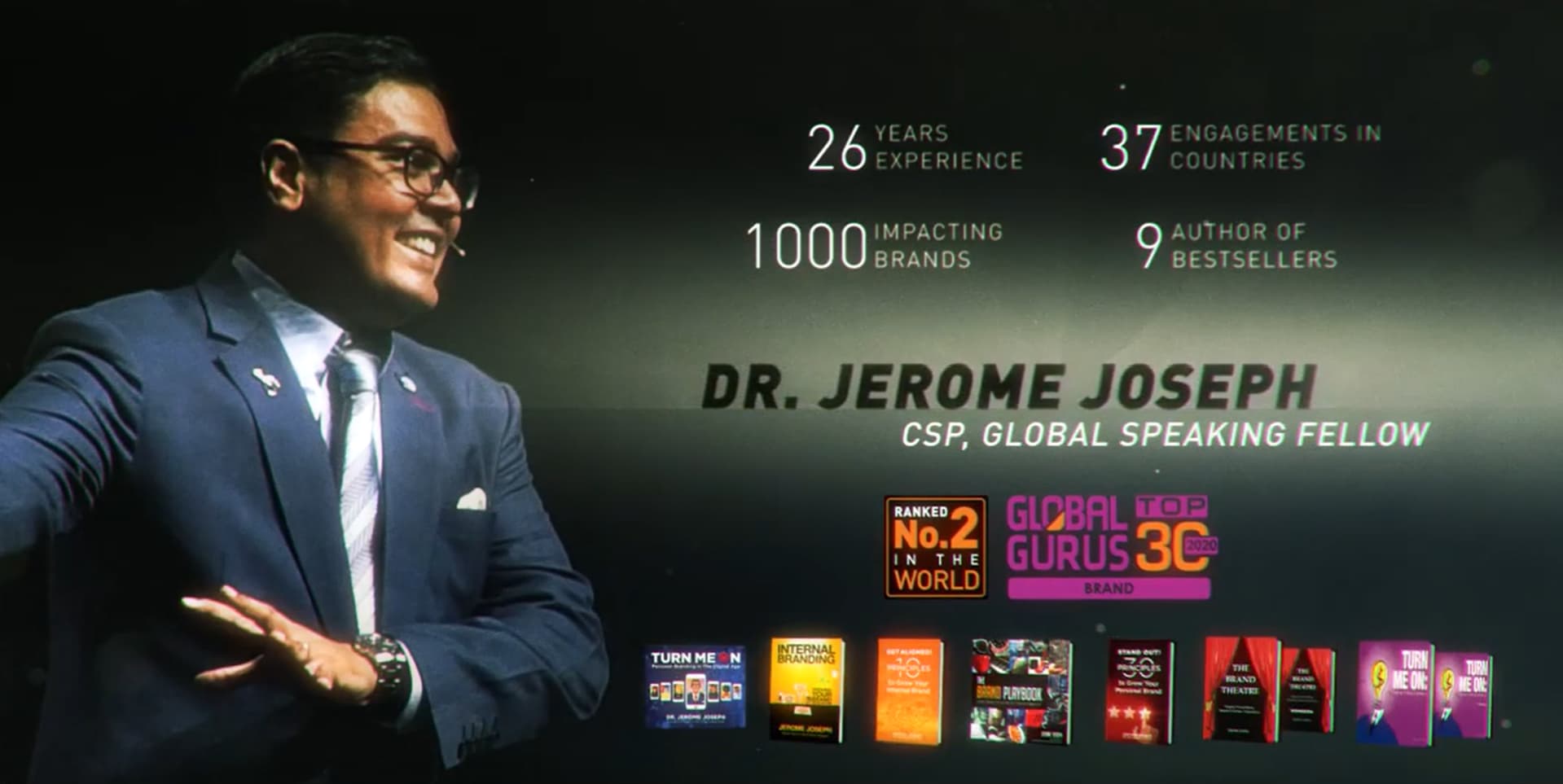
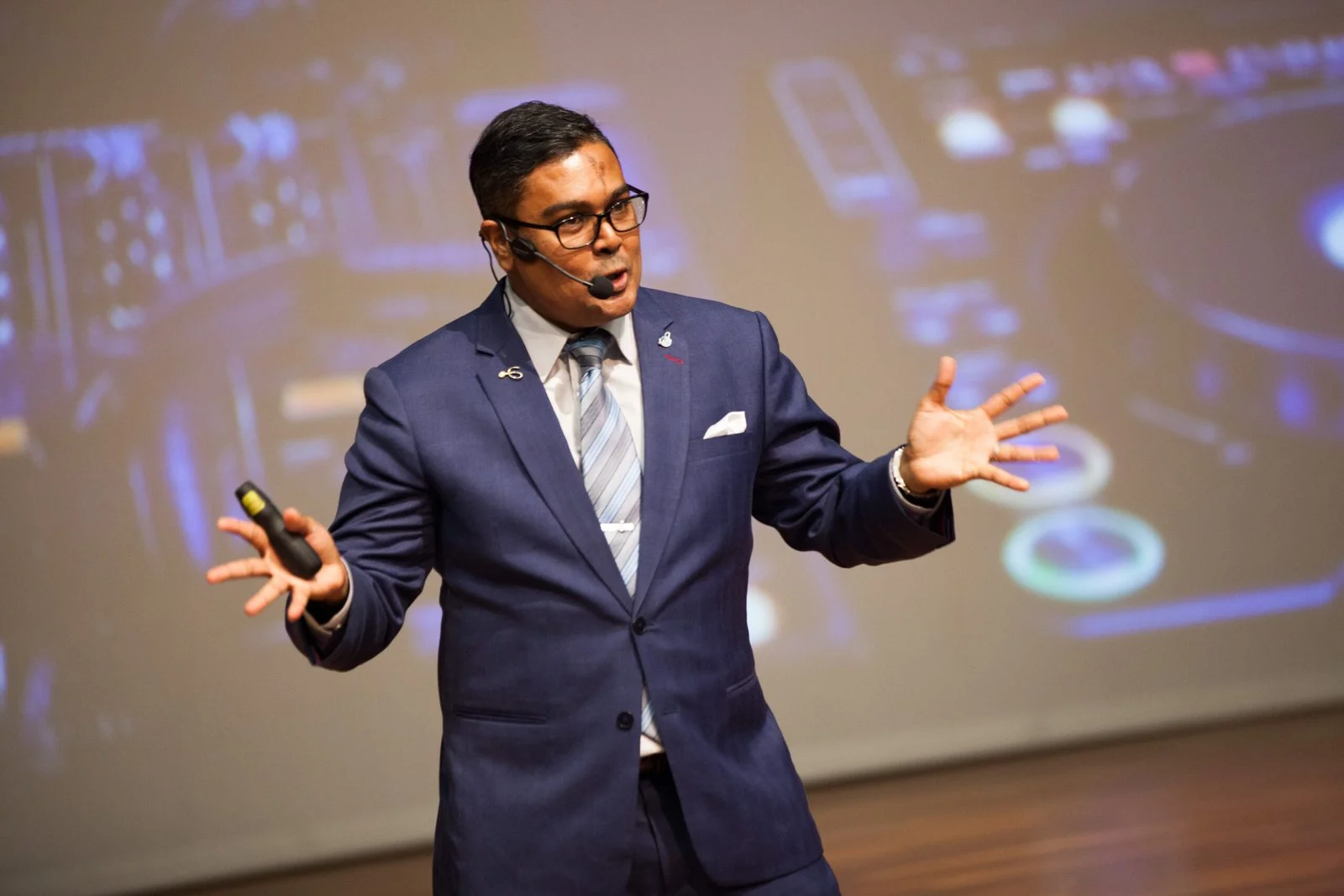
Dr Jerome Joseph is a global keynote speaker, brand strategist and author. He is ranked #2 in the world as a Global Brand Thought Leader on the Top 30 Global Gurus list. With more than 30 years of experience, he has worked with over 1,000 brands across 40+ countries and is the author of 12 best-selling books. He is a Hall of Fame speaker and a Certified Speaking Professional (CSP), and has worked with organisations including DHL, Standard Chartered, AIA, Dell, Fuji Xerox, BASF, Great Eastern and Changi Airport. He is based in Singapore and speaks across Asia and the Middle East.
Frequently Asked Questions
What industries hire AI keynote speakers most often?
Banking and financial services, healthcare and pharmaceuticals, logistics and supply chain, government and public sector, professional services, manufacturing, and technology hire AI keynote speakers most frequently. Banking generates the highest consistent volume, while government and public sector demand is currently growing fastest, particularly across Singapore, the UAE and Saudi Arabia.
Why do different industries want different things from an AI keynote?
Each sector frames the same underlying question through its own primary constraint. Banking frames it through regulation, healthcare through ethics, logistics through cost, government through public accountability, professional services through business model disruption, manufacturing through workforce impact, and technology through competitive differentiation.
Does an AI keynote speaker rebuild the session for each industry?
Typically around 40 % of the material changes. The core frameworks and strategic argument remain consistent, while examples, argument sequence, anticipated objections and terminology are adapted to the sector. Using the wrong terminology for an industry is one of the fastest ways to lose credibility with a specialist audience.
Which industry is the hardest audience for an AI keynote?
Technology audiences set the highest bar, because they already understand the underlying technology. Explaining fundamentals to a technology audience damages credibility. These sessions need to address strategic positioning and brand differentiation rather than technical explanation.
What should an event organiser include in an AI keynote brief?
Include the audience's current adoption stage, the industry context, whether leadership is aligned or divided on AI, and any internal tension around the topic. Organisers frequently omit the last point, though it is often the most useful information a speaker can receive.
Are AI keynote speakers only booked for technology events?
No. The majority of AI keynote bookings come from non-technology sectors. Banking, healthcare, logistics and government together account for considerably more demand than the technology sector itself, because those industries are managing adoption rather than building the technology.
How do government AI keynote bookings differ from corporate ones?
Government audiences focus on public accountability and workforce capability building rather than competitive advantage. Private sector case studies need translation into a public accountability context to be useful. Government engagements also convert into longer capability building programmes more often than single corporate keynotes do.
Why is manufacturing considered an underserved sector for AI keynotes?
Most AI keynote content is built for office based work and does not address what the technology means on a plant floor. Manufacturing audiences also carry significant unspoken concern about workforce displacement, and sessions that focus purely on efficiency without acknowledging that concern tend to land poorly.
Do AI keynote speakers work across multiple industries or specialise?
Both models exist. Speakers with cross-industry experience can draw comparisons between sectors, which many audiences find valuable. What matters more than specialisation is whether the speaker asks about the audience's specific context before building the session.
How far in advance should an AI keynote speaker be booked?
For major conferences and leadership summits, three to six months is typical, particularly for speakers who travel internationally. Regional events with smaller audiences can often be arranged with shorter notice, though a compressed timeline reduces the amount of audience research a speaker can do.