






























































Sales & Marketing

Relationship Selling in Singapore: What It Actually Means and Why Most Teams Get It Wrong

Published on August 05, 2026By Team Dr. Jerome Joseph
Relationship Selling in Singapore: What It Actually Means and Why Most Teams Get It Wrong

Some years ago I sat in on a quarterly review with a Singapore sales team that had every advantage. Strong product, established brand, an experienced team with an average tenure of six years. Their numbers had been flat for four quarters and nobody could explain why.

Halfway through the meeting the regional director said something that stayed with me.

"Our people have fantastic relationships with these clients. They have lunch together. They know each other's families. I do not understand why the renewals are slipping."

I asked him a simple question. When was the last time one of those clients told your team something that was genuinely difficult to say?

The room went quiet. Nobody could think of an example.

That is the moment I usually know what is wrong. Because in more than 30 years of working with over 1,000 brands across 40 plus countries, I have found that the teams who talk the most about relationships are frequently the ones who have the fewest real ones. What they have is familiarity. Those are not the same thing, and the difference shows up precisely when a competitor arrives with a better price.

Why this matters more in Singapore than most markets

Singapore is a small market with a long memory. The buying community in any given sector is small enough that people move between companies and keep their opinions with them. A procurement head who felt pushed into a bad deal in 2021 will remember that in 2026, and will mention it to a peer over coffee.

d4e49639-7fee-4c44-8953-304903fd7ff4

This changes the economics of selling here:

  • In a large market you can survive transactional behaviour because there is always another prospect

  • In Singapore, reputation compounds faster than pipeline does

  • A single badly handled account can quietly close doors across an entire sector

  • Buyers frequently check with peers before they ever contact you

That is what makes relationship selling less of a philosophy and more of a practical necessity. But it also makes the term dangerous, because it gets used to justify a great deal of activity that produces nothing.

The comfortable version of relationship selling

Here is the version I encounter most often, and it looks impressive from the outside.

A salesperson has a good rapport with a client contact. They meet regularly. Conversations are warm. There is genuine mutual liking. When the salesperson calls, the client picks up. Internally this is reported as a strong relationship and treated as an asset on the account plan.

Then one of three things happens:

  • The renewal comes up and the client goes to tender anyway

  • A competitor makes a move and your team finds out three weeks after the decision was already leaning

  • The client had a serious service problem six months ago and never raised it, because raising it would have made the pleasant lunches awkward

The rapport was real. It simply was not doing any commercial work.

I have watched this pattern often enough that I now treat easy, uniformly pleasant client relationships as a warning sign rather than a strength.

If nothing uncomfortable has ever been said in either direction, the relationship has not been tested. And an untested relationship tells you nothing about what will happen under pressure.

What the phrase originally meant

Relationship selling was never meant to describe being friendly. It emerged as a counterpoint to transactional selling, where each deal is treated as a self contained event and the objective is to maximise the outcome of that single event.

a9b84297-2c9c-40e5-aa15-4de30ea6080b

The relational alternative argues something different. The value of a client is not the current deal but the total value of everything that follows, including renewals, expansion, referrals and reputation. If that is true, then behaviour that wins today's deal while damaging tomorrow's trust is a bad trade even when it hits this quarter's number.

That framing has a hard commercial edge to it. It is not about warmth. It is about time horizon. Teams that want to develop this properly usually need structured sales training before it becomes consistent, because instinct alone tends to default back to the transactional approach under quota pressure.

If being liked is not the measure, what is?

I use one test with the teams I work with, and it is deliberately uncomfortable. Would this client call you before they call a competitor when something goes wrong on their side, not yours?

That is the real threshold. Every other measure of relationship strength is a proxy. This one is direct.

Transactional versus relational: what actually differs

The distinction is not about tone. It shows up in specific, observable choices.

Situation

Transactional response

Relational response

Client requirement arrives

Answer the requirement as stated

Ask what pressure created the requirement

Delivery is going to slip

Wait until you have a fix, then inform

Inform immediately, fix in parallel

Client wants something that will not work

Sell it, note the risk internally

Say so directly, offer the alternative

Deal will not close this quarter

Discount to pull it forward

Let it move, protect the pricing integrity

Nothing is on the table

No contact until a reason exists

Send something useful with no ask attached

Client asks for a competitor comparison

Position against them

Give an honest assessment, including where they are stronger

Read that right hand column carefully. Almost every entry costs something in the short term. That is not accidental. It is the entire mechanism.

Three things people believe about relationship selling that are not true

It means being agreeable. In practice the relationships that generate the most business over time are the ones where the salesperson has disagreed with the client at least once and been right. Agreement costs nothing and therefore signals nothing. I have seen accounts double in size after a salesperson told a client not to buy something.

It is slower. My experience is close to the opposite. Deals within trusted relationships move faster because the buyer skips several stages of due diligence they would otherwise run. What takes time is establishing the relationship. Once established, velocity increases rather than decreases.

It is a personality trait. This is the most damaging one, because it lets organisations off the hook. If relationship building is something people either have or do not have, then it cannot be trained and there is nothing to manage. That is untrue.

The behaviours are specific, observable and teachable. What varies between people is not capacity but discipline.

The five behaviours that actually build it

Vague advice about being authentic helps nobody. Here is what to look for and what to coach:

  • Ask about the pressure, not the requirement. Most discovery establishes what the client needs to buy. Very few establish what the client is personally under pressure to achieve, and who is watching. The requirement is the surface. The pressure is the reason it exists.

  • Bring something before you need something. Send a relevant article, an introduction, a piece of market intelligence, at a moment when there is nothing on the table. Most salespeople only appear when there is a reason to appear, which trains the client to associate their contact with being sold to.

  • Report bad news first and fast. Clients forgive problems. They rarely forgive finding out late. The speed at which you deliver unwelcome information is one of the strongest trust signals available to you.

  • Say no to something. At least once in every serious relationship, decline business that is not right for them. Nothing else establishes your independence as clearly. This is hard to ask of a team on quota, which is why it must be explicitly permitted by leadership rather than left to individual courage.

  • Understand their business well enough to ask one good question. Not to demonstrate expertise, which usually irritates. To ask the question that shows you thought about their situation when you were not in the room.

Where methodology fits

Relationship selling is often positioned as an alternative to structured sales methodology. That is a false choice.

The methodology gives you the shape of the deal, the qualification, the stakeholder map, the sequence. The relational discipline determines whether any of it works. I have written elsewhere about the sales methodologies every leader should know, and my view is straightforward. Method without trust produces well documented losses. Trust without method produces pleasant conversations that never close.

Building this into a team rather than hoping for it

The hardest part of relationship selling is not teaching it. It is that most sales organisations are structured in ways that quietly punish it. Consider a team measured entirely on quarterly closed revenue. A salesperson who tells a client to delay a purchase until the next budget cycle, because that genuinely serves the client better, has damaged their own quarter to strengthen a relationship whose value will appear in someone else's numbers eighteen months later.

63318cab-8e9a-4bf3-9fe7-43b244d027cb-1024x585

You can ask people to behave that way. You cannot expect it to become normal unless something in the system supports it.

If you are serious about this, three things need to change at leadership level:

  • Change what gets asked in the one to one. If the weekly conversation is only about pipeline status, relationship behaviour is invisible and therefore unmanaged. Add questions that surface it. What did you learn about that account that you did not know last month. When did a client last tell you something inconvenient. Where did you disagree with a client this quarter.

  • Give explicit permission to walk away. Teams need to hear from leadership, clearly and more than once, that declining bad fit business will not count against them. Without that, the fourth behaviour above will never happen regardless of how many workshops you run.

  • Measure something beyond the close. Quarterly bookings alone will always favour transactional behaviour.

Here is what I suggest tracking instead, alongside the number:

Indicator

What it reveals

Review cycle

Renewal rate by account

Whether trust survived delivery

Quarterly

Expansion revenue from existing clients

Whether you are trusted beyond the original scope

Half yearly

Referrals generated

The strongest signal available, because it costs the client something

Half yearly

Deals declined or redirected

Whether your team feels safe being honest

Quarterly

Client initiated contact with no deal active

The clearest measure of real relationship depth

Monthly

That last row is the one most organisations have never measured and the one I would start with.

This is also why I draw a firm line between training a team and coaching one. A workshop can explain these behaviours in a morning. Making them habitual requires someone observing real conversations over months and intervening at the moment the old instinct takes over. I have written about the difference between sales coaching and sales training because the two get treated as interchangeable and they produce very different results.

A note on honesty about outcomes

I want to be careful not to oversell this. Relationship selling does not win every deal. There are procurement processes where price is genuinely the only variable, and there are buyers who will take your best thinking and award the work elsewhere. That happens, and it will keep happening. What relationship selling changes is the distribution of outcomes over time:

  • You lose fewer accounts you should have kept

  • You hear about problems while they are still solvable

  • You get invited into conversations earlier, sometimes before a formal process exists

  • Your pricing holds because the client is not comparing you like for like

Across a portfolio and across years, that is a substantial commercial difference. Within any single quarter it may be invisible, which is exactly why it is so often abandoned.

The organisations in Singapore that built genuine relational depth did not do it through a programme. They did it by having leadership reward behaviour that did not pay off immediately, for long enough that it became how people worked.

There is no shortcut available, and anyone who tells you otherwise is selling something. If you are evaluating whether a structured programme is worth the investment at all, I have addressed that question directly in a piece on whether sales training programmes really work.

Where to start this week

If you lead a sales team and want one action rather than a plan, here it is. Take your ten largest accounts. For each one, write down the last time that client told your team something difficult. Not a complaint about your service. Something about their own business that they did not have to share. However many of the ten you can answer, that is the number of real relationships you have. The rest are contacts. Knowing the difference is the entire starting point, and most teams have never sat down to find out.

About Dr Jerome Joseph

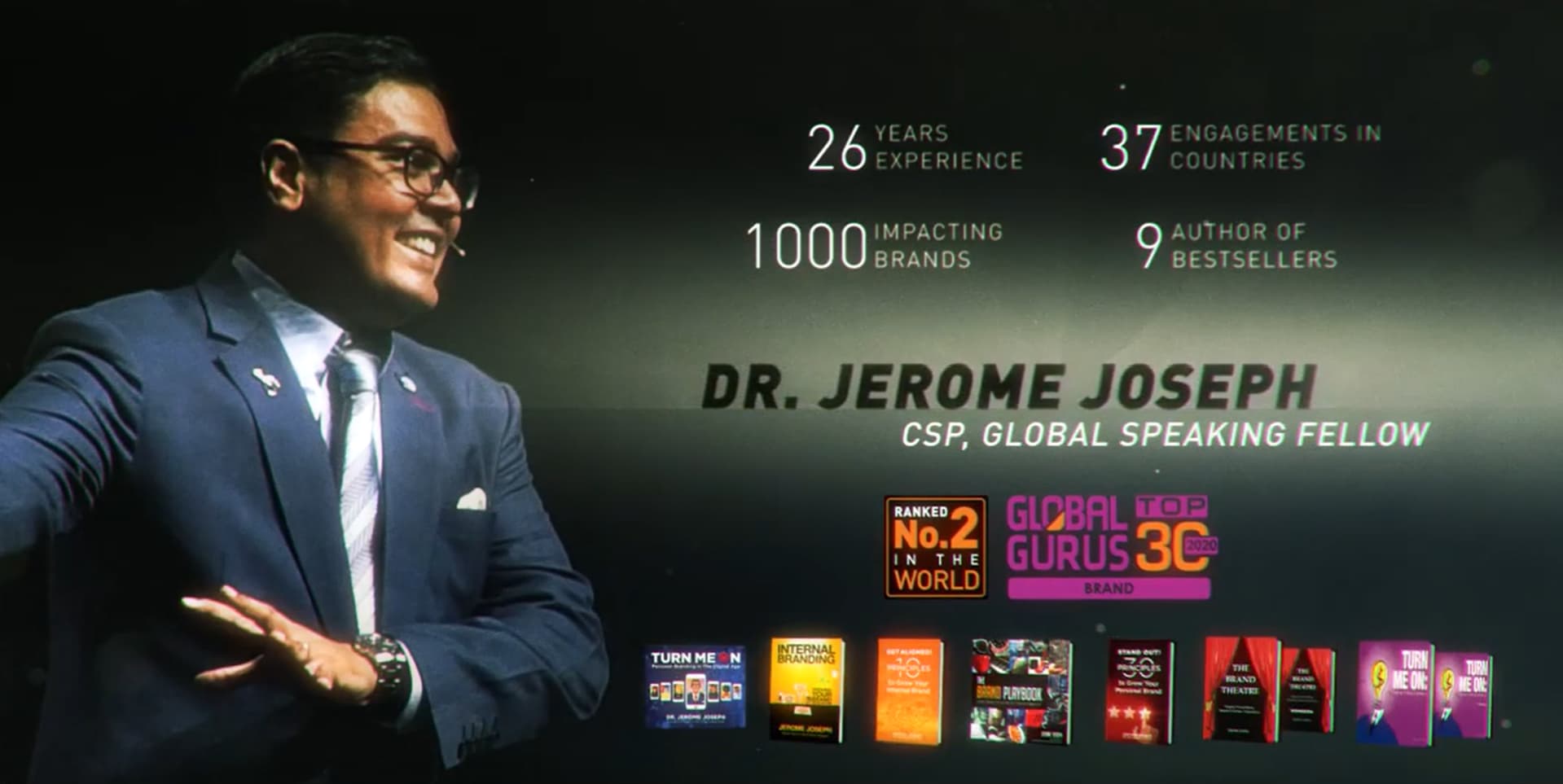
Dr Jerome Joseph is a global keynote speaker, brand strategist and author. He is ranked #2 in the world as a Global Brand Thought Leader on the Top 30 Global Gurus list. With more than 30 years of experience, he has worked with over 1,000 brands across 40 plus countries and is the author of 12 best-selling books. He is a Hall of Fame speaker and a Certified Speaking Professional (CSP), and works with organisations across Asia and the Middle East on branding, sales and leadership.

CARA AI - Talk to Dr. Jerome Joseph AI Assistant
CARA AI